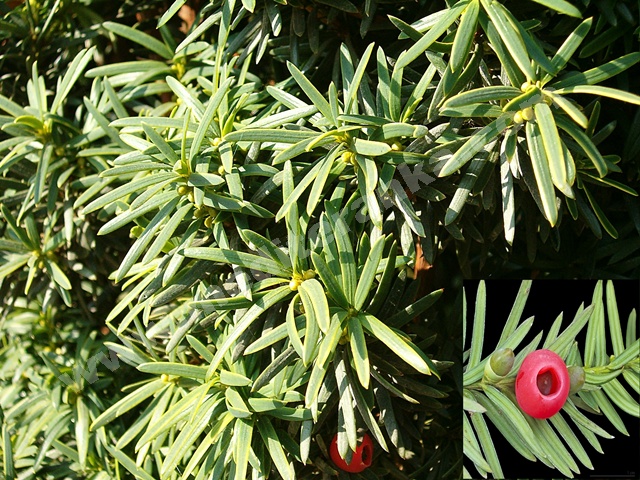
Taxus baccata, Jew tree is a small- to medium-sized evergreen tree, growing 10–20 metres tall, with a trunk up to 2 metres diameter. The leaves are lanceolate, flat, dark green, 1–4 centimetres long and 2–3 millimetres broad, the leaves are highly poisonous.
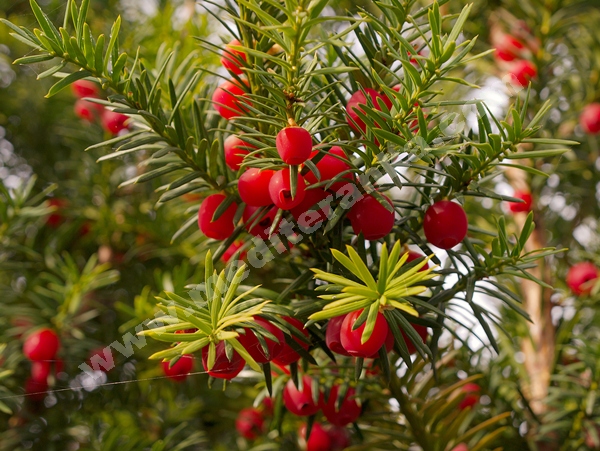
The seed cones are highly modified, each cone containing a single seed 4–7 millimetres long. The seeds themselves are extremely poisonous and bitter, but are opened and eaten by some bird species. The aril is not poisonous, and is gelatinous and very sweet tasting.
It is relatively slow growing, and can be very long-lived, with the maximum recorded trunk diameter of 4 metres probably only being reached in about 2,000 years. The potential age of yews is impossible to determine accurately and is subject to much dispute. Taxus baccata is the longest-living plant in Europe. One characteristic contributing to its longevity is that it is able to split under the weight of advanced growth without succumbing to disease in the fracture, as do most other trees.
Most parts of the tree are toxic, except the bright red aril surrounding the seed. The foliage remains toxic even when wilted, and toxicity increases in potency when dried. Ingestion and subsequent excretion by birds whose beaks and digestive systems do not break down the seed's coating are the primary means of yew dispersal.
The major toxin within the yew is the alkaloid taxine. Horses have the lowest tolerance to taxine. Symptoms of yew poisoning include an accelerated heart rate, muscle tremors, convulsions, collapse, difficulty breathing, circulation impairment and eventually heart failure. However, there may be no symptoms, and if poisoning remains undetected death may occur within hours. Fatal poisoning in humans is very rare, usually occurring after consuming yew foliage. The leaves are more toxic than the seed.
In the ancient Celtic world, the yew tree (*eburos) had extraordinary importance, a passage by Caesar narrates that Catuvolcus, chief of the Eburones poisoned himself with yew rather than submit to Rome.
The Christian church commonly found it expedient to take over existing pre-Christian sacred sites for churches. It has also been suggested that yews were planted at religious sites as their long life was suggestive of eternity, or because being toxic they were seen as trees of death. Another suggested explanation is that yews were planted to discourage farmers and drovers from letting animals wander on to the burial grounds, the poisonous foliage being the disincentive. A further possible reason is that fronds and branches of yew were often used as a substitute for palms on Palm Sunday. In the Central Himalayas, the plant is used as a treatment for breast and ovarian cancer.