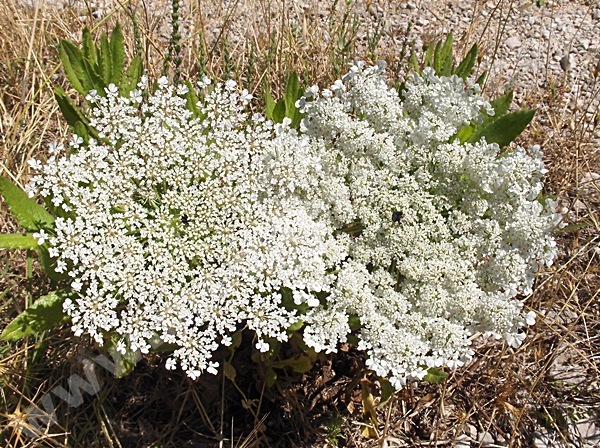
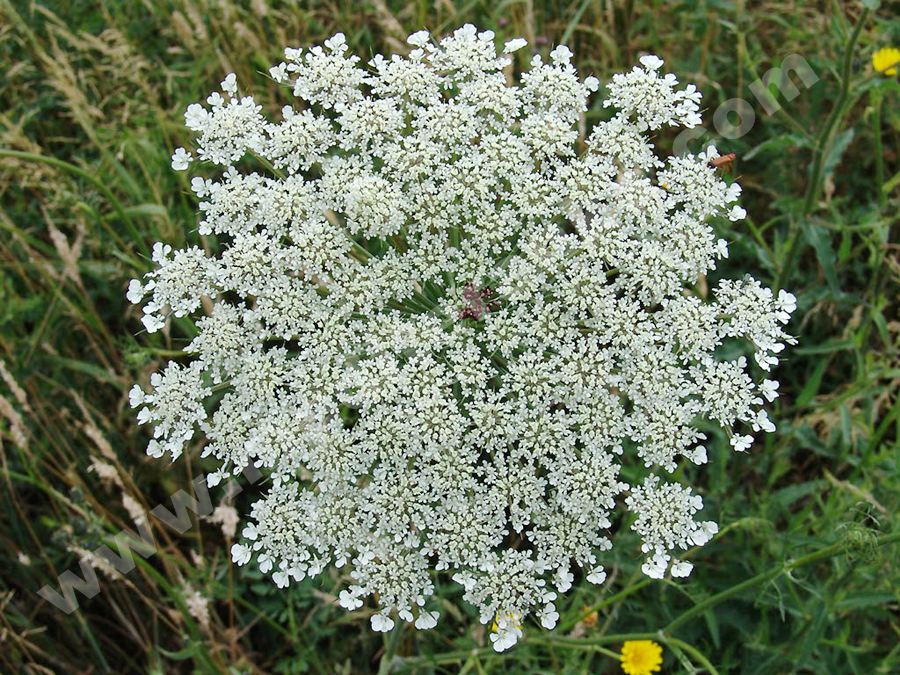
Wild carrot (Daucus carota), bird's nest, bishop's lace, is a flowering plant in the family Apiaceae, native to temperate regions of Europe and southwest Asia. The wild carrot is a herbaceous, somewhat variable biennial plant that grows between 0.3 and 0.6 m tall, roughly hairy, with a stiff solid stem. The flowers are small and dull white, clustered in flat, dense umbels. They may be pink in bud and there may be a reddish flower in the centre of the umbel. The fruits are oval and flattened, with short styles and hooked spines. A root that smells like carrots, and occasionally a single dark red flower in the centre of the umbel.
Like the cultivated carrot, the wild carrot root is edible while young, but quickly becomes too woody to consume. Extra caution should be used when collecting wild carrot because it bears a close resemblance to poison hemlock. Folk-medicine holds that an infusion of the seeds will inhibit pregnancy. D. carota, when freshly cut, will draw or change color depending on the color of the water in which it is held. This beneficial weed can be used as a companion plant to crops. Like most members of the umbellifer family, it attracts wasps to its small flowers in its native land, however, where it has been introduced, it attracts only very few of such wasps. This species is also documented to boost tomato plant production when kept nearby, and it can provide a microclimate of cooler, moister air for lettuce, when intercropped with it.