- You are here:
-
Home

- Krunoslav Tripalo
Products Categories
Your Cart
Currency
Taxi Booking


Krunoslav Tripalo
Chives
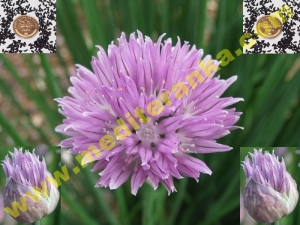
Chives is the common name of Allium schoenoprasum, an edible species of the Allium genus. A perennial plant, it is widespread in nature across much of Europe, growing to 30–50 cm tall. The flowers are pale purple, and star-shaped with six petals. The seeds are produced in a small, three-valved capsule, maturing in summer. The herb flowers from April to May. Chives are grown for their scapes, which are used for culinary purposes as a flavoring herb, and provide a somewhat milder flavor than those of other Allium species.
The medicinal properties of chives are similar to those of garlic, but weaker, the faint effects in comparison with garlic are probably the main reason for their limited use as a medicinal herb. They also have mild stimulant, diuretic, and antiseptic properties. Chives are cultivated both for their culinary uses and their ornamental value, the violet flowers are often used in ornamental dry bouquets.
Offer:
100 seeds
Coriander
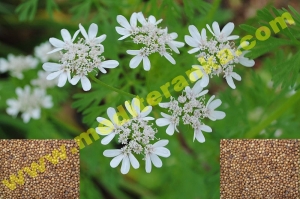
Coriander (Coriandrum Sativum), also known as Cilantro, belongs to the family Apiaceae, is an annually grown herb found mostly in Mediterranean countries. The herb loves to grow in places where the temperature is hot enough. The leaves are variable in shape, broadly lobed at the base of the plant, and slender and feathery higher on the flowering stems.
All parts of the plant are edible, but the fresh leaves and the dried seeds are commonly used in cooking. The leaves have a different taste from the seeds, with citrus overtones. Coriander has a very strong aroma that can be felt from meters away from the growing spot, the plant has slender stems with leaves on it. The leaves are different as you towards the top. At the base they are larger and at the top tips of branches they are a bit feathery in shape. The flowers on the branches are clustered and are slightly purple in color. The roots are also important in terms of their aroma and culinary use.
Offer:
30 seeds
Dill
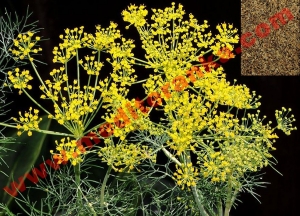
Dill (Anethum graveolens) is an annual growing to 0.8 m. It is in flower from Apr to July, and the seeds ripen from July to August. The flowers are hermaphrodite and are pollinated by bees. The plant is self-fertile.
Leaves, raw or cooked can be used as a flavouring in salads. The leaves lose their flavour if the are cooked for any length of time and so are best used raw or added to cooked dishes only a few minutes before the cooking is complete. The leaves can be harvested at any time the plant is growing, but are best just before the plant flowers. Seed, raw or cooked are very pungent and bitter in taste. It is used as a flavouring in salads. An essential oil from the seed is used as a flavouring in the food industry. A tea is made from the leaves and/or the seeds.
Offer:
100 seeds
Basil
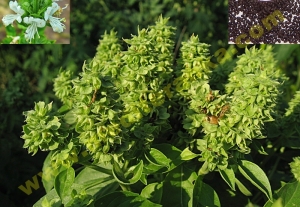
Basil (Ocimum basilicum) is an aromatic, annual herb, 0.3-0.5 metres tall. The plant is almost hairless. The leaves are ovate, often puckered, flowers white or pink, and fruits have four small nutlets, which are mucilaginous when wet. Basil is used to flavour soups and sauces and is the main ingredient of pesto sauce. The leaves can be eaten as a salad. Basil is also used in perfumery, soap-making, and to flavour liqueurs. The seeds are edible, and when soaked in water become mucilaginous.
In parts of the Mediterranean they are made into a refreshing drink known as cherbet tokhum. Basil is widely used in systems of traditional medicine, for treating digestive system disorders, such as stomach ache, kidney complaints, and infections. The leaves are used to make an insecticide that can protect stored crops from beetle damage.
Offer:
100 seeds
Mad hot mix
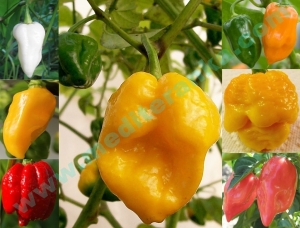
Mild hot mix
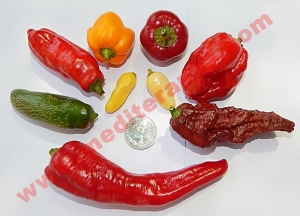
Pimiento de Padron
Pimiento de padron are a variety of peppers Capsicum annuum. These are small peppers (about 5 cm long), with a color ranging from bright green to yellowish green, and occasionally red. It's said that solely watering the soil of the plant is likely to produce milder pimentos, whilst watering the whole plant, leaves and stalks included, produces peppers of the spicier variety. Padron peppers are small, with an elongated, conic shape. The taste is mild, but some exemplars can be quite hot. Typically, there is no way of determining whether a given pepper will be hot or mild, short of actually eating it, though some maintain that smelling each cooked Padron for spice prior to eating is a good indicator.
Offer:
100 seeds
Jalapeno
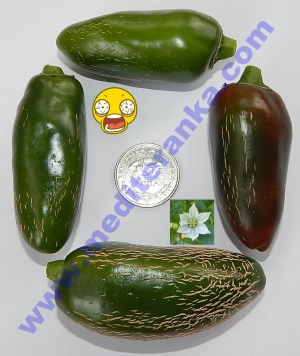
The jalapeno is a pod type of Capsiicum annuum, it is a medium-sized chili pepper. A mature jalapeno fruit is 5–10 cm long and hangs down with a round, firm, smooth flesh 25–38 mm wide. It is of mild to medium pungency, having a range of 2,500 to 8,000 Scoville units, depending on cultivar. Commonly picked and consumed while still green, it is occasionally allowed to fully ripen and turn red, orange or yellow. It is wider and milder than the similar Serrano pepper (in offer). The growing period is 70–80 days. When mature, the plant stands 70–90 cm tall. Typically, a plant produces 25 to 35 pods.
Jalapenos thrive in a number of soil types and temperatures, though they prefer warmer climates, provided they have adequate water. The optimum temperature for seed germination is 29 °C Jalapenos need at least 6 to 8 hours of sunlight per day. Once picked, individual peppers may turn to red of their own accord. The peppers can be eaten green or red. Though usually grown as an annual they are perennial and if protected from frost can produce during multiple years, as with all Capsicum annuum.
Offer:
10 seeds
Serrano
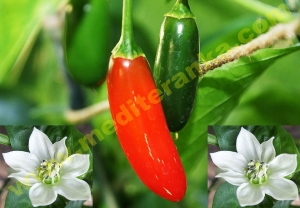
Serrano pepper (Capsicum annuum) plants reach a height of 0.5 to 1.5 m tall. Each plant can hold up to 50 pepper pods. The fruit can be harvested while they are green or ripe. Unripe serrano peppers are green, but the color at maturity varies. The Scoville rating of the serrano pepper is 8,000 to 23,000.
They are typically eaten raw and have a bright and biting flavor that is notably hotter than the jalapeno pepper (in offer). Serrano peppers are also commonly used in making salsa, as the chili is particularly fleshy compared to others, making it ideal for such dishes.
Offer:
100 seeds
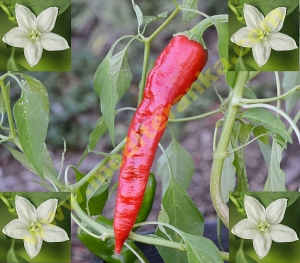
Hot Portugal