


- You are here:
-
Home

- Krunoslav Tripalo
Products Categories
Your Cart
Currency
Taxi Booking


Krunoslav Tripalo
Staghorn sumac
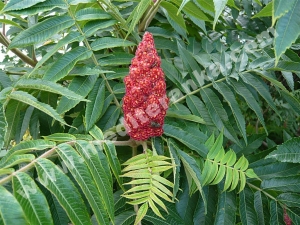
Rhus typhina (Staghorn sumac or Stag's horn sumach) is a species of flowering plant in the family Anacardiaceae, native to North America but is widely cultivated as an ornamental plant throughout the temperate world. Rhus typhina is a deciduous shrub or small tree growing to 5 m tall by 6 m broad. Staghorn sumac is deciduous, and large clumps can form with either male or female plants. The fruit is one of the most identifiable characteristics, forming dense clusters of small red drupes at the terminal end of the branches, the clusters are conic, 10–20 cm long. The plant flowers from May to July and fruit ripens from June to September, the fruit has been known to last through winter and into spring. Staghorn sumac spreads by seeds, and by rhizomes to form colonies, with the oldest plants in the center. Staghorn sumac is a highly ornamental plant which provides interest throughout the year, though its vigorous, suckering habit makes it unsuitable for smaller gardens. It can grow under a wide array of conditions, but is most often found in dry and poor soil on which other plants cannot survive. The fruit of sumacs can be collected, soaked and washed in cold water, strained, sweetened and made into a pink lemonade.
Indian hawthorn
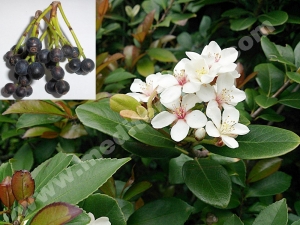
Rhaphiolepis umbellata, commonly known as Indian hawthorn or Yeddo hawthorne is a shrub from family Rosaceae. Yeddo hawthorne is a dense slow-growing, broad-leaved evergreen shrub that typically grows to 2 m tall and as wide. It is native to Japan. It features ovate glossy dark green leaves to 5-7 cm long. New leaves emerge gray green, but mature to dark green. Fragrant, white to light pink flowers bloom in spring in loose panicles to 5-8 cm. Flowers are followed by blue-black berries. Best flowering occurs in locations with full sun. Tolerates light shade. Established. Avoid wetting the leaves when watering this shrub because of its susceptibility to leaf spot.
Kaki persimmon

Japanese persimmon (Diospyros kaki), better known as the kaki persimmon or Asian persimmon is the most widely cultivated species of the Diospyros genus. The persimmon (kaki) is a sweet, slightly tangy fruit with a soft to occasionally fibrous texture. This species, native to China, is deciduous, with broad, stiff leaves. When ripe, this fruit comprises thick pulpy jelly encased in a waxy thin-skinned shell. It has a soft jelly-like consistency and is best eaten with a spoon.
The kaki tree reaches a size of up to ten meters. It is similar in shape to an apple tree. Its deciduous leaves are medium to dark green, stiff and equally wide as long. It blooms from May to June. Trees are typically either male or female, but some produce both types of flowers. Kaki trees typically do not bear until they are 3 to 6 years old, flowers appear in the spring. The spherical to oval fruit, bearing the indented stem and four sepals, can weigh up to 500 grams. The smooth, shiny, thin shell ranges in shade from yellow to red-orange. The slightly lighter fleshed fruits can contain up to eight seeds and may have an astringent taste. With increasing maturity, the fruit softens, similar to a kiwi fruit. The high content of tannin in the still-immature kaki provides a bitter component reminiscent of pear and apricot flavors, which becomes weaker with progressive maturation. The furry taste, caused by the tannins, is often reduced during the ripening process or by frost. The high content of the carotenoids, beta-carotene, along with some lutein and alpha-carotene makes the kaki fruit nutritionally valuable.
Peter penis
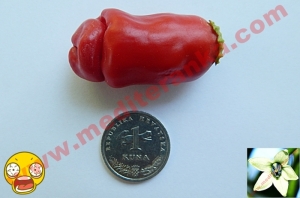
The peter penis (Capsicum annuum), the Peter pepper is an heirloom chili pepper that is best known for its unusual shape. The pepper is considered very rare, and its origin is unknown. The pepper has often been noted for its phallic appearance when fully grown. The pepper, particularly the red variety, has been described as a miniature replica of the circumcised male organ. It is approximately 7,5 to 10 cm in length, and 2,5 to 3,8 cm wide when fully mature. As it has a very high Scoville rating (10 000 – 23 000 SHU), the pepper has been suggested for ornamental use rather than human consumption. The unusual appearance of some chili peppers, and peter pepper in particular, causes amusement and provides the reasoning for a descriptive names, like penis pepper. Some kind of peppers are more predisposed to produce strange shapes.
Silver birch

Spanish bayonet
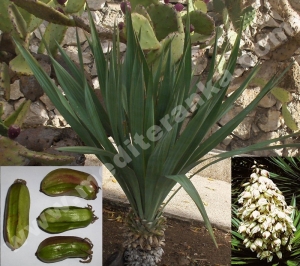
Yucca aloifolia, common names Spanish Bayonet, Aloe yucca, Dagger Plant, is from family Agavaceae, it is an evergreen tree growing to 7.5 m at a slow rate. The roots contain saponins. Whilst saponins are quite toxic to people, they are poorly absorbed by the body and so tend to pass straight through. They are also destroyed by prolonged heat, such as slow baking in an oven. Saponins are found in many common foods such as beans. Saponins are much more toxic to some creatures, such as fish.
Habitats are sand dunes of the coast, occasionally up to 60 km inland, in pine forests. Established plants are very drought resistant. The flowers open at night and are powerfully fragrant at this time. It is in flower from May to June, and the seeds ripen in September. The flowers are hermaphrodite (have both male and female organs) and are pollinated by self. The plant is self-fertile. Individual crowns are monocarpic, dying after flowering. A fibre obtained from the leaves is used for making ropes, baskets and mats. The leaves have been used in several types of basketry. The leaf splints have been used as brushes to apply colour to pottery. The roots are rich in saponins and can be used as a soap substitute. They are crushed and then placed in water to form suds that are used in bathing and shampooing. The juice from the plant has been used as a varnish.
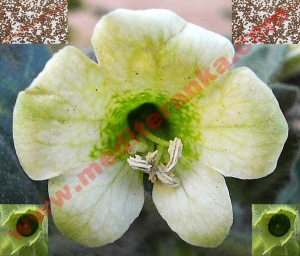
Yellow henbane
Midland hawthorn
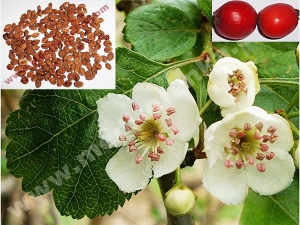
Midland hawthorn (Crataegus laevigata) is a deciduous shrub from family Rosaceae, growing to 6 m at a medium rate. Other names are Smooth hawthorn and English Hawthorn. It is in flower from April to May, and the seeds ripen from September to November, it is noted for attracting wildlife and it’s not frost tender, very hardy plant, tolerating temperatures down to at least -18°c. It can grow in full shade, semi-shade or no shade. A position in full sun is best when plants are being grown for their fruit. It can tolerate drought, strong winds but not maritime exposure. The fruit is about 1cm in diameter, can be used for jams and preserves. The fruit pulp can be dried, ground into a meal and mixed with flour in making bread. There are up to five fairly large seeds in the centre of the fruit, these often stick together and so the effect is of eating a cherry-like fruit with a single seed. Young leaves and young shoots are nice in a salad, young leaves are a tea substitute, the roasted seed is a coffee substitute.
Hawthorn is an extremely valuable medicinal herb. It is used mainly for treating disorders of the heart and circulation system, especially angina. The fruits and flowers have a hypotensive effect as well as acting as a direct and mild heart tonic. They are especially indicated in the treatment of weak heart combined with high blood pressure. Hawthorn is combined with ginkgo (Ginkgo biloba) to enhance poor memory, working by improving the blood supply to the brain.
Japanese privet
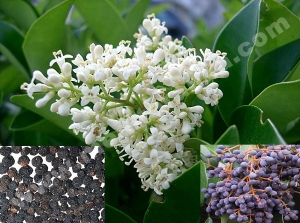
Japanese privet (Ligustrum japonicum), the Japanese ligustrum, is a large shrub or tree that is usually seen at 1.5 - 3.5 m in height but is capable of reaching 6 m or more. The attractive leaves are evergreen with a sharp terminal point. In spring, white flowers are borne on large terminal clusters 12-20 cm long. The flowers produce a perfume that is not particularly pleasant as well as quantities of pollen that many people find bothersome. The blossoms are followed by green berries that ripen to dull black in winter and tend to persist on the plant for most of the year.
Japanese privet is a native of Japan and eastern Asia as the species name indicates, this shrub is now widely naturalized in mild winter areas. Extremely tolerant of a wide variety of soil conditions, ligustrum is a strong, sturdy plant requiring little care other than regular pruning to maintain desired shape and size. It will grow in sun or part shade. Mature plants propagate themselves prolifically from seed. Cuttings are easily rooted. Japanese privet is an attractive and tough plant that requires little care, it is extremely fast growing. Ligustrums provide a source of food for birds when other berries or food sources are meager.
Silver Ragwort
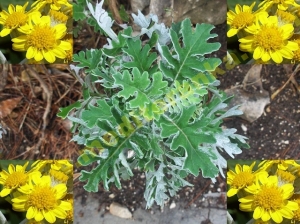
Silver Ragwort (Jacobaea maritime) is a perennial plant species in the genus Jacobaea in the family Asteraceae, native to the Mediterranean region. It is widely cultivated as an ornamental plant for its white, felt-like tomentose leaves. Silver Ragwort is a very white-wooly, heat and drought tolerant evergreen shrub growing to 0.5–1 m tall. The leaves are pinnate, 5–15 cm long and 3–7 cm broad, covered with long grey-white hairs. The flowers are yellow, daisy-like in dense capitula 12–15 mm diameter, the seeds are cylindrical achenes. Jacobaea maritima is native to the western and central Mediterranean region, it occurs primarily on cliffs and rocky coastal sites, more rarely inland. As with many other densely tomentose plants, the tomentum on the leaves is used by some species of bees. Jacobaea maritima is widely used in horticulture for its silvery foliage. It is winter hardy, tolerating winter temperatures down to -12° to -15 °C, tolerant of light shade but preferring full sun. In colder areas it is grown as an annual plant.