


- You are here:
-
Home

- Krunoslav Tripalo
Products Categories
Your Cart
Currency
Taxi Booking


Krunoslav Tripalo
Schefflera

Schefflera is a plant that has dark green or mottled leaves, which are divided into 7-9 parts and are on long stalks. Species with streaked leaves should be bright location without direct midday sun, while the green all the way to prosper in the darker areas but will grow more slowly. They need plenty of moisture so it is recommended to put a vase in another and a greater gap to fill with sand or peat to retain as much moisture. You can put pebbles in the tray. In summer it should be watered 2-3 times a week until the winter approximately every 5-6 days. To get a nice bushy appearance needs to be trimmed in early spring so that they drove more side shoots. It is desirable to put a stick to have the support and grow upright, especially when light is coming from somewhere, because all parts will be seeking a stoop light source. Transplantation is by cuttings, which is necessary to keep the water to push the roots and then transplant into the ground. You do not have to transplant so often, just every other year, and if you keep it in a large vase it's enough to remove top soil and add fresh. Transplation is also by seed, and it is safer and faster than cuttings. In Dalmatia, lives as a garden plant, in continental areas in the room temperature.
Offer:
Seeds of green schefflera that I offer are the berries, in each individual berry are 2-4 seeds.
50 berries (150 seeds)
Pittosporum tobira
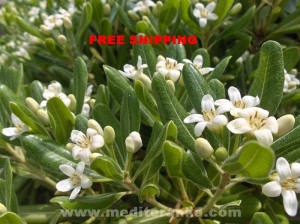
Pittosporum evergreen plant is very suitable for forming living fences. In the Mediterranean gardens and anywhere else inside the ideal hedge is certainly pittosporum torbira because is very resistant to cold. In the gardens of our Adriatic coastline is usually planted Pittosporum tobira, which grows as a tall shrub or tree, and pruned regularly can be formed in a very nice living the high fence that will also protect the garden from strong winds. Pittosporum grows well in moist earth, the sun or halfshadow position. Types of colorful and beautiful purple leaves appear to grow in a fully sunny positions. It's growing 2-3 plants per meter, and the bushes are trimmed twice a year, in spring and mid summer. Reproduce by sowing seeds or cuttings in summer.
Strelitzia reginae

Strelitzia reginae is a monocotyledonous flowering plant indigenous to South Africa. Common names include Strelitzia, Crane Flower or Bird of Paradise. Its scientific name commemorates Charlotte of Mecklenburg-Strelitz, queen consort of King George III.
The plant grows to 2 m tall, with large, strong leaves 25–70 cm long and 10–30 cm broad. The leaves are evergreen, the flowers stand above the foliage at the tips of long stalks.
S. reginae is very popular as an ornamental plant. It was first introduced to Europe in 1773, when it was grown at the Royal Botanic Gardens, Kew. Since then, it has been widely introduced around the world, including the Americas and Australia.
It is propagated by division or from seeds, and is a low-maintenance plant that is easy to grow in the garden, it is fairly tolerant of soil conditions and needs little water once established. If cared for well, they will flower several times in a year. They do well in full sun to semi-shade and respond well to regular feeding. They are sensitive to cold and need to be sheltered from frost, as it can damage the flowers and leaves.
S. reginae is slow-growing and will not bloom until three to five years have passed since germination. It flowers only when properly established and division of the plant may affect flowering patterns. The flowers are, however, quite long-lasting once they appear. Peak flowering is in the winter and early spring. Bird of Paradise flowers are associated with liberty, magnificence, and good perspective.
Caesalpinia gilliesii
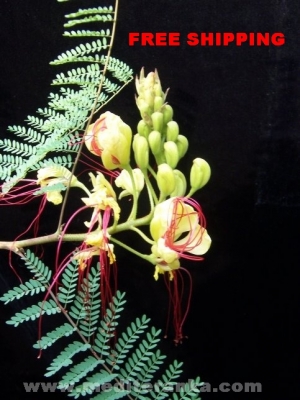
Caesalpinia gilliesii is a shrub in the legume family. It is commonly known as bird of paradise, but it is not related to the bird of paradise genus Strelitzia. It grows to 1–4 m tall, depending on rainfall. The leaves are bipinnate, 10–15 cm long, bearing 3-10 pairs of pinnae, each with 6-10 pairs of leaflets 5–6 mm long and 2–4 mm broad. The flowers are borne in racemes up to 20 cm long, each flower with five yellow petals with 10 long conspicuous red stamens.
It is a striking ornamental plant native to tropical America, mainly Argentina and Uruguay. It is naturalised in Texas, and fairly common in the rest of the southwestern United States, where it is known as bird of paradise bush, desert bird of paradise, yellow bird of paradise, and barba de chivo.
Although it is a tropical plant adapted to dry climate, it also thrives in the climate of Avsa and neighbouring islands in the south of Sea of Marmara in northwestern Turkey, where it is commonly known as Paşabiyigi, Cennetkuşu agaci, which in Turkish means "bird of paradise tree," and Bodurakasya, which means "dwarf acacia".
Medicine men of peoples indigenous to the Amazon Rainforest used this plant and the similar Caesalpinia pulcherrima, which they called ayoowiri, for curing fever, sores, and cough. Four grams from the root is also said to induce abortion in the first trimester of pregnancy.
Opuntia bergeriana
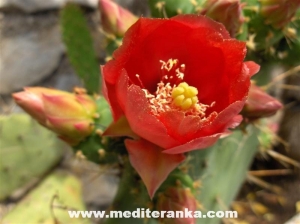
Opuntia bergeriana is one of the two types most commonly in the Mediterranean area, and both have edible fruits. It is quite hardy growing cactus and finally it becomes like a great tree, and has extensive branches that occupy much space as if it formed like. To encourage the rapid growth that blooms profusely it is best to plant in the country, if possible. If it is not possible, it should be planted in the smallest possible pot, it's necessary during the summer months to feed it to encourage it to develop to maximum size. These plants are very attractive addition to the garden.
O. bergeriana is a useful strong and long lasting grafting stock, it is very successful with big columnar cacti, but it is also used for globular species and for grafting other opuntias too. This plant is reasonably hardy and is a good stock for frost sensitive species like Melocactus.
O. bergeriana is a strong shrubby species, it can grows up to 4.5 m with pads that can be up to 40 cm long. This plant produces bright red flowers in profusion also in small specimen.
It is a low maintenance plant that tolerate considerable neglect and will naturalize . Easy to cultivate outdoor in dry, sandy or gravely, well-drained soils. May be grown in clay soils as long as drainage is good and soils do not remain wet, it is very adaptable both in acid, neutral and basic (alkaline) soils. No serious insect or disease problems.
Watering Needs: Must be kept fairly dry in winter but likes a reasonable supply of water in the growing season, tolerate dry condition but suffer if exposed to prolonged and severe drought. A position at the base of a south-facing wall or somewhere that can be protected from winter rain is best for this plant, but is however resistant to moisture and rain.
Sun Exposure: Full sun (only), in semi shaded position wont produce many flowers. Plants are reasonably cold-hardy , tolerating temperatures of -5° to -10° C, they are also quite tolerant of winter wet. (In good drained soils)
Propagation: Is propagated by seeds, cuttings of leaf pads at any time in the growing season.
Offer:
Cutting (10-15cm)
Opuntia ficus indica (100x)

Opuntia ficus-indica is a domesticated cactus that has been used for food for at least 9000 years. Some of the common English names for the plant and its fruit are Indian fig opuntia, barbary fig, and prickly pear, although this last name has also been applied to other less common Opuntia species. Fig opuntia is grown primarily as a fruit crop, but also for the vegetable nopales and other uses. The name "tuna" is also used for the fruit of this cactus. The plant spread to many parts of the Americas in pre-Columbian times, and since Columbus, have spread to many parts of the world, especially the Mediterranean, where they have become naturalized.
The plant’s edible uses have been tied to the Christopher Columbus and the Mayan Indians. The fruits have a sweet taste somewhat resembling watermelon. Jams and jellies are produced from the fruit, which resemble strawberries and figs in color and flavor.
The name ficus, which means fig, also has to do with the plant’s fruit. The pads are also eaten as a vegetable that can be made into cactus salad, added to omelets and more. While the pads of various opuntia species are used for this purpose, ficus-indica is the most popular. These edible uses make opuntia somewhat of a saving grace for arid areas because it allows crop production in an environment that would otherwise be unsuitable. Cacti are good crops for dry areas because they efficiently convert water into biomass.
Mexicans have used Opuntia for thousands of years to make an alcoholic drink called colonche. Accordingly, ficus-indica is one of Mexico's most important exports, ranking among tequila and corn. In Malta, a liqueur called Bajtra (the Maltese name for prickly pear) is made from this fruit, which can be found growing wild in most every field. On the island of Saint Helena, the prickly pear also gives its name to locally distilled liqueur, Tungi Spirit.
Along with being a food source, this species has a number of medicinal uses including everything from treatment of enlarged prostate to treatment of colitis and irritable bowel syndrome to being a hangover cure. The cactus does have one drawback. Its spines take the form of fine hairs, which can seem harmless, but they act much like hairy splinters in the skin that will work themselves in deeply if allowed to.
The plants flower in three distinct colors: white, yellow and red. The flowers first appear in early may through the early summer in the Northern Hemisphere, and the fruit ripen from august through october. The fruit are typically eaten, minus the thick outer skin, after chilling in a refrigerator for a few hours. The bright red/purple or white/yellowish flesh contains many tiny hard seeds that are usually swallowed, but should be avoided by those who have problems digesting seeds.
Opuntia Robusta (1000x)

Opuntia robusta - this cactus is the rarest everywhere in the mediterranean area, the dimensions of a sheet of this cactus are up to 45 cm in diameter, and leaf weight up to 3.5 kg. Like all species of cactus is very undemanding in terms of land and waters, you choose how you will form it, like all cacti - more sun - more blooms and grows faster.
Aloe vera barbadensis miller

Aloe vera also known as Aloe Vera Barbadensis Miller, the elixir of youth, and called the queen of herbs, because of its exceptional value. This is similar to a cactus plant, about 60 cm in height, with thick, fleshy leaves, which was developed for its survival rich content of vitamins, amino acids, enzymes and minerals. In the world there are over 250 species of aloe vera, and 4 of them have beneficial effects. Grows only in areas with warm and humid climate. Aloe vera contains over 240 nutrients, among them are: Vitamins A, B1, B2, B3, B6, B9, B12, C and E, folic acid, magnesium, zinc, manganese, potassium and iron. Aloe vera also has anti-inflammatory, antibacterial, antiviral and a laxative. Used in the form of juice, tea, or in the form of creams for topical application.It also neutralizes stomach acid increased, normalized stool pH, improves liver function, strengthens the heart muscle and relieves symptoms of asthma and allergies. Excellent moisturizing and rejuvenating the skin and accelerates wound healing. Excellent for dry, sensitive and damaged skin, and softens and removes the age spots on hands.
Offer:
Seedling (1 year old, 10-15 cm high)
Rosemary
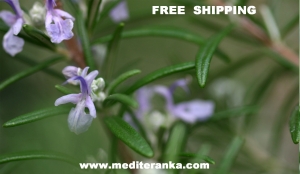
Rosemary (Salvia rosmarinus) leaves are collected by the branch cut in the summer and put to dry. When the branches are dried, the leaves are. Distillation of leaves and twigs of rosemary oil is obtained (aetheroleum Rosmarini). Oil is an integral part of rosemary fat (Unguentum Rosmarini compositum). The flowers and plants in bloom, are harvested in April and May, and dried in the shade, the plant is best kept in closed containers, as is generally required for plants that evaporate.
Curative effect of rosemary in a better blood flow makes it convenient to treat digestive weakness and inertia of the stomach, insufficient supply of blood and paleness. The effect of rosemary can lead to improved function of liver and gall bladder secretion, which contributes to improving the general condition of the whole organism. To eliminate these diseases from drinking the tea of rosemary. Rosemary oil in small quantities affects the expansion of blood vessels and thus to better circulation. Raises blood pressure, allowing for better concentration and memory. Alcoholic solution of rosemary (Spiritus Rosmarini) serves as a tool to massage the paralysis, muscular rheumatism, gout, nervous tension, headaches and mental or physical exhaustion.
Offer:
100g fresh leaves