- You are here:
-
Home

- Krunoslav Tripalo
Products Categories
Your Cart
Currency
Taxi Booking


Krunoslav Tripalo
Wild carrot

Wild carrot (Daucus carota), bird's nest, bishop's lace, is a flowering plant in the family Apiaceae, native to temperate regions of Europe and southwest Asia. The wild carrot is a herbaceous, somewhat variable biennial plant that grows between 0.3 and 0.6 m tall, roughly hairy, with a stiff solid stem. The flowers are small and dull white, clustered in flat, dense umbels. They may be pink in bud and there may be a reddish flower in the centre of the umbel. The fruits are oval and flattened, with short styles and hooked spines. A root that smells like carrots, and occasionally a single dark red flower in the centre of the umbel.
Like the cultivated carrot, the wild carrot root is edible while young, but quickly becomes too woody to consume. Extra caution should be used when collecting wild carrot because it bears a close resemblance to poison hemlock. Folk-medicine holds that an infusion of the seeds will inhibit pregnancy. D. carota, when freshly cut, will draw or change color depending on the color of the water in which it is held. This beneficial weed can be used as a companion plant to crops. Like most members of the umbellifer family, it attracts wasps to its small flowers in its native land, however, where it has been introduced, it attracts only very few of such wasps. This species is also documented to boost tomato plant production when kept nearby, and it can provide a microclimate of cooler, moister air for lettuce, when intercropped with it.
Neem tree
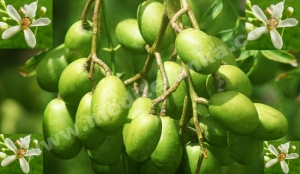
Azadirachta indica (Neem), an herb extensively used in Ayurveda to treat many health related problems and ailments, and also known to exert anticancer, antioxidant, wound-healing, and antimicrobial properties is also known to be one of these plants from which almost every part is used, from the Neem oil extracted from its seeds to the leaves and branches. As in other herbs, Neem beneficial effects are given by some of its active constituents, some of which the pharmaceutical industry have used as their primary source to build drugs against illnesses as important as cancer, for which already more than 400 active constituents derived from plants and herbs are used. Herbs as Neem and Ginkgo biloba as well as many other well renown herbs, have been in the scope of pharmaceutical companies since long ago, mainly due to the properties and health benefits exerted by some of their active constituents known to act as health boosters. Azadirachta indica (Neem) however has a main target on which its use seems to be highly effective, skin and skin related problems, either as part of poly herbal anti-acne face wash gels formulations, or part of antimicrobial preparations against some groups of bacteria as Escherichia coli. Five active constituents found in Azadirachta indica showed an important inhibitory effect on the melanogenesis in the melanoma cells, with which Neem becomes one of these plants to be noted for the development of new drugs based on the active constituents of this plant.
European cornel
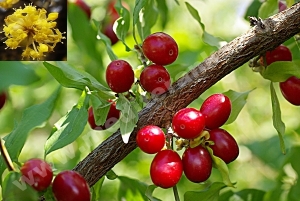
European cornel (Cornus mas), Cornelian cherry or dogwood is a species of flowering plant in the dogwood family Cornaceae, native to southern Europe. It is a medium to large deciduous shrub or small tree growing to 5-12 m tall, The leaves are opposite, 4-10 cm long, the flowers are small (5–10 mm diameter), 10-25 together in the late winter, well before the leaves appear. The fruit is an oblong reddrupe 2 cm long and 1.5 cm in diameter, containing a single seed. The berries when ripe on the plant bear a resemblance to coffee berries, and ripen in mid- to late summer.
The fruit is edible but the unripe fruit is astringent. The fruit only fully ripens after it falls from the tree. When ripe, the fruit is dark ruby red, it has an acidic flavour which is best described as a mixture of cranberry and sour cherry, it is mainly used for making jam, makes an excellent sauce similar to cranberry sauce when pitted and then boiled with sugar and orange, but also can be eaten dried. It is eaten in Eastern Europe in many ways including as a medicine. It is very high in vitamin C and is used to fight colds and flus. The species is also grown as an ornamental plant for its late winter flowers, which open earlier than those of forsythia, and, while not as large and vibrant as those of the forsythia, the entire plant can be used for a similar effect in the landscape. The wood of C. mas is extremely dense, and unlike the wood of most other woody plant species, sinks in water. This density makes it valuable for crafting into tool handles, parts for machines. The red dye used to make fezzes was produced from its bark, and tannin is produced from its leaves.
Hawthorn

Crataegus monogyna, known as common hawthorn or single-seeded hawthorn, is a species of hawthorn native to Europe, northwest Africa and western Asia. Other common names include may, mayblossom, maythorn, quickthorn,whitethorn, motherdie, and haw. The Common Hawthorn is a shrub or small tree 5–14 m tall, with a dense crown. The bark is dull brown with vertical orange cracks. The younger stems bear sharp thorns, 1 to 1.5 cm long. The leaves are 2–4 cm long. The hermaphrodite flowers are produced in late spring, the haw is a small, oval dark red fruit about 1 cm long, berry-like.
Crataegus monogyna is one of the most common species used as the hawthorn of traditional herbalism, which is of considerable interest for treating cardiac insufficiency by evidence-based medicine. The plant parts used medicinally are usually sprigs with both leaves and flowers, or alternatively the fruit. It is a good source of antioxidant phytochemicals. The fruit of hawthorn, called haws, are edible raw but are commonly made into jellies, jams, and syrups, used to make wine, or to add flavour to brandy. Botanically they are pomes, but they look similar to berries. A haw is small and oblong, similar in size and shape to a small olive or grape, and red when ripe. Haws develop in groups of 2-3 along smaller branches. They are pulpy and delicate in taste. In this species (C. monogyna) they have only one seed. Petals are also edible, as are the leaves, which if picked in spring when still young are tender enough to be used in salads.
Indian cress
Naga viper
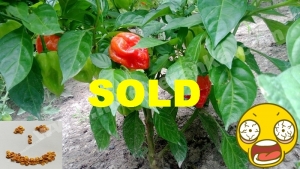
Red savina
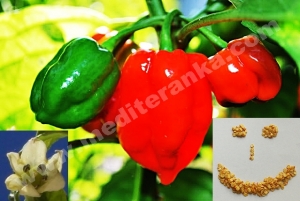
Trinidad Scorpion Moruga
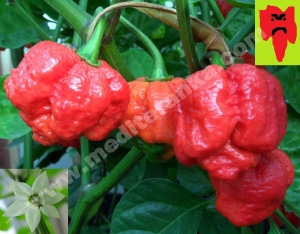
The Trinidad moruga scorpion (Capsicum chinense) is native to the district of Moruga in Trinidad and Tobago. In 2012, Trinidad moruga scorpion was the hottest chili in the world, with a mean heat of more than 1.2 million Scoville heat units (SHU) and individual plants with a heat of more than 2 millionSHU. However the Trinidad Moruga Scorpion has not been certified as the hottest pepper by the Guinness Book of World Records. The previous record holder was the Bhut jolokia. On December 26, 2013, the Guinness World Records rated the 'Carolina Reaper' the world's hottest pepper, dethroning the Trinidad Scorpion Butch T.
Aside from the heat, the Trinidad moruga scorpion has a tender fruit-like flavor, which makes it a sweet-hot combination. The pepper can be grown from seeds in most parts of the world. Freezing weather ends the growing season and kills the plant, but otherwise they are perennials which grow all year, slowing in colder weather.
Soap aloe

Black chokeberry