Mediteranka

Your Cart

No items in cart

Currency

Taxi Booking

taxibooking

Krunoslav Tripalo

Krunoslav Tripalo

Wednesday, 12 November 2014 17:28

The quince

7
Quantity:

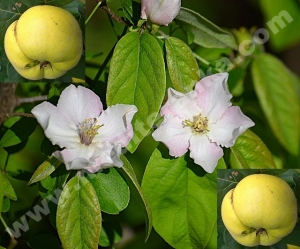
The quince (Cydonia oblonga) is the sole member of the genus Cydoniain the family Rosaceae. It is a small deciduous tree that bears a pome fruit, similar in appearance to a pear, and bright golden-yellow when mature. The cooked fruit has been used as food, but the tree is also grown for its attractive pale pink blossom and other ornamental qualities. The tree grows 5 to 8 m high and 4 to 6 m wide. The fruit is 7 to 12 cm long.The immature fruit is green, in late autumn when the fruit changes colour to yellow with hard, strongly perfumed flesh. The flowers, produced in spring after the leaves, are white or pink, 5 cm across, with five petals.

Quince is resistant to frost and requires a cold period below 7 °C to flower properly (yarovization). The fruit can be left on the tree to ripen further, which softens the fruit to the point where it can be eaten raw in warmer climates, but should be picked before the first frosts. In Europe, quinces are commonly grown in central and southern areas where the summers are sufficiently hot for the fruit to fully ripen. They are not grown in large amounts, typically one or two quince trees are grown in a mixed orchard with several apples and other fruit trees. The fruit is high in pectin, they are used to make jam, jelly and quince pudding, or they may be peeled, then roasted, baked or stewed. The very strong perfume means they can be added in small quantities to apple pies and jam to enhance the flavour. The fruit, like so many others, can be used to make a type of wine.

Offer:
 
10 seeds
7
Quantity:
Monday, 10 November 2014 18:27

Datura stramonium

7
Quantity:
 
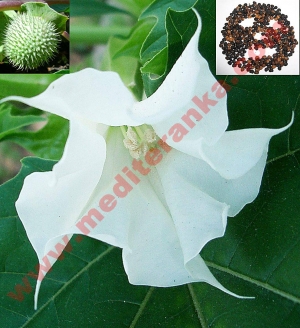
Datura is a genus of nine species of poisonous vespertine flowering plants belonging to the family Solanaceae. They are known as angel's trumpets, sometimes sharing that name with the closely related genus Brugmansia, and commonly as daturas. All species of Datura are poisonous, especially their seeds and flowers. Datura species are herbaceous, leafy annuals and short-lived perennials which can reach up to 2 m in height. The leaves are alternate, 10–20 cm long and 5–18 cm broad, with a lobed or toothed margin. The flowers are erect or spreading (not pendulous like those of Brugmansia), trumpet-shaped, 5–20 cm long and 4–12 cm broad at the mouth, colors vary from white to yellow, pink, and pale purple. The fruit is a spiny capsule 4–10 cm long and 2–6 cm broad, splitting open when ripe to release the numerous seeds. Datura species are usually planted annually from the seed produced in the spiny pods, but with care, plants can be overwintered. Most species are suited to being planted outside or in containers. As a rule, they need warm, sunny places and soil that will keep their roots dry. When grown outdoors in good locations, the plants tend to reseed themselves and may become invasive. 
 
All Datura plants contain tropane alkaloids primarily in their seeds and flowers, because of the presence of these substances, Datura has been used for centuries in some cultures as a poison. Due to the potent combination of anticholinergic substances it contains, Datura intoxication typically produces effects similar to that of an anticholinergic delirium (as contrasted to a complete inability to differentiate reality from fantasy), hyperthermia, tachycardia, bizarre, and possibly violent behavior, and severe mydriasis (dilated pupils) with resultant painful photophobia that can last several days. Pronounced amnesia is another commonly reported effect. No other substance has received as many severely negative recreational experience reports as has Datura
 
Offer:
 
50 seeds
7
Quantity:
Thursday, 23 October 2014 05:12

Japanese spindle

7
Quantity:
 
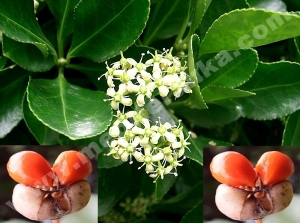
Japanese spindle (Euonymus japonicus) is a species of flowering plant in the family Celastraceae, native to Japan, Korea and China. It is an evergreen shrub or small tree growing to 2–8 m tall, with opposite, oval leaves 3–7 cm long with finely serrated margins. The flowers are inconspicuous, greenish-white, 5 mm diameter. In autumn, orange fruit hangs below the flaring pink seed coverings. Euonymus japonicus is a popular ornamental plant for parks and gardens, both in its native area and also in Europe. 
 
Offer:
 
50 seeds
7
Quantity:
Wednesday, 22 October 2014 11:53

Amorpha fruticosa

7
Quantity:

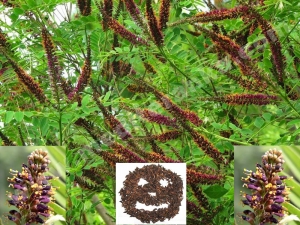
Amorpha fruticosa is a species of flowering plant in the legume family (Fabaceae) known by several common names, including desert false indigo, false indigo-bush, and bastard indigo bush. The species is present as an introduced species in Europe, Asia, and other continents. It is often cultivated as an ornamental plant, and some wild populations may be descended from garden escapees. A. fruticosa grows as a glandular, thornless shrub which can reach 5 or 6 meters in height and spread to twice that in width. The leaves are made up of many hairy, oval-shaped leaflets. The inflorescence is a spike-shaped raceme of many flowers, each with a single purple petal, the fruit is alegume pod containing one or two seeds. Easily grown in average in full sun to light shade. Tolerant of occasional flooding. May spread by self-seeding and/or suckers to form thickets.

It is considered weedy/invasive in some parts of its range. Genus name comes from the Greek word amorphos meaning without form in reference to the single-petaled flowers. Plants contain indigo pigment, but in quantities too small for commercial use (hence the common name of false indigo). False indigo has attractive flowers. It is often used for erosion control, windbreaks and screens. Good shrub for moist naturalized areas or areas with poor soils.

Offer:
 
100 seeds
7
Quantity:
Wednesday, 15 October 2014 17:04

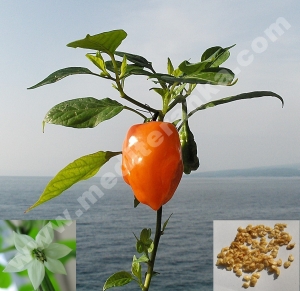
Habanero orange

7
Quantity:

The habanero (Capsicum chinense) is a variety of chili pepper. Unripe habaneros are green, and they color as they mature, common colors are orange and red. Typically, a ripe habanero chili is 2–6 cm long. Habanero chilis are very hot, rated 100,000–350,000 on the Scoville scale. The habanero chili comes from the Amazonas region, its flavor and aroma have become increasingly popular all over the world. The habanero's heat, its fruity, citrus-like flavor, and its floral aroma have made it a popular ingredient in hot sauces and spicy foods.

In 1999, the habanero was listed in the Guinness Book of World Records as the world's hottest chili, but it has since been displaced by a number of other peppers. Habaneros thrive in hot weather. As with all peppers, the habanero does well in an area with good morning sun and should be watered only when dry. The habanero is a perennial flowering plant, meaning that with proper care and growing conditions, it can produce flowers and fruit for many years.

Offer:
 
10 seeds
7
Quantity:
Monday, 13 October 2014 05:39

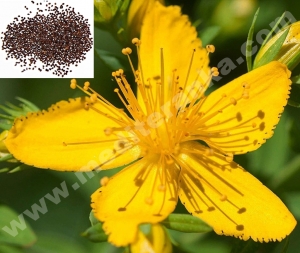
St John's wort

7
Quantity:
 
Common St John's wort (Hypericum perforatum) is a flowering plant species of the genus Hypericum. It is a medicinal herb with antidepressant properties and potential antibacterial and anti- inflammatory properties. Extracts of St John's wort can be used as a treatment for depression. Other names for St John's wort include Tipton's weed, rosin rose, goatweed, chase-devil, or Klamath weed.
 
Hypericum perforatum is a yellow-flowering, perennial herb indigenous to Europe. It has been introduced to many temperate areas of the world and grows wild in many meadows. The herb's common name comes from its traditional flowering and harvesting on St John's day, 24 June. 
St John's wort is a perennial plant with extensive, creeping rhizomes. Its stems can grow to 1 m high. The leaves are yellow-green in color. Its flowers measure up to 2.5 cm across and are colored bright yellow with conspicuous black dots. When flower buds (not the flowers themselves) or seed pods are crushed, a purple liquid is produced. St John's wort is widely known as a herbal treatment for depression. In some countries, it is commonly prescribed for mild to moderate depression, especially in children and adolescents and has similar efficacy to standard antidepressants. 
 
Offer:
 
50 seeds
7
Quantity:
Monday, 13 October 2014 05:22

Manna ash

7
Quantity:
 
Fraxinus ornus (manna ash or South European flowering ash) is a species of Fraxinus native to southern Europe and southwestern Asia. Fraxinus ornus is a medium sized deciduous tree growing to 15–20 m tall with a trunk up to 1 m diameter. The bark is dark grey, remaining smooth even on old trees. 
The leaves are in opposite pairs, 20 - 30 cm long. The flowers are produced in dense panicles 10–20 cm long after the new leaves appear in late spring, each flower with four slender creamy white petals 5–6 mm long, they are pollinated by insects. The fruit is a slender samara 1.5 - 3 cm long, the seed 2 mm broad and the wing 4–5 mm broad, green ripening brown.
 
Fraxinus ornus is frequently grown as an ornamental tree in Europe north of its native range, grown for its decorative flowers. A sugary extract from the sap is extracted by making a cut in the bark, this was compared in late mediaeval times with the biblical manna, giving rise to the English name of the tree. In fact, the sugar mannose and the sugar alcohol mannitol both derive their name from the extract.
 
Offer:
 
50 seeds
7
Quantity:
Tuesday, 07 October 2014 17:56

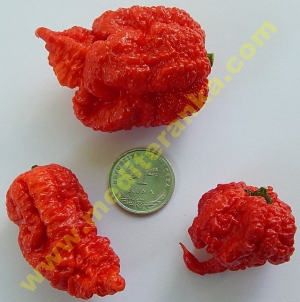
Carolina reaper

The Carolina Reaper is a hybrid cultivar of chili pepper of the Capsicum chinense species, it's the world's hottest hybrid pepper. The original cross was a red naga pepper (see offer) and a Red Savina pepper (see offer). The Carolina Reaper was rated as the world's hottest chili pepper by Guinness World Records according to 2012 tests, averaging 1,569,300 on the Scoville scale with peak levels of over 2,200,000 Scoville Heat Units (SHU). The previous record-holder was the Trinidad Scorpion Butch T.

Offer:
 
10 seeds
Tuesday, 07 October 2014 17:39

Chaste tree

7
Quantity:
 
Vitex agnus-castus, also called Vitex, Chaste Tree, Chasteberry or Monk's Pepper, is a native of the Mediterranean region. Vitex agnus-castus is widely cultivated in warm temperate and subtropical regions for its delicate-textured aromatic foliage and butterfly attracting. It grows to a height of 1–5 meters. It requires full sun or partial shade along with well-drained soil. The leaves and tender stem growth of the upper 10 cm, along with the flowers and ripening seeds, are harvested for alternative medicinal purposes. The berries are harvested by gently rubbing the berries loose from the stem. The leaves, flowers, and berries may be consumed as a decoction, traditional tincture, cider vinegar tincture, syrup, elixir, or simply eaten straight off the plant as an alternative medicinal food. In alternative medicine, it is believed the berries are a tonic herb for both the male and female reproductive systems. The leaves are believed to have the same effect but to a lesser degree. 
 
In ancient times it was believed to be an anaphrodisiac, hence the name chaste tree. More recently, this plant has been called monk's pepper in the thought that it was used as anti-libido medicine by monks to aid their attempts to remain chaste. There are disputed accounts regarding its actual action on libido, with some claims that it is anaphrodisiac and others that it is aphrodisiac. Clinical studies have demonstrated effectivness of standardised and controlled medications produced from extract of the plant in the management of premenstrual stress syndrome (PMS), and cyclical breast pain (mastalgia).  
 
Vitex agnus-castus is used to alleviate symptoms of various gynecological problems, different extracts or herbal mixes may have significantly different properties and safety issues. Some of the modern uses include premenstrual syndrome, abnormal uterine bleeding disorders andmastodynia.
 
Offer:
 
100 seeds
7
Quantity:
Saturday, 04 October 2014 05:55

Bhut jolokia chocolate

7
Quantity:

The bhut jolokia, also known as naga jolokia, naga morich, bih jolokia, ghost pepper, ghost chili pepper, red naga chilli, and ghost chilli is an interspecific hybrid chili pepper. In 2007, Guinness World Records certified that the ghost pepper was the world's hottest chili pepper, 401.5 times hotter than Tabasco sauce, the ghost chilli is rated at more than 1 million Scoville heat units (SHU). Classic Tabasco sauce ranges from 2,500 to 5,000 SHU.

However, as of 2012, it was superseded by the Trinidad moruga scorpion. On December, 2013, the Guinness World Records rated the Carolina Reaper the world's hottest pepper, moving the ghost chili to third place. Ripe peppers measure 60 to 85 mm long and 25 to 30 mm wide with a red, yellow, orange, or chocolate color. Bhut jolokia pods are unique among peppers, with their characteristic shape, and very thin skin.

Offer:

30 seeds

7
Quantity:
Page 9 of 24
FaLang translation system by Faboba