Mediteranka

Your Cart

No items in cart

Currency

Taxi Booking

taxibooking

Krunoslav Tripalo

Krunoslav Tripalo

Thursday, 12 May 2016 08:02

Christmas rose

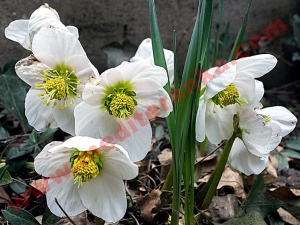
Christmas rose (Helleborus niger), Christmas Hellebore, Black Hellebore is a very distinct species, immediately recognisable and rarely confused with others, it is the best known of the species hellebores. The Christmas Rose it is one of the first plants to bloom producing a succession of delicate white flowers. The blooms can open by the end of December, in gardens, the flowers generally appear from January to March, occasionally earlier. The blossoms are a study in elegance and purity, with five petals. Each blossom lasts for several weeks, going through an aging process. A couple of weeks after opening, the backs of the petals become blushed with the most delicate shade of pink. This colour deepens and the petals thicken, turning slowly green as the seeds ripen in the centre of the flower.

This beautiful hellebore is smaller and more compact than its relatives. The leaves form a beautiful clump to around 30cm wide that is evergreen if protected from winter wind and its foliage stays neater throughout the year. It is an easy plant to grow in light shade in most soils and is good for massing under trees.

Offer:

9 seeds

Friday, 01 April 2016 10:15

Siberian larch

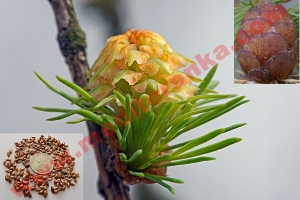
The Siberian larch (Larix sibirica) or Russian larch is a frost-hardy tree. It is a medium-size to large tree reaching 20-50 m tall, with a trunk up to 1 m diameter. The crown is conic when young, becoming broad with age. The shoots are dimorphic, with growth divided into long shoots (typically 10-50 cm long. It has bimorphic needles, with needles on new growth borne singly and arranged in a spiral around the branch. It is most easily distinguished from the closely related European larch by the shoots being downy (hairless in European larch).

The leaves are needle-like, light green, 2-5 cm long, and turn bright yellow before they fall in the autumn. The male and female cones are borne separately on the same tree, the male cones are solitary, yellow, 4-8 mm diameter, and produce wingless pollen. The mature female cones are erect, 2-5 cm long, they are green variably flushed red when immature, turning brown and opening to release the winged seeds when mature, 4–6 months after pollination. The old cones commonly remain on the tree for many years, turning dull grey-black. Because of its rot resistance, larch wood is especially valuable for posts, poles, railroad tie sleepers, and mine props.

Offer:

50 seeds

Monday, 21 March 2016 17:18

Araujia Sericifera (1000x)

25
Quantity:

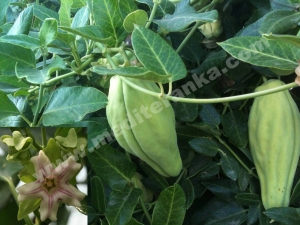
Araujia sericifera, Cruel Plant, Moth Plant, Bladder Vine, Poor Man's Stephanotis je tropska penjačica koja raste do 7 m. Listovi  su blago trokutastog oblika i dlakavi su. Kada se listovi ili stabljika oštete, izlazi sok nalik mlijeku koji ima neugodan miris. Cvjetovi su svijetlo-roza boje, dugački  oko 2 cm i oprašuju ih moljci, po čemu je biljka i dobila ime - moth plant. Nakon cvjetanja stvaraju se veliki zeleni plodovi, piramidalnog oblika, koji zrenjem posmeđe i pucaju, a iz njih izlaze sjemenke slične maslačku. Biljka se koristi za prekrivanje neuređenih površina ili kao zelena ograda jer vrlo brzo raste i prekrije željenu površinu, a nakon stvaranja većeg broja velikih plodova, djeluje poprilično atraktivno.

Ponuda:

1000 sjemenki

25
Quantity:
Wednesday, 24 February 2016 06:18

Wild asparagus (1000x)

95
Quantity:
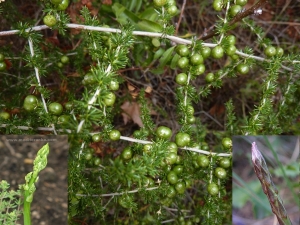
Wild asparagus (Asparagus acutifolius) is an evergreen perennial plant belonging to the genus Asparagus. The Latin name acutifolius of this species, meaning "thorny leaves", derives from the characteristics shape of the leaves, a quite common feature in the typical plants of the Mediterranean. Asparagus acutifolius reaches on average 30–70 centimetres of height. The stems have much-branched feathery foliage. The "leaves" are in fact needle-like modified stems. The flowers are bell-shaped and in small clusters, greenish-white to yellowish, 4–5 millimetres long. The flowers are dioecious (on each plant they are only male or female).
 
In some Mediterranean regions flowering occurs in late Summer from August through September, often after heavy storms. In this case the small green (black) berries with 1-2 seeds, 5-6 millimetres of diameter, are fully ripe in winter.
 
Offer:
 
1000 seeds
 
95
Quantity:
Saturday, 20 February 2016 09:34

Opuntia ficus indica - cutting

8
Quantity:
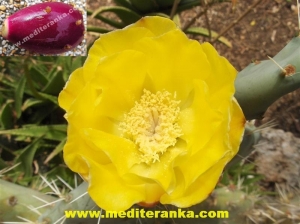
Opuntia ficus-indica is a domesticated cactus that has been used for food for at least 9000 years. Some of the common English names for the plant and its fruit are Indian fig opuntia, barbary fig, and prickly pear, although this last name has also been applied to other less common Opuntia species. Fig opuntia is grown primarily as a fruit crop, but also for the vegetable nopales and other uses. The fruits have a sweet taste somewhat resembling watermelon. Jams and jellies are produced from the fruit, which resemble strawberries and figs in color and flavor.
The name ficus, which means fig, also has to do with the plant’s fruit. The pads are also eaten as a vegetable that can be made into cactus salad, added to omelets and more. While the pads of various opuntia species are used for this purpose, ficus-indica is the most popular. These edible uses make opuntia somewhat of a saving grace for arid areas because it allows crop production in an environment that would otherwise be unsuitable. Cacti are good crops for dry areas because they efficiently convert water into biomass
Mexicans have used Opuntia for thousands of years to make an alcoholic drink called colonche. Accordingly, ficus-indica is one of Mexico's most important exports, ranking among tequila and corn. In Malta, a liqueur called Bajtra (the Maltese name for prickly pear) is made from this fruit, which can be found growing wild in most every field. 
Along with being a food source, this species has a number of medicinal uses including everything from treatment of enlarged prostate to treatment of colitis and irritable bowel syndrome to being a hangover cure. The cactus does have one drawback. Its spines take the form of fine hairs, which can seem harmless, but they act much like hairy splinters in the skin that will work themselves in deeply if allowed to.
The plants flower in three distinct colors: white, yellow and red. The flowers first appear in early may through the early summer in the Northern Hemisphere, and the fruit ripen from august through october. The fruit are typically eaten, minus the thick outer skin, after chilling in a refrigerator for a few hours. The bright red/purple or white/yellowish flesh contains many tiny hard seeds that are usually swallowed, but should be avoided by those who have problems digesting seeds.
 
Offer:
 
Cutting - 1x
8
Quantity:
Saturday, 20 February 2016 09:15

Opuntia ficus indica (1000x)

19
Quantity:
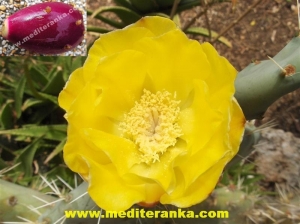
Opuntia ficus-indica is a domesticated cactus that has been used for food for at least 9000 years. Some of the common English names for the plant and its fruit are Indian fig opuntia, barbary fig, and prickly pear, although this last name has also been applied to other less common Opuntia species. Fig opuntia is grown primarily as a fruit crop, but also for the vegetable nopales and other uses. The name "tuna" is also used for the fruit of this cactus.  The plant spread to many parts of the Americas in pre-Columbian times, and since Columbus, have spread to many parts of the world, especially the Mediterranean, where they have become naturalized.
The plant’s edible uses have been tied to the Christopher Columbus and the Mayan Indians. The fruits have a sweet taste somewhat resembling watermelon.  Jams and jellies are produced from the fruit, which resemble strawberries and figs in color and flavor.
The name ficus, which means fig, also has to do with the plant’s fruit. The pads are also eaten as a vegetable that can be made into cactus salad, added to omelets and more. While the pads of various opuntia species are used for this purpose, ficus-indica is the most popular. These edible uses make opuntia somewhat of a saving grace for arid areas because it allows crop production in an environment that would otherwise be unsuitable. Cacti are good crops for dry areas because they efficiently convert water into biomass
Mexicans have used Opuntia for thousands of years to make an alcoholic drink called colonche. Accordingly, ficus-indica is one of Mexico's most important exports, ranking among tequila and corn. In Malta, a liqueur called Bajtra (the Maltese name for prickly pear) is made from this fruit, which can be found growing wild in most every field. 
Along with being a food source, this species has a number of medicinal uses including everything from treatment of enlarged prostate to treatment of colitis and irritable bowel syndrome to being a hangover cure. The cactus does have one drawback. Its spines take the form of fine hairs, which can seem harmless, but they act much like hairy splinters in the skin that will work themselves in deeply if allowed to.
The plants flower in three distinct colors: white, yellow and red. The flowers first appear in early may through the early summer in the Northern Hemisphere, and the fruit ripen from august through october. The fruit are typically eaten, minus the thick outer skin, after chilling in a refrigerator for a few hours. The bright red/purple or white/yellowish flesh contains many tiny hard seeds that are usually swallowed, but should be avoided by those who have problems digesting seeds.
 
Offer:
 
1000 seeds
19
Quantity:
Friday, 19 February 2016 19:01

Arizona cypress

7
Quantity:

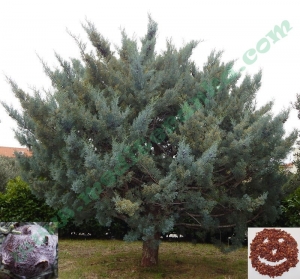
Arizona cypress (Cupressus arizonica) is a coniferous evergreen tree with a conic to ovoid-conic crown. It grows to heights of 10–25 m and its trunk diameter reaches 0.5 m. The foliage grows in dense sprays, varying from dull gray-green to bright glaucous blue-green. The leaves are scale-like, 2–5 mm long. The seed cones are globose to oblong, 15–33 mm long, green at first, maturing gray or gray-brown about 20–24 months after pollination. The cones remain closed for many years, only opening after the parent tree is killed in a wildfire, thereby allowing the seeds to colonize the bare ground exposed by the fire. Arizona Cypress is widely cultivated as an ornamental tree.

Offer:

20 seeds

7
Quantity:
Friday, 05 February 2016 18:43

Honesty (500x)

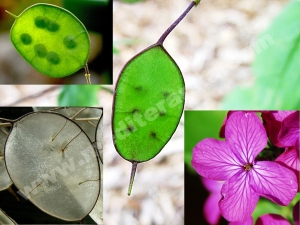
Lunaria annua, called honesty or annual honesty in English, is a species of flowering plant native to the Balkans and south west Asia, and naturalized throughout the temperate world. It is an annual or biennial growing to 90 cm tall by 30 cm broad, with large, coarse, pointed oval leaves with marked serrations. In spring and summer it bears terminal racemes of violet (rarely white) flowers, followed by showy, light brown, disc-shaped seedpods the skin of which falls off to release the seeds, revealing a central membrane which is white with a silvery sheen, 3–8 cm in diameter, they persist on the plant through winter.

The Latin name lunaria means "moon-shaped" and refers to the shape and appearance of the seedpods. In South East Asia, it is called the "money plant". This plant is easy to grow from seed. It is usually grown as a biennial, being sown one year to flower the next. It is suitable for cultivation in a shady or dappled area, or in a wildflower garden, and the flowers and dried seedpods are often seen in flower arrangements.

Offer:

500 seeds

Friday, 05 February 2016 18:27

Opuntia Robusta (100x)

7
Quantity:

Opuntia robusta - this cactus is the rarest everywhere in mediterranean region, the dimensions of a sheet of this cactus are up to 45 cm in diameter, and leaf weight up to 3.5 kg. Like all species of cactus is very undemanding in terms of land and waters, you choose how you will form it, like all cacti - more sun - more blooms and grows faster. 

Offer:

100 seeds

7
Quantity:
Thursday, 04 February 2016 14:52

Virginia creeper (50x)

7
Quantity:
 
Virginia creeper, five-leaved ivy, or five-finger (Parthenocissus quinquefolia) is a woody vine native to eastern and central North America, in southeastern Canada, the eastern and central United States. Parthenocissus quinquefolia is also known as woodbine although woodbine can refer to other plant species.
It is a prolific climber, reaching heights of 20 to 30 m in the wild. It climbs smooth surfaces using small forked tendrils tipped with small strongly adhesive pads 5 mm in size. The leaves are palmately compound, composed of five leaflets (rarely three leaflets, particularly on younger vines) joined from a central point on the leafstalk, and range from 3 to 20 cm (rarely 30 cm) across. The leaflets have a toothed margin. The species is often confused with Parthenocissus vitacea, which has the same leaves, but does not have the adhesive pads at the end of its tendrils.
The flowers are small and greenish, produced in clusters in late spring, and mature in late summer or early fall into small hard purplish-black berries 5 to 7 mm diameter. These berries contain oxalic acid, which is only moderately toxic to humans and other mammals. The berries provide an important winter food source for birds.
 
Virginia creeper is grown as an ornamental plant, because of its deep red to burgundy fall foliage. It is frequently seen covering telephone poles or trees. The creeper may kill vegetation if it covers by shading its support and thus limiting the supporting plants' ability to photosynthesize.
Virginia creeper can be used as a shading vine for buildings on masonry walls. Because the vine, like its relative Boston ivy, adheres to the surface by disks rather than penetrating roots, it will not harm the masonry but will keep a building cooler by shading the wall surface during the summer, saving money on air conditioning.
Native Americans used the plant as an herbal remedy for diarrhea, difficult urination, swelling, and lockjaw.
 
Offer:
 
50 seeds
 
7
Quantity:
Page 5 of 24
FaLang translation system by Faboba