


- You are here:
-
Home

- Krunoslav Tripalo
Products Categories
Your Cart
Currency
Taxi Booking


Krunoslav Tripalo
Smilax aspera (50x)

Smilax aspera, common name Rough Bindweed or Sarsaparille, is a species of flowering vine in the greenbriar family, Smilacaceae. Smilax aspera is a perennial, evergreen shrub with a flexible and delicate stem, with sharp thorns. The climbing stem is 1–4 metres long. The leaves are 8–10 centimetres long, petiolated, alternate, tough and leathery, heart-shaped, with toothed and spiny margins. Also the midrib of the underside of the leaves are provided with spines. The flowers, very fragrant, are small, yellowish or greenish, gathered in axillary racemes. The flowering period in Mediterranean regions extends from September to November. The fruits are globose berries, gathered in clusters, which ripen in Autumn. They are initially red, later turn black. They have a diameter of 8–10 millimetres and contain one to three tiny and round seeds. Insipid and unpalatable to humans, they are a source of nourishment for many species of birds. It grows in the woods and scrubs, at an altitude of 0–1,200 metres above sea level.
Offer:
50 seeds
Dalmatian iris (50x)
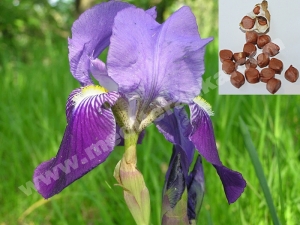
Iris pallida – pseudopallida (Dalmatian iris or Sweet iris) is a hardy flowering perennial plant of the genus Iris, family Iridaceae. It is native to the Dalmatian coast (Croatia) but widely naturalised elsewhere. It is a member of the subgenus iris, meaning that it is a bearded iris, and grows from a rhizome. This iris prefers rocky places in the mediterranean and submediterranean zone and reaches sometimes montane regions at its southern range in Montenegro. It grows to a stem height of 50 to 80 centimeters. The leaves are bluish-green in color, and sword-shaped, 40 to 50 centimeters in length, and 2.5 to 3 centimeters in width. The inflorescence, produced in May/June, is fan-shaped and contains two or three flowers which are often very fragrant and usually pale purplish to whitish. It is cultivated as a garden plant, and commercially for extraction of essential oils from its rhizome (orris root). Three subspecies of Iris pallida are Iris pallida - cengialti (with deep purplish flowers) from Slovenia and adjacent Italy, Iris pallida - illyrica from the North Dalmatian coast, and Iris pallida - pseudopallida from the South Dalmatian coast. Another subspecies is Iris pallida ssp. musulmanica.
Offer:
50 seeds
Buckthorn (50x)
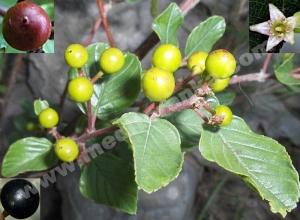
Jamaican Hot Red
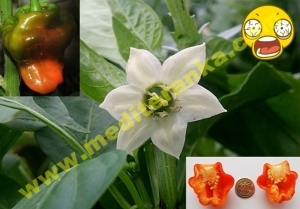
The Jamaican Hot Red (Capsicum chinense) is shiny and Habanero-type pepper color from green to red after about 85 to 100 days. The wrinkled pods are very hot and with their strong smoky flavor they are very suitable for making hot sauces. The heat is between 100.000 and 200.000 Scoville heat units (SHUs). The peppers are about 4 to 5 cm. long and 4 cm wide.
Checker tree
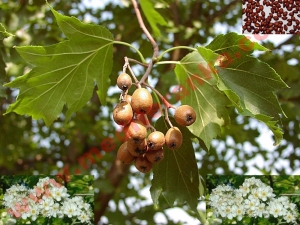
Checker tree (Sorbus torminalis), sometimes known as the chequer tree or wild service tree, is a species of Sorbus native to Europe, south to northwest Africa. It is a medium-sized tree growing to 15–25 m tall, with a trunk up to 1.3 m diameter. The bark is smooth and greyish, the leaves are 6–14 cm long and broad with a 2.5–5 cm petiole, dark green on both sides, the autumn colour is yellow to red-brown. The flowers are 10–15 mm diameter, with five white petals. The fruit is a globose to ovoid pome 10–15 mm diameter, greenish to russet or brown, when mature in mid to late autumn.
The fruit, sometimes called "chequers," are edible and taste similar to dates, although they are now rarely collected for food. They are usually too astringent to eat until they are over-ripe and bletted. Before the introduction of hops, the fruit were used to flavour beer, which may be related to the ancient symbol of a pub being the chequer-board.
Mammillaria prolifera
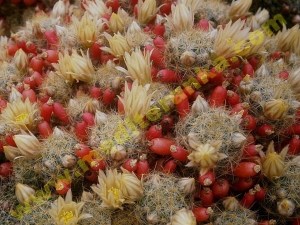
Mammillaria prolifera is a cactus forming a clump of globose stems to 10 cm, bearing short, white or red-brown spines. The flowers are up to 2 cm in diameter, yellow in color, tinged pink and the outer segments are striped with brown. To encourage better flowering, allow the plants to enjoy a cooling period in the winter and suspend watering. Unlike many other cacti, which use their ribs as storage devices, the Mammillaria feature raised tubercles, from which spines emerge. When you water, the tubercles will expand to allow for increased water storage. The flowers emerge from the axils of these tubercles on the previous year’s growth, which accounts for their interesting halo effect.
Purple plum
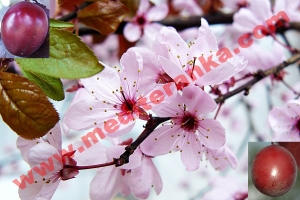
Purple plum (Prunus cerasifera – Nigra) is an upright deciduous tree eventually making a ball shaped specimen. It has a rounded to pyramidal habit and dark-red leaves when young in spring and a very attractive deep purple foliage later which is retained throughout the summer. It has many different names like Black leaved plum, Blaze, Flowering cherry tree, Blossom Tree, Cherry blossom tree, Ornamental Cherry or Ornamental Plum tree. Masses of bowl-shaped bright pink flowers contrast dramatically on its bare purple branches in early to mid-spring and are occasionally followed by plum-like red or yellow fruits. These fruits are the same size as ordinary plums are edible, sweet and juicy and can be used to produce canned fruit.
When left unpruned this tree can grow to 6m x 6m in 20 years and later reach its ultimate height of 8m. Can be used as low tree, larger specimen shrub or in loose hedges requiring little pruning. Grows in sun and shade as well, it is very frost resistant, copes well with dry weather, city climate, wind and moisture.
Stapelia

Orbea variegata is almost certainly the most common Asclepiad in cultivation, even if it is still often seen under its earlier name of Stapelia variegata. It is soft stemmed succulent each stem can reach over 25 cm, grey green mottled purple in full sun, in age forms big clumps. The typical flower is 5-7 cm across with 5 blunt lobes, starfish-like, attractively patterned or dusted with chocolate/purple, brown/bronze blotches on a greenish-yellow background, It is quite free flowering if in direct sunlight. The plant can readily set seed, after the fecundation the carpels develop long cylindrical fruits up to 12 cm long, these need to be contained when they ripen, because as soon as the fruit opens it liberate a cloud of flying seed provided with a white feathery cotton fluff. Stapelia is very easy to grow, it is the ideal plant for beginners, needs light shade to full sun, it is very resistant to heat will also tolerate cold temperatures and light frost, best in a ventilated environment.
Jamaican Hot Chocolate

Yellow Trinidad Scorpion Moruga
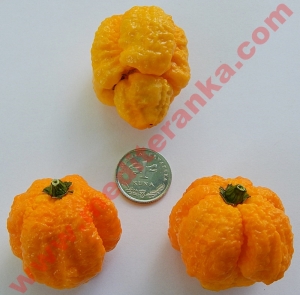
The Yellow Trinidad moruga scorpion (Capsicum chinense) is native to the district of Moruga in Trinidad and Tobago. On February 13, 2012, Trinidad moruga scorpion was the hottest chili in the world, with a heat of more than 1.2 million Scoville heat units (SHUs) and individual plants with a heat of more than 2 million SHUs. The current world record holder is the Carolina Reaper (see offer). Aside from the heat, the Trinidad moruga scorpion has a tender fruit-like flavor, which makes it a sweet-hot combination. The pepper can be grown from seeds in most parts of the world. Freezing weather ends the growing season and kills the plant, but otherwise they are perennials which grow all year, slowing in colder weather.