


- You are here:
-
Home

- Krunoslav Tripalo
Products Categories
Your Cart
Currency
Taxi Booking


Krunoslav Tripalo
Ardisia crenata

Ardisia crenata is a species of flowering plant in the colicwood family, Myrsinaceae, that is native to East Asia. It is known by a variety of names such as coral bush, coralberry, coralberry tree, hen's-eyes, and spiceberry. A. crenata is a compact shrub that reaches 1 metre, often with a single stem. Leaves are dark green, thick, glossy, and have tightly waved edges The flowers are small, white or reddish, fragrant, and form clusters. The fruit is a glossy, bright red drupe. The seeds are able to germinate under a dense canopy and are dispersed by birds and humans.
Preparations made from the root of Ardisia crenata are used as an ingredient in traditional Chinese medicine.
It is evergreen unless killed back by very hard freezes. Coral ardisia's (Ardisia crenata) native range stretches from Japan to northern India. It has escaped cultivation and become established in much of northern and central Florida. In some areas it has become a serious pest, displacing native species. Coral ardisia likes deep soil rich with lots of organic matter but it can also thrive in almost any non-soggy soil. Mulch around plants or allow leaves and needles from overhead trees to fall down naturally around them. Ardisia may be topped off to maintain height.
Coral ardisia tolerates some direct sun but not much without showing signs of distress. It grows best under a canopy of trees in fairly deep shade.
For winter color in a forest grove, plant coral ardisia under trees and allow to colonize freely, thinning as necessary. A more formal use can be made of these lovely plants in shade gardens. For best effect, plant a group of at least three. In frost-free areas, ardisia can become quite large and a single specimen might occupy the same space allowed for two or three elsewhere. Where freezes are severe, ardisia should be placed in a protected area or covered. A hard freeze will kill the plant to the ground. Ardisia is easily transformed into a houseplant and is attractive for the shiny foliage even if berries do not form. Red berries, glossy foliage and low maintenance distinguish this beautiful little shrub.
Euonymus europaeus - Spindle

Euonymus europaeus (spindle, European spindle, common spindle) is a species of flowering plant in the family Celastraceae, native to much of Europe, especially Mediterannean area where it inhabits the edges of forest, hedges and gentle slopes, tending to thrive on nutrient-rich, chalky and salt-poor soils. It is a deciduous shrub or small tree. Other names include fusoria, fusanum, ananbeam, shemshad rasmi.
Euonymus europaeus grows to 3–6 m tall, with a stem up to 20 cm in diameter. The leaves are opposite, 3-8 cm long and 1-3 cm broad. Leaves are dark green in summer. Fall color ranges from yellow-green to reddish-purple, depending on environmental conditions. The hermaphrodite flowers are produced in late spring and are insect-pollinated, they are small, yellowish green and grow in cymes of 3-8 together. The capsular fruit ripens in autumn, and is red to purple in colour and approximately 1-1.5 cm wide. When ripe, the four lobes split open to reveal the orange seeds. It is a popular ornamental plant in gardens and parks due to its bright pink or purple fruits and attractive autumn colouring, in addition to its resistance to frost and wind.
European spindle wood is very hard, and can be cut to a sharp point, it was used in the past for making wool spindles. Parts of the plant have been used medicinally. However, the fruit is poisonous, containing, amongst other substances, the alkaloids theobromine and caffeine, as well as an extremely bitter terpene.
Viburnum tinus
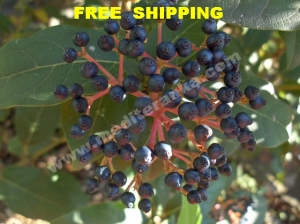
Viburnum tinus (subsp. Tinus) is a shrub (rarely a small tree) reaching up to 2-7 m tall, with a dense, rounded crown. The leaves are evergreen, persisting 2-3 years, ovate to elliptic, borne in opposite pairs, 4-10 cm long and 2-4 cm broad, with an entire margin. The flowers are small, white or light pink, produced from reddish-pink buds in dense cymes 5-10 cm diameter in the winter. The fragrant flowers are bisexual and pentamerous. The flowering period is from October to June. Pollination is by insects. The fruit is a dark blue-black drupe 5-7 mm long.
This plant is native to the Mediterranean area and Macaronesia, in Europe within (Portugal, Spain, France, Italy, Albania, Greece), in North Africa (Algeria, Morocco, Tunisia, Libya) and in the Middle East (Israel, Lebanon, Turkey). Is also present in the Azores and the Canary Islands. It grows mainly in the Mediterranean maquis and in oak forests. It prefers shady, moist areas, at an altitude of 0–800 metres above sea level.
Viburnum tinus is a popular evergreen shrub widely cultivated for its winter flowering habit in regions with mild winters. Several cultivars have been introduced by the horticultural trade; mostly these are similar to the species, but with subtle variations in habit, leaf size or flower colour. As it tolerates pruning well it is often sold as topiary specimens, although even moderate clipping significantly reduces flowering ability.
Paulownia Elongata

Paulownia Elongata (also known as the Empress Tree, Princess Tree or Foxglove Tree) is a deciduous tree in the genus Paulownia, native to central and western China. It grows to 10–25 m tall, with large heart-shaped to five-lobed leaves 15–40 cm across, arranged in opposite pairs on the stem. On young growth, the leaves may be in whorls of three and be much bigger than the leaves on more mature growth. The characteristic large size of the young growth is exploited by gardeners: by pollarding the tree and ensuring there is vigorous new growth every year, massive leaves are produced (up to 60 cm across). Regarding its nomenclature, Paulownia is in honour of the Grand Duchess Anna Pavlovna of Russia, also known as Anna Paulowna, a princess of the Netherlands, with tomentosa being derived from the Latin meaning ‘covered in hairs’.
The flowers are produced before the leaves in early spring, on panicles 10–30 cm long, with a tubular purple corolla 4–6 cm long resembling a foxglove flower. The fruit is a dry egg-shaped capsule 3–4 cm long, containing numerous tiny seeds. The seeds are winged and disperse by wind and water.
Paulownia elongata can survive wildfire because the roots can regenerate new, very fast-growing stems. It is tolerant of pollution and it is not fussy about soil type. For this reason it functions ecologically as a pioneer plant. Its nitrogen-rich leaves provide good fodder and its roots prevent soil erosion. Eventually, Paulownia is succeeded by taller trees that shade it. It cannot thrive in the shade of other trees.
In China, an old custom is to plant an Empress Tree when a baby girl is born. The fast-growing tree matures when she does. When she is eligible for marriage the tree is cut down and carved into wooden articles for her dowry. Carving the wood of Paulownia is an art form in Japan and China. In legend, it is said that the Phoenix will only land on the Empress Tree and only when a good ruler is in power. Several Asian string instruments are made from Paulownia, including the Japanese koto and Korean gayageum zithers.
The soft, lightweight seeds were commonly used as a packing material by Chinese porcelain exporters in the 19th century, before the development of polystyrene packaging. Packing cases would often leak or burst open in transit and scatter the seeds along rail tracks. This, together with seeds released by specimens deliberately planted for ornament, has allowed the species to become an invasive weed tree in areas where the climate is suitable for its growth, notably Japan and the eastern United States.
Arbutus unedo
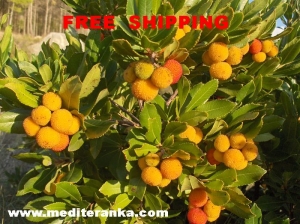
Arbutus unedo (strawberry tree, occasionally cane apple) is an evergreen shrub or small tree in the family Ericaceae, native to the Mediterranean region and western Europe north to western France, Ireland, Portugal and Turkey. Due to its presence in South West Ireland, it is known as either "Irish strawberry tree" or "Killarney strawberry tree".
Arbutus unedo grows to 5–10 m tall, rarely up to 15 m, with a trunk diameter of up to 80 cm. The leaves are dark green and glossy, 5–10 cm long and 2–3 cm broad, with a serrated margin. The hermaphrodite flowers are white (rarely pale pink), bell-shaped, 4–6 mm diameter, produced panicles of 10–30 together in autumn. They are pollinated by bees.
The fruit is a red berry, 1–2 cm diameter, with a rough surface, maturing 12 months at the same time as the next flowering. The fruit is edible, though many people find it bland and meally, the name 'unedo' is explained by Pliny the Elder as being derived from unum edo - "I eat one", which may seem an apt response to the flavour.
Unlike most of the Ericaceae, Arbutus unedo grows well in limy soils. It is best planted in a sheltered position due to its late flowering habit. When grown as a tree rather than a multi-stemmed shrub, it is important to select one stem that becomes the main trunk, keeping any other basal sprouts pruned off. It prefers well-drained soil and only moderate amounts of water.
Arbutus unedo is naturally adapted to dry summers, though also growing well in the cool, it is therefore useful for planting in areas with a dry-summer climate, and has become a very popular garden specimen in California and the rest of the west coast of North America.
Its Mediterranean habitat, elegant details of leaf and habit and dramatic show of fruit with flowers made Arbutus unedo notable in Classical Antiquity, when Pliny thought it should not be planted where bees are kept, for the bitterness it imparts to honey.
The fruit mainly serve as food for birds but in some countries they are used to make jam and liqueurs (such as the Portuguese medronho, a kind of strong brandy).
Moringa oleifera

Moringa oleifera (synonym: Moringa pterygosperma) is the most widely cultivated species of the genus Moringa, which is the only genus in the family Moringaceae. English common names include moringa, and drumstick tree, from the appearance of the long, slender, triangular seed pods, horseradish tree, from the taste of the roots which resembles horseradish, or ben oil tree, from the oil derived from the seeds. The tree itself is rather slender, with drooping branches that grow to approximately 10m in height. In cultivation, it is often cut back annually to 1-2 meters and allowed to regrow so the pods and leaves remain within arm's reach. It is a fast-growing, drought-resistant tree that is native to the southern foothills of the Himalayas in northwestern India.
India is the largest producer of moringa, with an annual production of 1.1 to 1.3 million tonnes of tender fruits from an area of 380 km2.
Moringa is grown in home gardens and as living fences in Thailand, where it is commonly sold in local markets. In the Philippines, it is commonly grown for its leaves, which are used in soup. Moringa is also actively cultivated by the World Vegetable Center in Taiwan, a center for vegetable research with a mission to reduce poverty and malnutrition in developing countries through improved production and consumption of vegetables.
Moringa derives from the Tamil word murungai. The Chinese name, pronounced la mu in Mandarin and lat mok in Cantonese, means "spicy (hot) wood" and is reminiscent of the English name, "horseradish tree".
Many parts of the moringa are edible. In some regions, the young seed pods are most commonly eaten, while in others, the leaves are the most commonly used part of the plant. The flowers are edible when cooked and are said to taste like mushrooms. The bark, sap, roots, leaves, seeds, oil, and flowers are used in traditional medicine in several countries.
The leaves are the most nutritious part of the plant, being a significant source of vitamin B6, vitamin C, provitamin A as beta-carotene, magnesium and protein.
The leaves are cooked and used like spinach. In addition to being used fresh as a substitute for spinach, its leaves are commonly dried and crushed into a powder used in soups and sauces. It is important to remember that like most plants heating moringa above 140 degrees Fahrenheit will destroy some of the nutritional value.
The seeds, sometimes removed from more mature pods and eaten like peas or roasted like nuts, contain high levels of vitamin C and moderate amounts of B vitamins and dietary minerals.
The fruit meat of drum sticks, including young seeds, is used for soup. Young leaves can either be fried with shrimp or added as a topping in fish soup.
In Jamaica, the sap is used for a blue dye.
There are several traditional Cambodian dishes using leaves of the moringa tree, such as m'rum or a mixed soup known as korko. As it is a favorite vegetable, Cambodians traditionally grow moringa trees close to their residences.
In South India and Sri Lanka, it is used to prepare a variety of sambal, is fried, or made into curry dishes by mixing with coconut, poppy seeds, and mustard or boiled until the drumsticks are semisoft and consumed directly without any extra processing or cooking.
The leaves may be fried and mixed with dried-fried tuna chips (Maldive fish), onions and dried chillies. This is equivalent to a sambal and eaten along with rice and curry. In one area in the Maldives, a soup is made with these leaves and rice, and eaten especially for breakfast during the month of Ramazan. It is also a common ingredient in an omelet. The pods are used to cook a mild curry.
In the Philippines, moringa is widely eaten, and its leaves are available in many markets at affordable prices. The leaves are most often added to a broth to make a simple and nutritious soup. The leaves are also sometimes used as a characteristic ingredient in tinola, a traditional chicken dish consisting of chicken in a broth, moringa leaves, and either green papaya or another vegetable. The leaves can also be processed with olive oil and salt for a pesto-like pasta sauce that has become popular on the Filipino culinary scene. Moringa juice may be mixed with lemonsito juice to make ice candies or cold drinks, possibly more palatable to those who dislike vegetables.
Moringa has been used in folk medicine, including Ayurvedic traditional medicine and in the Philippines. In Africa and Indonesia, moringa leaves are given to nursing mothers in the belief that they increase lactation.
Skimmia japonica

Skimmia is a genus of four species of evergreen shrubs and small trees in the Rue family, Rutaceae, all native to warm temperate regions of Asia. The leaves are clustered at the ends of the shoots, simple, lanceolate, 6-21 cm long and 2-5 cm broad, with a smooth margin. The flowers are in dense panicle clusters, each flower small, 6-15 mm diameter, with 4-7 petals. The fruit is red to black, 6-12 mm diameter, a fleshy drupe containing a single seed. All parts of the plant have a pungent aroma when crushed. The botanical name, Skimmia, is a Latinization of shikimi, which is the Japanese name for Illicium religiosum as well as an element in miyama shikimi, the Japanese name for Skimmia japonica.
There are four well-defined species of skimmia that grow in the wild, all originating in Asia. They are evergreen shrubs, with dark green, oval leaves. After nearly a century of confusion, scientists in Kew’s Herbarium managed to work out the relationships between the species. With cultivars (varieties of a plant that have been created or selected intentionally and maintained through cultivation), accurate naming still poses problems but work is ongoing to unravel these complex associations. For example, 28 of the 53 known named cultivars of Skimmia japonica subsp. Japonica have been identified.
Skimmias are grown as garden plants for their foliage, flowers, and showy red fruits. They are grown in shade, with moist, well-drained, humus-rich soils. They are tolerant of both drought and air pollution. A large number of cultivars have been selected for garden use.
Passion fruit

Passion fruit (Passiflora edulis) is a vine species of passion flower that is native to Brazil, Paraguay and northern Argentina, its common names include passionfruit and purple granadilla. The passion fruit is round to oval, either yellow or dark purple at maturity, with a soft to firm, juicy interior filled with numerous seeds. The fruit is both eaten and juiced, passion fruit juice is often added to other fruit juices to enhance the aroma.
Several distinct varieties of passion fruit with clearly differing exterior appearances exist. The bright yellow flavicarpa variety, also known as the Golden Passion Fruit, can grow up to the size of a grapefruit, has a smooth, glossy, light and airy rind. The dark purple edulis variety is smaller than a lemon, though it is less acidic than the yellow passion fruit, and has a richer aroma and flavour. Fresh passion fruit is high in beta carotene, potassium, and dietary fibre. Passion fruit juice is a good source of ascorbic acid (vitamin C), and good for people who have high blood pressure. Some research is showing that purple passion fruit peel may help with controlling asthma symptoms. The fruit contains Lycopene in the mature and immature pericarp.
Laurel tree - Laurus nobilis

Laurus nobilis, of the plant family Lauraceae, also known as sweet bay, bay tree (esp. United Kingdom), true laurel, Grecian laurel, laurel tree, or simply laurel, is an aromatic evergreen tree or large shrub with green, glossy leaves, native to the Mediterranean region. It is one of the plants used for bay leaf used in cooking. Under the simpler name "laurel", Laurus nobilis figures prominently in classical Greek, Roman, and Biblical culture.
The laurel is dioecious (unisexual), with male and female flowers on separate plants. Each flower is pale yellow-green, about 1 cm diameter, the fruit is a small, shiny black berry about 1 cm long.
The most abundant essential oil found in laurel is cineole, also called eucalyptol. The leaves contain about 1.3% essential oils (ol. lauri folii), consisting of 45% eucalyptol, 12% terpenes, 3-4% sesquiterpenes, 3% methyleugenol, and other ?- und ß-pinenes, phellandrene, linalool, geraniol, and terpineol.
Both essential and fatty oils are present in the fruit. The fruit is pressed and water-extracted to obtain these products. The fruit contains up to 30% fatty oils and about 1% essential oils (terpenes, sesquiterpenes, alcohols, and ketones).
The plant is the source of several popular spices used in a wide variety of recipes, particularly among Mediterranean cuisines. Most commonly, the aromatic leaves are added whole to Italian pasta sauces. However, even when cooked, whole bay leaves can be sharp and abrasive enough to damage internal organs, so they are typically removed from dishes before serving, unless used as a simple garnish.
Ground bay leaves, however, can be ingested safely and are often used in soups and stocks, as well as being a common addition to a Bloody Mary. Dried laurel berries and pressed leaf oil can both be used as robust spices, and even the wood can be burnt for strong smoke flavoring.
Aqueous extracts of bay laurel can also be used as astringents and even as a reasonable salve for open wounds. In massage therapy, the essential oil of bay laurel is reputed to alleviate arthritis and rheumatism, while in aromatherapy, it is used to treat earaches and high blood pressure.
The chemical compound lauroside B isolated from Laurus nobilis is an inhibitor of human melanoma (skin cancer) cell proliferation at high concentrations. Bay is widely cultivated as an ornamental plant in regions with Mediterranean or oceanic climates, and as a house plant or greenhouse plant in colder regions.
Bay laurel was used to fashion the laurel wreath of ancient Greece, a symbol of highest status. A wreath of bay laurels was given as the prize at the Pythian Games because the games were in honor of Apollo, and the laurel was one of his symbols.
In the Bible, the laurel is often an emblem of prosperity and fame. In Christian tradition, it symbolizes the resurrection of Christ.
Cotoneaster dammeri

Cotoneaster dammeri is a genus of flowering plants in the rose family, Rosaceae, native to the Palaearctic region (temperate Asia, Europe, north Africa), with a strong concentration of diversity in the genus in the mountains of southwestern China and the Himalayas. Depending on the species definition used, there are between 70 to 300 different species of cotoneaster. The majority of species are shrubs from 0.5–5 metres (1.6–16 ft) tall.
The shoots are dimorphic, with long shoots (10–40 centimetres) producing structural branch growth, and short shoots (0.5–5 centimetres) bearing the flowers; this pattern often developing a 'herringbone' form of branching. The flowers are produced in late spring through early summer, solitary or in corymbs of up to 100 together. The flower is either fully open or has its five petals half open 5–10 millimetres in diameter. They may be any shade from white through creamy white to light pink to dark pink to almost red. The fruit is a small pome 5–12 millimetres in diameter, pink or bright red, orange or even maroon or black when mature, containing one to three seeds. Fruit on some species stays on until the following year.
Cotoneaster species are used as larval food plants by some Lepidoptera species including Grey Dagger, Mottled Umber, Short-cloaked Moth, Winter Moth. The flowers attract bees and butterflies and the fruits are eaten by birds. The red berries are also highly attractive to blackbirds and other thrushes.
Cotoneasters are very popular garden shrubs, grown for their attractive habit and decorative fruit. Many species have escaped from cultivation and become invasive weeds where climatic conditions are suitable for them.