


- You are here:
-
Home

- Krunoslav Tripalo
Products Categories
Your Cart
Currency
Taxi Booking


Krunoslav Tripalo
Mirabilis jalapa
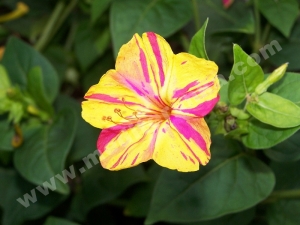
Mirabilis jalapa (The four o'clock flower or marvel of Peru) is the most commonly grown ornamental species of Mirabilis, and is available in a range of colours. Mirabilis in Latin means wonderful. Mirabilis jalapa is said to have been exported from the Peruvian Andes in 1540. A curious aspect of this plant is that flowers of different colors can be found simultaneously on the same plant (see gallery). Additionally, an individual flower can be splashed with different colors. Another interesting point is a color-changing phenomenon. For example, in the yellow variety, as the plant matures, it can display flowers that gradually change to a dark pink color. Similarly white flowers can change to light violet. The flowers usually open from late afternoon onwards, then producing a strong, sweet-smelling fragrance, hence the first of its common names.
M. jalapa hails from tropical South America, but has become naturalised throughout tropical and warm temperate regions. In cooler temperate regions, it will die back with the first frosts, regrowing in the following spring from the tuberous roots. The plant does best in full sun. It grows to approximately 0.9 m in height. The single-seeded fruits are spherical, wrinkled and black upon maturity, having started out greenish-yellow. The plant will self-seed, often spreading rapidly if left unchecked in a garden. Some gardeners recommend that the seeds should be soaked before planting, but this is not totally necessary for this plant.
The flowers are used in food colouring. The leaves may be eaten cooked as well, but only as an emergency food. An edible crimson dye is obtained from the flowers to colour cakes and jellies. In herbal medicine, parts of the plant may be used as a diuretic, purgative, and for vulnerary (wound healing) purposes. The root is believed an aphrodisiac as well as diuretic and purgative. It is used in the treatment of dropsy. The leaves are used to reduce inflammation. A decoction of them (mashing and boiling) is used to treat abscesses. Leaf juice may be used to treat wounds. Powdered, the seed of some varieities is used as a cosmetic and a dye.
Chinese lantern

Chinese lantern (Physalis alkekengi), Bladder cherry, Japanese lantern, or Winter cherry, is easily identifiable by the larger, bright orange to red papery covering over its fruit, which resemble paper lanterns. It is native from southern Europe east across southern Asia to Japan. It is an herbaceous perennial plant growing to 40–60 cm tall, with spirally arranged leaves 6–12 cm long and 4–9 cm broad. The flowers are white, with an inflated basal calyx which matures into the papery orange fruit covering, 4–5 cm long and broad.
Chinese Lantern blooms during winter and dries during spring. Once it is dried, the bright red fruit is seen. It is a popular ornamental plant, though it can be invasive with its wide-spreading root system sending up new shoots some distance from where it was originally planted. In various places around the world, it has escaped cultivation.
It has food and medicinal uses. The dried fruit of Physalis alkekengi is used as a diuretic, antiseptic, liver corrective, and sedative. Like a number of other species in the genus Physalis, it contains a wide variety of physalins. When isolated from the plant, these have antibacterial and leishmanicidal activities in vitro. In Japan, its seeds are used as part of the Bon Festival as offerings to guide the souls of the deceased.
Canna
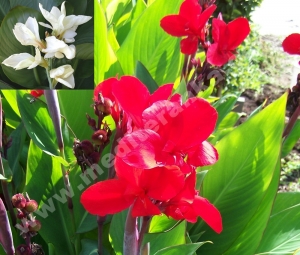
Canna (canna lily) is a genus of nineteen species of flowering plants. Canna is the only genus in the family Cannaceae. The species have large, attractive foliage and horticulturists have turned it into a large-flowered and bright garden plant. Although a plant of the tropics, most cultivars have been developed in temperate climates and are easy to grow in most countries of the world as long as they can enjoy at least 6–8 hours average sunlight during the summer, and are moved to a warm location for the winter. The flowers are typically red, orange, or yellow or any combination of those colours, the wild species often grow to at least 2–3 m in height but there is a wide variation in size among cultivated plants, numerous cultivars have been selected for smaller stature. Cannas grow from swollen underground stems, correctly known as rhizomes, which store starch, and this is the main attraction of the plant to agriculture, having the largest starch particles of all plant life.
Some species and many cultivars are widely grown in the garden in temperate and sub-tropical regions. Sometimes, they are also grown as potted plants. A large number of ornamental cultivars have been developed. Internationally, cannas are one of the most popular garden plants and a large horticultural industry depends on the plant. The rhizome of cannas is rich in starch, and it has many uses in agriculture. All of the plant has commercial value, rhizomes for starch, stems and foliage for animal fodder, young shoots as a vegetable and young seeds as an addition to tortillas. The seeds are used as beads in jewelry. In more remote regions of India, cannas are fermented to produce alcohol. A fibre obtained from the leaves is used for making paper. The leaves are harvested in late summer after the plant has flowered, they are scraped to remove the outer skin and are then soaked in water for 2 hours prior to cooking. The fibres are cooked for 24 hours with lye and then beaten in a blender. They make a light tan brown paper. A purple dye is obtained from the seed and a smoke from the burning leaves is said to be insecticidal. Cannas are used to extract many undesirable pollutants in a wetland environment as they have a high tolerance to contaminants. Cannas grow best in full sun with moderate water in well-drained rich or sandy soil and grow from perennial rhizomes but are frequently grown as annuals in temperate zones for an exotic or tropical look in the garden.
Offer (C. indica):
20 seeds
Pineapple palm

Phoenix canariensis is a species of flowering plant in the palm family Arecaceae, native to the Canary Islands. It is a relative of Phoenix dactylifera, the true date palm. It is the natural symbol of the Canary Islands, together with the canary Serinus canaria. It is a large solitary palm, 10–20 m tall, occasionally growing to 40 m. The leaves are pinnate, 4–6 m long, with 80–100 leaflets on each side of the central rachis. The fruit is an oval, yellow to orange drupe 2 cm long and 1 cm in diameter and containing a single large seed, the fruit pulp is edible but too thin to be worth eating.
The most used common name in English is Canary Island date palm. The common name in Spanish speaking countries and in the Canary Islands is palmera canaria. It is also widely known as the pineapple palm. The Canary Island date palm is very widely planted as an ornamental plant in warm temperate regions of the world, particularly in areas with Mediterranean climates. It can be cultivated where temperatures rarely fall below 10 °C. It is a slowly growing tree, exclusively propagated by seed. The palm is easily recognized through its crown of leaves and trunk characteristics. It is not uncommon to see Canary Island date palms pruned and trimmed to enhance the appearance. When pruned, the bottom of the crown, also called the nut, appears to have a pineapple shape. In the Canary Islands, the sap of this date palm is used to make palm syrup. La Gomera is where most of the sap is produced in the Canary Islands. In some mediterranean and subtropical countries, P. canariensis has proven to be an invasive plant.
Oregon grape

Oregon grape (Mahonia aquifolium) is a species of flowering plant in the family Berberidaceae, native to western North America. It is an evergreen shrub growing to 1 m tall by 1.5 m wide, with pinnate leaves consisting of spiny leaflets, and dense clusters of yellow flowers in early spring, followed by black berries.
The specific epithet aquifolium means "holly-leaved", referring to the spiny foliage. Some authors place Mahonia in the barberry genus, Berberis. The Oregon-grape is not related to true grapes, but gets its name from the purple clusters of berries whose color and slightly dusted appearance are reminiscent of grapes.
Mahonia aquifolium is a native plant on the North American west coast from Southeast Alaska to Northern California. In some areas outside its native range, M. aquifolium has been classified as an invasive exotic species that may displace native vegetation.
M. aquifolium is a popular subject in shady or woodland plantings. It is valued for its striking foliage and flowers, which often appear before those of other shrubs. It is resistant to summer drought, tolerates poor soils, and does not create excessive leaf litter. Its berries attract birds.
The small purplish-black fruits, which are quite tart and contain large seeds, are included in smaller quantities in the traditional diets of Pacific Northwest aboriginal peoples, mixed with Salal or another sweeter fruit. Today they are sometimes used to make jelly, alone or mixed with salal. Oregon grape juice can be fermented to make wine, similar to European barberry wine folk traditions, although it requires an unusually high amount of sugar. Certain extracts from M. aquifolium may be useful in the treatment of inflammatory skin diseases such as eczema and psoriasis, although side effects include rash and a burning sensation when applied.
Indian gooseberry
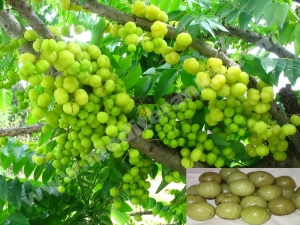
Phyllanthus emblica (Emblica officinalis), the Indian gooseberry, or aamla, is a deciduous tree of the family Phyllanthaceae. It is known for its edible fruit of the same name. The tree is small to medium in size, reaching 8 to 18 m in height, with a crooked trunk and spreading branches, the leaves are simple, subsessile, light green. The flowers are greenish-yellow. The fruit is nearly spherical, light greenish yellow, quite smooth and hard on appearance. Ripening in autumn, the berries are harvested by hand after climbing to upper branches bearing the fruits. The taste of Indian gooseberry is sour, bitter and astringent, and it is quite fibrous. Indian gooseberry has undergone preliminary research, demonstrating in vitro antiviral and antimicrobial properties. There is preliminary evidence in vitro that its extracts induce apoptosis and modify gene expression in osteoclasts involved in rheumatoid arthritis and osteoporosis. It may prove to have potential activity against some cancers.
In traditional Indian medicine, dried and fresh fruits of the plant are used. All parts of the plant are used in various Ayurvedic/Unani medicine (Jawarish amla) herbal preparations, including the fruit, seed, leaves, root, bark and flowers. According to Ayurveda, aamla fruit is sour and astringent in taste, with sweet, bitter and pungent secondary tastes. Its qualities are light and dry, the postdigestive effect is sweet, and its energy is cooling. It may be used as a rasayana (rejuvenative) to promote longevity, and traditionally to enhance digestion, treat constipation, reduce fever, purify the blood, reduce cough, alleviate asthma, strengthen the heart, benefit the eyes, stimulate hair growth, enliven the body, and enhance intellect.
In Ayurvedic polyherbal formulations, Indian gooseberry is a common constituent, and most notably is the primary ingredient in an ancient herbal rasayana called Chyawanprash. This formula, which contains 43 herbal ingredients as well as clarified butter, sesame oil, sugar cane juice, and honey, was first mentioned in the Charaka Samhita as a premier rejuvenative compound. Particularly in South India, the fruit is pickled with salt, oil, and spices. Aamla is eaten raw or cooked into various dishes. Popularly used in inks, shampoos and hair oils, the high tannin content of Indian gooseberry fruit serves as a mordant for fixing dyes in fabrics. Amla shampoos and hair oil are traditionally believed to nourish the hair and scalp and prevent premature grey hair.
Black Bryony
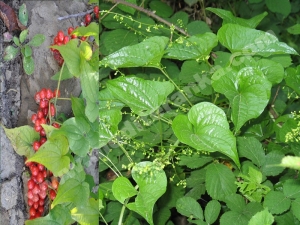
Black Bryony belongs to a family of twining and climbing plants which generally spring from large tubers, some of which are cultivated for food which forms an important article of food in many tropical countries. Tamus communis, from its powerful, acrid and cathartic qualities, ranks as a dangerous irritant poison.
It is a very common plant in woods and hedges, with weak stems twining round anything within reach, and thus ascending or creeping among the trees and bushes to a considerable distance. The leaves are heart-shaped pointed, smooth and generally shining as if they had been varnished. Late in autumn they turn dark purple or bright yellow, making a very showy appearance. In winter, the stems die down, though the root is perennial.
The flowers are small, greenish-white, in loose bunches and of two kinds, barren and fertile on different plants, the latter being succeeded by berries of a red colour when ripe. The large, fleshy root is black on the outside and exceedingly acrid, and, although an old cathartic medicine, is a most dangerous remedy when taken internally. It is like that of the yam, thick and tuberous and abounding in starch, but too acrid to be used as food in any manner.
The Greeks use the young suckers like Asparagus, they eat them boiled with oil and salt, after they have been first soaked in hot water.
T. communis is rubifacient, diuretic. The expressed juice of the fresh root, mixed with a little white wine, has been used as a remedy for gravel, being a powerful diuretic, but it is not given internally now. Death in most painful form is the result of an overdose, while the effect of a small quantity, varying not with the age only, but according to the idiosyncrasies of the patient, leaves little room for determining the limit between safety and destruction. The expressed juice of the root, with honey, has also been used as a remedy for asthmatic complaints, but other remedies that are safer should be preferred. The berries act as an emetic, and children should be cautioned against eating them.
As an external irritant, Black Bryony has, however, been used with advantage, and it was formerly much employed. The scraped pulp was applied as a stimulating plaster, and in gout, rheumatism and paralysis has been found serviceable in many instances.
A tincture made from the root proves a most useful application to unbroken chilblains, and also the fruits, steeped in gin, are used for the same remedy.
Arum italicum
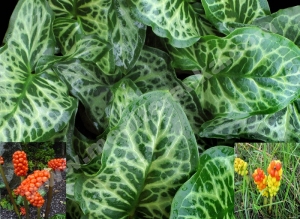
Arum italicum is a species of flowering herbaceous perennial plant in the family Araceae, also known as Italian arum and Italian lords-and-ladies. It grows 30–46 cm high and it blooms in spring with white flowers that turn to showy red fruit. It is cultivated as an ornamental plant for traditional and woodland shade gardens.
The purple spotted leaves of Arum italicum appear in the spring (April–May) followed by the flowers borne on a poker shaped inflorescence called a spadix. The flowers are hidden from sight, clustered at the base of the spadix with a ring of female flowers at the bottom and a ring of male flowers above them.
Above the male flowers is a ring of hairs forming an insect trap. The insects are trapped beneath the ring of hairs and are dusted with pollen by the male flowers before escaping and carrying the pollen to the spadices of other plants, where they pollinate the female flowers.
In autumn the lower ring of female flowers forms a cluster of bright red berries which remain after the spathe and other leaves have withered away.
These attractive red to orange berries are extremely poisonous. The berries contain oxalates of saponins which have needle-shaped crystals which irritate the skin, mouth, tongue, and throat, and result in swelling of throat, difficulty breathing, burning pain, and upset stomach. However, their acrid taste coupled with the almost immediate tingling sensation in the mouth when consumed mean that large amounts are rarely taken and serious harm is unusual.
The root-tube may be very big and is used to store starch. In mature specimens the tuber may be as much as 400 mm below ground level.
All parts of the plant can produce allergic reactions in many people and the plant should be handled with care. Many small rodents appear to find the spadix particularly attractive and it is common to find examples of the plant with much of the spadix eaten away. The spadix produces heat and probably scent as the flowers mature and it may be this that attracts the rodents.
The root of Arum, when roasted well, is edible. It was used like salop or salep (a working class drink popular before the introduction of tea or coffee). It was also used as a substitute for arrowroot. If prepared incorrectly, it can be highly toxic so should be prepared with due diligence and caution.
Jew tree

Taxus baccata, Jew tree is a small- to medium-sized evergreen tree, growing 10–20 metres tall, with a trunk up to 2 metres diameter. The leaves are lanceolate, flat, dark green, 1–4 centimetres long and 2–3 millimetres broad, the leaves are highly poisonous.
The seed cones are highly modified, each cone containing a single seed 4–7 millimetres long. The seeds themselves are extremely poisonous and bitter, but are opened and eaten by some bird species. The aril is not poisonous, and is gelatinous and very sweet tasting.
It is relatively slow growing, and can be very long-lived, with the maximum recorded trunk diameter of 4 metres probably only being reached in about 2,000 years. The potential age of yews is impossible to determine accurately and is subject to much dispute. Taxus baccata is the longest-living plant in Europe. One characteristic contributing to its longevity is that it is able to split under the weight of advanced growth without succumbing to disease in the fracture, as do most other trees.
Most parts of the tree are toxic, except the bright red aril surrounding the seed. The foliage remains toxic even when wilted, and toxicity increases in potency when dried. Ingestion and subsequent excretion by birds whose beaks and digestive systems do not break down the seed's coating are the primary means of yew dispersal.
The major toxin within the yew is the alkaloid taxine. Horses have the lowest tolerance to taxine. Symptoms of yew poisoning include an accelerated heart rate, muscle tremors, convulsions, collapse, difficulty breathing, circulation impairment and eventually heart failure. However, there may be no symptoms, and if poisoning remains undetected death may occur within hours. Fatal poisoning in humans is very rare, usually occurring after consuming yew foliage. The leaves are more toxic than the seed.
In the ancient Celtic world, the yew tree (*eburos) had extraordinary importance, a passage by Caesar narrates that Catuvolcus, chief of the Eburones poisoned himself with yew rather than submit to Rome.
The Christian church commonly found it expedient to take over existing pre-Christian sacred sites for churches. It has also been suggested that yews were planted at religious sites as their long life was suggestive of eternity, or because being toxic they were seen as trees of death. Another suggested explanation is that yews were planted to discourage farmers and drovers from letting animals wander on to the burial grounds, the poisonous foliage being the disincentive. A further possible reason is that fronds and branches of yew were often used as a substitute for palms on Palm Sunday. In the Central Himalayas, the plant is used as a treatment for breast and ovarian cancer.
Honeyberry
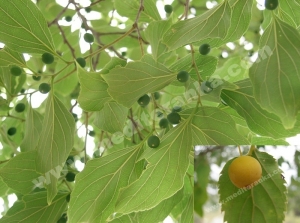
Celtis australis, commonly known as the European nettle tree, Mediterranean hackberry, lote tree, or honeyberry, is a deciduous tree that can grow 20 or 25 meters in height. Leaves are simple, alternate, and sharp-toothed are rough on top, and furry underneath, 5 to 15 cm long and dark grey/green throughout the year fading to a pale yellow before falling in autumn. The flowers are hermaphrodite (have both male and female organs) small and green without petals, either singly or in small clusters. Not effective ornamentally. Fruit is small, dark-purple berry-like drupes, 1 cm wide hang in short clusters and are extremely popular with birds and other wildlife. Smooth, gray bark develops picturesque corky warts and ridges as it matures. The plant prefers light (sandy) and medium (loamy) soils, requires well-drained soil and can grow in nutritionally poor soil. It cannot grow in the shade. It requires dry or moist soil and can tolerate drought. The Mediterranean climate is especially suitable for the plant. This tree is also widely found in the Middle-East. It is often planted as an ornamental as it is resistant to air pollution and long-living.
The fruit of this tree is sweet and edible, and can be eaten raw or cooked. The leaves and fruit are astringent, lenitive and stomachic. Decoction of both leaves and fruit is used in the treatment of amenorrhoea, heavy menstrual and intermenstrual bleeding and colic. The decoction can also be used to astringe the mucous membranes in the treatment of diarrhoea, dysentery and peptic ulcers. A yellow dye is obtained from the bark. Wood is very tough, pliable, durable. Widely used by turners. The flexible thin shoots are used as walking sticks.
The European Nettle, Celtis australis, is supposed to have been the Lotus of the ancients, whose fruit Herodotus, Dioscorides, and Theophrastus describe as sweet, pleasant, and wholesome. Homer has Ulysses refer to the "Lotus-eaters" and the "lotus" in Odyssey.
The leaves of Celtis australis are a rich source of flavonoid C-glycosides. Young leaves of Celtis australis from Northern Italy were found to contain the highest amounts of phenolics per gram dry weight. Amounts rapidly decreased until mid-May and after this date the level of phenolics fluctuated but showed no discernible trend. This general trend of high amounts of phenolics in the early growing season and a fast decline affected both caffeic acid derivatives and flavonoids.