


- You are here:
-
Home

- Krunoslav Tripalo
Products Categories
Your Cart
Currency
Taxi Booking


Krunoslav Tripalo
Turpentine tree
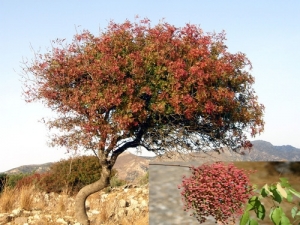
Turpentine tree (Pistacia terebinthus), known commonly as terebinth, is a species of Pistacia, native to the Mediterranean region. In the eastern shores of the Mediterranean sea - Syria, Lebanon and Israel - a similar species, Pistacia palaestina, fills the same ecological niche as this species and is also known as terebinth. It is a species of flowering plant belonging to the family Anacardiaceae. It is a small deciduous tree or large shrub growing to 10 m tall. The leaves are compound, 10–20 cm long. It is a dioecious tree, exists as male and female specimens. For a viable population both genders must be present. The flowers range from purple to green, the fruit is the size of a pea and turns from red to brown, depending on the degree of maturation. The whole plant emits a strong smell - bitter, resinous or medicinal. The species propagates by seeds and shoots. Although marred by the presence of galls, is a very strong and resistant tree which survives in degraded areas where other species have been eliminated.
Pistacia terebinthus is a plant related to Pistacia lentiscus (see my offer - medicinal plants), with which hybridizes frequently in contact zones. Terebinth tree (cornicabra) is more abundant in the mountains and inland, and the P. lentiscus (mastic) is usually found more frequently in areas where the Mediterranean influence of the sea moderates the climate. Mastic tree does not reach the size of the Pistacia terebinthus, but the hybrids are very difficult to distinguish.
It prefers relatively moist areas, up to 600 m in height. Supports Mediterranean summer drought and frost more intense than mastic. Pistacia terebinthus is one of the Anacardiaceae species present in Europe, it is a family of about 600 tropical species. Can be found in meso-and Thermo floors to 1,500 meters above sea level. Pistacia terebinthus is more moisture demanding than the mastic and more resistant to cold. Requires a sunny exposure and average soils, tolerating lime and some salt, often grows near the sea, deep ravines and near salt lakes and streams.
The fruits are used in Cyprus for baking of a specialty village bread. In Crete, where the plant is called tsikoudia, it is used to flavor the local variety of pomace brandy, also called tsikoudia. The plant is rich in tannin and resinous substances and was used for its aromatic and medicinal properties in classical Greece. A mild sweet scented gum can be produced from the bark, and galls often found on the plant are used for tanning leather. Recently an anti-inflammatory triterpene has been extracted from these galls. In Turkey, where it is known as menengiç or bittim, a coffee-like beverage known as menengiç kahvesi is made from the roasted fruit and a soap is made from the oil. Terebinth resin was used as a wine presevative in the ancient Near East.
Osyris alba
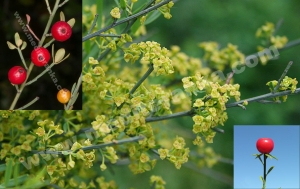
Osyris alba, common name Osyris, is a small perennial plant in the genus Osyris, belonging to the Santalaceae family. Osyris alba is a semi-parasitic (hemiparasitic) broom-like shrub reaching 30–150 centimetres in height. The stem is woody, brown or dark green, sometimes creeping on the ground. This plant has numerous longitudinally striated branches, green when young. The leaves are linear, lanceolate, coriaceous, persistent, although sometimes deciduous. They are about 15–35 millimetres long and 1–5 millimetres wide. They are produced during the winter while in summer they are almost totally absent. The flowers are hermaphroditic or unisexual, in the latter case, the male and female flowers show differences associated with the timing of pollination. They are very small (1 or 2 mm), with four yellow-green tepals and four stamens. Flowering period extends from March and June. The fruits are small red fleshy drupes, 4–6 millimetres in diameter. Their roots form haustoria that tap into the roots of nearby plants and extract their sap. The species is widespread in all countries of the Mediterranean basin, from southern Portugal to Turkey. This xerophilous species lives in arid and semi-desert areas, in sunny areas at altitudes of between 0–1,110 metres above sea level. In favorable climates it can also push up to 1,800 metres.
Dalmatian iris (1000x)
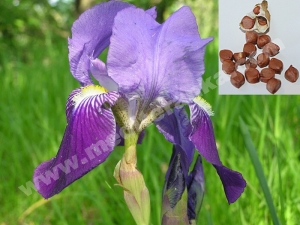
Iris pallida – pseudopallida (Dalmatian iris or Sweet iris) is a hardy flowering perennial plant of the genus Iris, family Iridaceae. It is native to the Dalmatian coast (Croatia) but widely naturalised elsewhere. It is a member of the subgenus iris, meaning that it is a bearded iris, and grows from a rhizome. This iris prefers rocky places in the mediterranean and submediterranean zone and reaches sometimes montane regions at its southern range in Montenegro. It grows to a stem height of 50 to 80 centimeters. The leaves are bluish-green in color, and sword-shaped, 40 to 50 centimeters in length, and 2.5 to 3 centimeters in width. The inflorescence, produced in May/June, is fan-shaped and contains two or three flowers which are often very fragrant and usually pale purplish to whitish. It is cultivated as a garden plant, and commercially for extraction of essential oils from its rhizome (orris root). Three subspecies of Iris pallida are Iris pallida - cengialti (with deep purplish flowers) from Slovenia and adjacent Italy, Iris pallida - illyrica from the North Dalmatian coast, and Iris pallida - pseudopallida from the South Dalmatian coast. Another subspecies is Iris pallida - musulmanica.
Wonder Berry
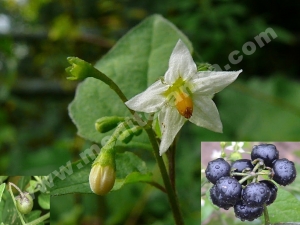
Solanum nigrum (European Black Nightshade or just Black nightshade, Duscle, Garden Nightshade, Hound's Berry, Petty Morel, Wonder Berry, Small-fruited black nightshade or Popolo) is a species in the Solanum genus, native to Eurasia. Parts of this plant can be highly toxic to livestock and humans. Nonetheless, ripe berries and cooked leaves of edible strains are used as food in some locales and plant parts are used as a traditional medicine. Black nightshade is a fairly common herb or short-lived perennial shrub, found in many wooded areas, as well as disturbed habitats. It has a height of 30 to 120 cm, leaves 4 to 7.5 cm long and 2 to 5 cm wide. The flowers have petals greenish to whitish, recurved when aged and surround prominent bright yellow anthers. The berry is mostly 6 to 8 mm, dull black or purple-black. The toxicity of Solanum nigrum varies widely depending on the variety, and poisonous plant experts advise to avoid eating the berries unless they are a known edible strain. Toxin levels may also be affected by the plant's growing conditions.
All parts of the plant can be poisonous, containing toxic glycoalkaloids, including solamargine, solasonine and solanine. The toxins are most concentrated in the unripe green berries, but also occur in ripe berries. Solanine levels in S. nigrum can be extremely toxic and potentially fatal. Poisoning symptoms are typically delayed for 6 to 12 hours after ingestion. Initial symptoms of toxicity include fever, sweating, vomiting, abdominal pain, diarrhea, confusion, and drowsiness. Although numerous texts state that the cooked ripe fruit of black nightshade is safe to eat, detoxification can not be attributed to normal cooking temperatures because the decomposition temperature of solanine is much higher at about 243 C. There are ethnobotanical accounts of S. nigrum leaves and shoots being boiled as a vegetable with the cooking water being discarded and replaced several times to remove toxins. The thoroughly boiled leaves — although strong and slightly bitter flavoured — are used like spinach as horta, in fataya pies and quiches. The ripe black berries are described as sweet and salty, with hints of liquorice and melon.
In India, the berries are casually grown and eaten, but not cultivated for commercial use. In South India, the leaves and berries are routinely consumed as food after cooking with tamarind, onion, and cumin seeds. S. nigrum is an important ingredient in traditional Indian medicines. Infusions are used in dysentery, stomach complaints and fever. The juice of the plant is used on ulcers and other skin diseases. The fruits are used as a tonic, laxative, appetite stimulant and also for treating asthma and "excessive thirst". Traditionally the plant was used to treat tuberculosis. This plant's leaves are used to treat mouth ulcers that happen during winter periods in India. In North India, the boiled extracts of leaves and berries are also used to alleviate liver-related ailments, including jaundice. S. nigrum is a widely used plant in oriental medicine where it is considered to be antitumorigenic, antioxidant, anti-inflammatory, hepatoprotective, diuretic, and antipyretic. Chinese experiments confirm that the plant inhibits growth of cervical carcinoma in mice.
Honeysuckles
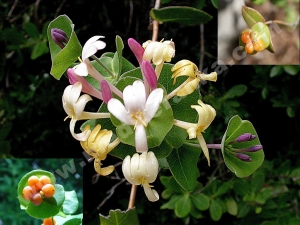
Honeysuckles (genus Lonicera) are arching shrubs or twining vines in the family Caprifoliaceae, native to the Northern Hemisphere. Another name for honeysuckle is woodbine. There are about 180 species of honeysuckle, with by far the greatest diversity in China, where over 100 species occur, by comparison, Europe and North America have only about 20 native species each. Most species of Lonicera are hardy twining climbers, with a large minority of shrubby habit; a handful of species (including Lonicera hildebrandiana from the Himalayan foothills and L. etrusca from the Mediterranean) are tender and can only be grown outside in subtropical zones. The leaves are opposite, simple, and from 1–10 cm long, most are deciduous but some are evergreen. Many of the species have sweetly-scented, tubular flowers that produce a sweet, edible nectar. The fruit is a red, blue or black berry containing several seeds, in most species the berries are mildly poisonous, but a few have edible berries. Honeysuckles are also eaten by children, who remove the blossom by hand to suck at the sweet nectar in the center. Honeysuckles are valued as garden plants, for their ability to cover unsightly walls and outbuildings, their profuse tubular flowers in summer, and the intense fragrance of many varieties. The hardy climbing types need their roots in shade, and their flowering tops in sunlight or very light shade. Varieties need to be chosen with care, as they can become substantial.
During Victorian times, teenage girls were forbidden to bring honeysuckle home because it was thought to induce erotic dreams.
Clematis flammula
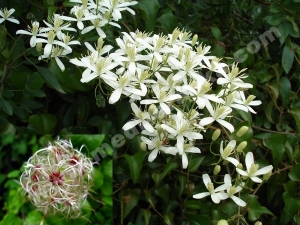
Clematis flammula is a deciduous climber growing to 4 m. It is in leaf in March, in flower from August to October, and the seeds ripen from October to January. The flowers are hermaphrodite (have both male and female organs) and are pollinated by bees, flies. It is suitable for light, medium and heavy soils and prefers well-drained soil. It can grow in semi-shade (light woodland) or no shade. It prefers moist soil. The plant can tolerate strong winds but not maritime exposure. Plants are hardy to about -15°C. The leafstalks wrap themselves around twigs and branches for support. When a side of the stalk touches an object, the growth on that side slows down whilst the other side grows at its normal rate - this causes the leaf stalk to entwine the object it is touching. When planting out, in order to avoid the disease 'clematis wilt', it is best to plant the rootball about 8 cm deeper in the soil. This will also serve to build up a good root crown of growth buds.
A very ornamental plant, the flowers are very fragrant. They have a pronounced smell of meadowsweet, almost too powerful when inhaled close-up. They are produced on the current season's growth and so any pruning of the plant is best carried out in the spring before new growth begins. Plants seem to be immune to the predations of rabbits. This species is notably resistant to honey fungus. Seed - best sown as soon as it is ripe in a cold frame. Sow stored seed as soon as it is obtained in a cold frame. Pre-soak the seed for 12 hours in warm water and remove as much of the tail and outer coat as possible. A period of cold stratification is beneficial. The seed germinates in 1 - 9 months or more at 20°C. Prick out the seedlings into individual pots when they are large enough to handle and grow them on in a cold frame for their first winter. Plant out in late spring or early summer, after the last expected frosts.
Canna Intrigue

Canna Intrigue is from family Cannaceae, other known names are Canna and Canna Lily. It is a tropical-looking perennial with fleshy rhizomes (underground stems). Intrigue canna is exceptionally tall and thin, with a central stalk clasped by large, tapered, upright purplish-gray leaves and topped by orange flowers above the leaves. The flowers open in succession, continue from spring into autumn, and attract hummingbirds. Cut spent stems before they make seeds to encourage the growth of new stems and prolong flowering. In temperate zones, cannas are grown as annuals. Their rhizomes are dug in autumn and brought into a cool, dry garage or basement to overwinter and then planted again in spring after the last frost date. They transplant and divide easily. In milder areas, the rhizomes are hardy in the ground over winter and new leaves emerge in late spring. Cannas are amazingly adaptable, growing on almost any soil. They grow and flower best in full sun and rich, moist to wet soil but can be surprisingly drought tolerant if faced with dry weather. Use Intrigue in containers, waterside gardens, shallow ponds, or as bold focal points in a bed or border. Though tolerant of wet soils and shallow water, it does not tolerate deep standing water.
African lily

Agapanthus africanus (African lily) is a native of the Cape of Good Hope in South Africa. It has a short stem bearing a tuft of long, narrow, arching leaves 10–35 cm long and 1–2 cm broad, and a central flower stalk 25–60 cm tall, ending in an umbel of 20-30 white, or bright blue, funnel-shaped flowers, each flower 2.5–5 cm diameter.
It was introduced to Europe at the close of the 17th century as a handsome greenhouse plant. The plants are easy to cultivate and (in areas that have winter) are generally grown in large pots or tubs that can be protected from frost. During the summer they require plenty of water and are very effective on the margins of lakes or by running streams, where they thrive. They may be propagated from seeds or by dividing the rootstock in early spring or autumn.
Tree of heaven
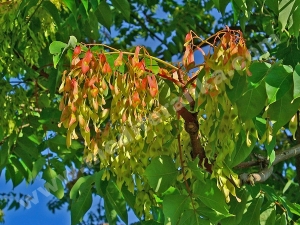
Tree of heaven (Ailanthus altissima), commonly known as ailanthus, or in Standard Chinese as Chouchun is a deciduous tree in the Simaroubaceae family. It is native to both northeast and central China and Taiwan. Unlike other members of the genus Ailanthus, it is found in temperate climates rather than the tropics. The tree grows rapidly and is capable of reaching heights of 15 metres in 25 years. However, the species is also short lived and rarely lives more than 50 years.
In China, the tree of heaven has a long and rich history. It was mentioned in the oldest extant Chinese dictionary and listed in countless Chinese medical texts for its purported ability to cure ailments ranging from mental illness to baldness. The roots, leaves and bark are still used today in traditional Chinese medicine, primarily as an astringent. The tree was first brought from China to Europe in the 1740. All parts of the plant have a distinguishing strong odour that is often likened to peanuts, cashews, or rotting cashews. The flowers are small and appear in large panicles up to 50 cm in length at the end of new shoots. The individual flowers are yellowish green to reddish in colour. The tree prefers moist and loamy soils, but is adaptable to a very wide range of soil conditions. It is drought-hardy, but not tolerant of flooding. It also does not tolerate deep shade. The tree of heaven is found within a wide range of climatic conditions. In its native range it is found at high altitudes in Taiwan as well as lower ones in mainland China. Prolonged cold and snow cover cause dieback, though the trees re-sprout from the roots.
Ailanthus is an opportunistic plant that thrives in full sun and disturbed areas. It spreads aggressively both by seeds and vegetatively by root sprouts, re-sprouting rapidly after being cut. It is considered a shade-intolerant tree and cannot compete in low-light situations, though it is sometimes found competing with hardwoods. The drought-tolerance of the tree is strong due to its ability to effectively store water in its root system. It is frequently found in areas where few trees can survive. The roots are also aggressive enough to cause damage to subterranean sewers and pipes. Along highways it often forms dense thickets in which few other tree species are present, largely due to the toxins it produces to prevent competition. Ailanthus produces an allelopathic chemical called ailanthone, which inhibits the growth of other plants. The inhibitors are strongest in the bark and roots, but are also present in the leaves, wood and seeds of the plant.
Goldenrain tree
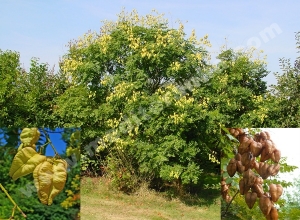
Goldenrain tree (Koelreuteria paniculata) is a species of flowering plant in the family Sapindaceae, native to eastern Asia, in China and Korea. Common names include Pride of India, China tree, or Varnish tree. It is a small to medium-sized deciduous tree growing to 7-10 m tall, with a broad, dome-shaped crown. The leaves are pinnate, 15–40 cm long. The flowers are yellow, growing in large terminal panicles 20–40 cm long. The fruit is a three-parted inflated bladderlike pod 3–6 cm long, green ripening orange to pink in autumn, containing several dark brown to black seeds.
It is popularly grown as an ornamental tree in temperate regions all across the world because of the aesthetic appeal of its flowers, leaves and seed pods. The seeds are edible when roasted, but not commonly consumed.
The leaves turn yellow before falling. The bark is light gray-brown and becomes furrowed with age. Golden rain tree is perhaps most striking in the fall with its large clusters of showy yellow flowers. These are followed by red-purple seed pods, which are equally dramatic! The fruit is a papery three-compartment, bladder-like structure full of seeds. In warm climates seed is produced in great quantities and there are always seedlings beneath a mother tree. The tree is invasive under these conditions. Golden rain tree is best grown in cooler zones where the shorter growing season prevents formation of seed. Golden rain tree is quite adaptable to most soil conditions. It does best in loose, well drained soil with good watering, especially when young. It tolerates drought, alkaline soil, heat, wind, and air pollution. Prune crossing branches as needed during winter when dormant. In cooler zones, use as a free-standing tree where it can be seen in all its glory! It is also good as a small shade tree where space is limited.
Golden rain tree should be used more often as a street and park tree, it is a fast grower that can produce welcome shade and beauty for new homes in quick order. The cheerful, bright yellow flowers are unique and segue into the even more ornamental seed pods.