


- You are here:
-
Home

- Krunoslav Tripalo
Products Categories
Your Cart
Currency
Taxi Booking


Krunoslav Tripalo
Smilax aspera (500x)

Smilax aspera, common name Rough Bindweed or Sarsaparille, is a species of flowering vine in the greenbriar family, Smilacaceae. Smilax aspera is a perennial, evergreen shrub with a flexible and delicate stem, with sharp thorns. The climbing stem is 1–4 metres long. The leaves are 8–10 centimetres long, petiolated, alternate, heart-shaped, with toothed and spiny margins. Also the midrib of the underside of the leaves are provided with spines.
The flowers, very fragrant, are small, yellowish or greenish, gathered in axillary racemes. The flowering period in Mediterranean regions extends from September to November. The fruits are globose berries, gathered in clusters, which ripen in Autumn. They are initially red, later turn black. They have a diameter of 8–10 millimetres and contain one to three tiny and round seeds. Insipid and unpalatable to humans, they are a source of nourishment for many species of birds. It grows in the woods and scrubs, at an altitude of 0–1,200 metres above sea level.
Chamaerops humilis

Chamaerops is a genus of flowering plants in the family Arecaceae (palm family), comprising a single species Chamaerops humilis (European fan palm, Mediterranean dwarf palm or dwarf fan palm), is the only palm species native to continental Europe. It is mainly found in southwestern Europe (Spain, Portugal, France, Italy and Malta) and northwest Africa (Morocco, Algeria, Tunisia).
It is a shrub-like clumping palm, with several stems growing from a single base. The stems grow slowly and often tightly together, eventually reaching 2–5 m tall with a trunk diameter of 20–25 cm. The flowers are borne in dense, short inflorescences at the top of the stems; it is usually (but not invariably) dioecious with male and female flowers on separate plants. Unripe fruits are bright green, turning to dull yellow to brown when ripe during the fall (September–November). The seed (usually 0.6–0.8 g) comprises a small cylindrical embryo, which is surrounded by several layers.
C. humilis is used massively in gardening and landscaping in many parts of the world. In temperate regions it is usually cultivated as a houseplant, though in sheltered areas it will survive short periods below freezing point. It is adapted to a Mediterranean climate with cool, moist winters and summer drought, and can grow on poor and rocky soils. It is one of the hardier palms, tolerating winter frosts down to about -12°C. It will grow even in climates where the summer temperature is in the low 20 C.
The ripe pulp of C. humilis has several intriguing ecological functions. First, when ripened, the pulp smells strongly of rancid butter and thus acts as a foraging cue for nocturnal frugivores. Second, it has a germination inhibitory function, ensuring that the seed does not germinate until has been dispersed. And third, the pulp also acts as a chemical and/or physical barrier against invertebrate seed predators (curculionoid beetles). Because of such pulp multifunctionality, fruit ingestion (and thus pulp removal) by carnivores can have both positive and negative consequences for the palm. On the one hand, seeds ingested by carnivores germinate more frequently than non-ingested seeds. On the other hand, ingested seeds experience higher predation by invertebrates than non-ingested seeds. However, because of the high mobility of carnivores, their dispersal service appears paramount given the severe fragmentation and isolation of most C. humilis populations across the highly humanized Mediterranean basin.
Due to its rusticity and resprouting ability after fire, it has a high ecological value for preventing erosion and desertization. This charismatic palm is thus considered one of the most important species in the natural conformation of the "garrigues" and "macchias" of the Mediterranean coastline.
The leaves of the adult plants have been used in basketweaving to make mats, carrier baskets, and brooms. The young unopened leaves are treated with sulphur to make them softer and supple and are then used for finer work. The husk, known in southern Spain as "higa", is edible before its full development. The fruits are not edible but have been traditionally used in medicine as an astringent because of their bitterness and high tannin content.
Kalanchoe daigremontiana

Kalanchoe daigremontiana (Bryophyllum daigremontianum) also called Mother of Thousands, Alligator Plant, or Mexican Hat Plant is a succulent plant native to Madagascar. This plant is distinguished by its ability to propagate via vegetative propagation. All parts of the plant are poisonous, which can even be fatal if ingested by infants or small pets.
Plants reach up to 1 m tall with opposite, fleshy leaves that reach 15-20 cm long and about 3.2 cm wide. These are medium green above and blotched with purple underneath. The margins of these leaf-like organs have spoon-shaped bulbiliferous spurs that bear young plants.
Furthermore, Kalanchoe daigremontiana can go through a flowering season, where the main stalk elongates vertically upwards by as much as 30 cm, within a couple of days, developing an umbrella-like terminal inflorescence of small bell-shaped pink flowers. Flowering is, however, not an annual event and will occur sporadically if at all. Particularly in climates with distinct seasonal temperature differences, flowering is most frequently observed at the beginning of a warm season. As a succulent plant, K. daigremontiana can survive prolonged periods of drought with little or no water. It is however not frost-hardy and typically dies if subjected to temperatures below freezing. K. daigremontiana is toxic, it contains a cardiac glycoside - daigremontianin.
K. daigremontiana is native to the Fiherenana valley and Androhibolava mountains in southwest Madagascar. It has been introduced to numerous tropical and subtropical regions, such as Florida, Puerto Rico, Hawaii, and parts of the Canary Islands.
Offer:
50 viviparous seeds
Carpobrotus glaucescens

Carpobrotus (Pigface or Ice plants) is a genus of ground-creeping plants, with succulent leaves and large daisy-like flowers. The name refers to the edible fruits. It comes from the Greek "karpos" (fruit) and "brota" (edible).
Carpobrotus juice (from leaves) can be used as a mild astringent. When mixed with water the juice can be used to treat diarrhea, dysentery and stomach cramps. It can also be used as a gargle for sore throat and laryngitis, and mild bacterial infections of the mouth. The leaf juice can also be used externally, much like Aloe Vera for burns, abrasions, open cuts, grazes, mosquito bites and sunburn. It is also used to treat ringworm, eczema, dermatitis, herpes, thrush, cold sores, cracked lips, chafing, skin conditions and allergies. An ancient remedy for constipation is to eat the fruit with brackish water. Syrup made from the fruit is said to have laxative properties. A mixture of leaf juice, honey and olive oil in water is an old remedy for TB.
Offer:
Cutting (10-15 cm)
Myrtus communis
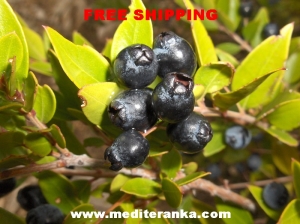
The common myrtle - Myrtus communis, also called true myrtle, is widespread in the Mediterranean region and is commonly cultivated. The other species, Saharan myrtle M. nivellei, is restricted to the Tassili n'Ajjer mountains in southern Algeria and the Tibesti Mountains in Chad, where it occurs in small areas of sparse relict woodland near the centre of the Sahara Desert; it is listed as an endangered species. However, some botanists are not convinced that M. nivellei is sufficiently distinct to be treated as a separate species.
Myrtus (myrtle) is a genus of one or two species of flowering plants in the family Myrtaceae, native to southern Europe and north Africa. The plant is an evergreen shrub or small tree, growing to 5 m tall. The leaf is entire, 3–5 cm long, with a fragrant essential oil. The star-like flower has five petals and sepals, and numerous stamens. Petals usually are white. The fruit is a round berry containing several seeds, most commonly blue-black in colour. The flower is pollinated by insects, and the seeds are dispersed by birds that eat the berries.
Myrtle is cultivated as an ornamental garden shrub, particularly for its numerous flowers in late summer. It may be clipped to form a hedge.
It is used in the islands of Sardinia and Corsica to produce an aromatic liqueur called "Mirto" by macerating it in alcohol. Mirto is known as one of the most typical drinks of Sardinia and comes in two varieties: "Mirto Rosso" (red) produced by macerating the berries, and "Mirto Bianco" (white) produced from the less common yellow berries and sometimes the leaves.
Myrtle occupies a prominent place in the writings of Hippocrates, Pliny, Dioscorides, Galen, and the Arabian writers.
In several countries, particularly in Europe and China, there has been a tradition for prescribing this substance for sinus infections. A systematic review of herbal medicines used for the treatment of rhinosinusitis concluded that the evidence that any herbal medicines are beneficial in the treatment of rhinosinusitis is limited, and that for Myrtus there is insufficient data to verify the significance of clinical results.
Carob tree
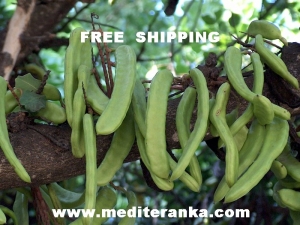
Ceratonia siliqua, commonly known as the Carob tree and St John's-bread, is a species of flowering evergreen shrub or tree in the pea family, Fabaceae. It is widely cultivated for its edible legumes, and as an ornamental tree in gardens. The seed pod may be crushed and used as ersatz chocolate. It is native to the Mediterranean region including Southern Europe.
The Ceratonia siliqua tree grows up to 10 metres tall. The crown is broad and semi-spherical, supported by a thick trunk with brown rough bark and sturdy branches. Leaves are 10 to 20 cm long, alternate, pinnate, and may or may not have a terminal leaflet. It is frost-tolerant.
The trees blossom in autumn (September–October). The flowers are small and numerous, spirally arranged along the inflorescence axis in catkin-like racemes borne on spurs from old wood and even on the trunk (cauliflory), they are pollinated by both wind and insects. Male flowers produce a characteristic odour, resembling semen.
The fruit is a pod that can be elongated, compressed, straight or curved, and thickened at the sutures. The pods take a full year to develop and ripen. The ripe pods eventually fall to the ground and are eaten by various mammals, thereby dispersing the seed. Likewise, carob consumed by humans is actually the dried (and sometimes roasted) pod.
The carob genus, Ceratonia, is believed to be an archaic remnant of a part of this family now generally considered extinct. It grows well in warm temperate and subtropical areas, and tolerates hot and humid coastal areas. As a xerophytic (drought-resistant) species, carob is well adapted to the ecological conditions of the Mediterranean region. Trees prefer well drained loam and are intolerant of waterlogging, but the deep root systems can adapt to a wide variety of soil conditions and are fairly salt-tolerant.
Jujube - Ziziphus
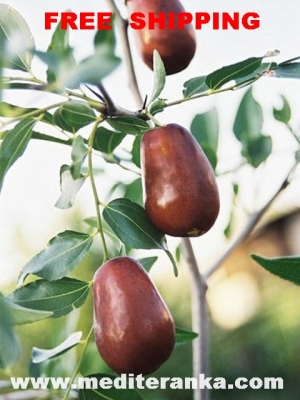
Ziziphus. Yellow flesh is white, sweet pleasant sour taste. Berries are used fresh or dried. Since we do jujube fruit jams, juices and brandy, if you put the fruit in brandy have a special drink. Due to the high content of useful substances and vitamins C, jujube fruit is used for lowering blood pressure and to treat stomach and intestinal discomfort. Leaves, bark and plant mass used in the pharmaceutical industry for the production of various medicines and teas. The Dalmatian is the only name jujube - ćićindra. The tree grows to 4 meters in height, but it like most plants can establish themselves to make it easier picking. Jujube grows in warm regions, and is characterized by high resistance to temperature changes, so summer can withstand more than 40 ° C and drought, and when you reject their branches, and becomes highly resistant to cold, the idle period and withstands temperatures to -25 ° C
The fruit is eaten raw and partially or completely dried. Also, the jujube fruits are made jams, juices and grape-based brandy. The fruit is recommended due to its high content of useful components and vitamin C, blood pressure and to treat stomach and intestinal ailments. The fruits, leaves and bark jujube used in the pharmaceutical industry to produce medicines and teas.
Mallow

Mallow is a perennial with well-developed herbaceous stem that grows over 1 m in height. The plant blooms from May to September. Healing all the parts of plants, roots, leaves and flowers. The drug is primarily harvested leaves from June through mid-September, and flowers during the flowering plants. The leaves are harvested with a short stem and it just completely healthy leaves, which by themselves have no stain. The flowers can be harvested only in dry weather, when fully open. The flowers and leaves are dried in the shade in a very thin layer, the warm and airy place. The root of the plant drain in March, April and October.The healing herb black marshmallow plant, which is appreciated ancient Chinese 5000 years ago as a plant that dissolves phlegm and relieves indigestion. Young leaves in the fresh state contain plenty of vitamin C, carotene, iron and calcium. They can be prepared as a stew like spinach or added to vegetable soups. The flowers used to decorate salads and other dishes. The plant serves the local effect on the skin and mucous membranes and prevent and reduce inflammation in the gastrointestinal tract.
Ivy

Ivy (Hedera), is a genus of 12–15 species of evergreen climbing or ground-creeping woody plants in the family Araliaceae, native to western, central and southern Europe, Macaronesia, northwestern Africa and across central-southern Asia east to Japan and Taiwan.
On level ground they remain creeping, not exceeding 5–20 cm height, but on suitable surfaces for climbing, including trees, natural rock outcrops or man-made structures such as quarry rock faces or built masonry and wooden structures, they can climb to at least 30 m above the ground. Ivies have two leaf types, with palmately lobed juvenile leaves on creeping and climbing stems and unlobed cordate adult leaves on fertile flowering stems exposed to full sun, usually high in the crowns of trees or the tops of rock faces, from 2 m or more above ground. The flowers are greenish-yellow with five small petals, they are produced in umbels in autumn to early winter and are very rich in nectar. The fruit is a greenish-black, dark purple berry 5–10 mm diameter with one to five seeds, ripening in late winter to mid-spring. The seeds are dispersed by birds which eat the berries.
The species differ in detail of the leaf shape and size (particularly of the juvenile leaves) and in the structure of the leaf trichomes, and also in the size and, to a lesser extent, the colour of the flowers and fruit.
Ivies are natives of Euroasia and north Africa but have been introduced to North America where they can be invasive. The speciation of ivies probably began around the Mediterranean Basin.
Ivies are of major ecological importance for their nectar and fruit production, both produced at times of the year when few other nectar or fruit sources are available. The Ivy Bee Colletes hederae is completely dependent on ivy flowers, timing its entire life cycle around ivy flowering. The fruit are eaten by a range of birds. The leaves are eaten by the larvae of some species of Lepidoptera.
Ivies are very popular in cultivation within their native range and compatible climates elsewhere, for their evergreen foliage, attracting wildlife, and for adaptable design uses in narrow planting spaces and on tall or wide walls for aesthetic addition, or to hide unsightly walls, fences and tree stumps.
Spartium junceum

Spartium junceum (Genista juncea), known as Spanish Broom or Weaver's Broom, is a perennial, leguminous shrub native to the Mediterranean region in southern Europe, southwest Asia and northwest Africa, where it is found in sunny sites, usually on dry, sandy soils. It is the sole species in the genus Spartium, but is closely related to the other brooms in the genera Cytisus and Genista.
The plant typically grows to 2 to 4 meters tall, with main stems up to 5 centimeters thick. It has thick, somewhat succulent grey-green rush-like shoots with very sparse small deciduous leaves 1 to 3 centimeters long and up to 4 millimeters broad. The leaves are of little importance to the plant, with much of the photosynthesis occurring in the green shoots (a water-conserving strategy in its dry climate). The leaves fall away early. In late spring and summer shoots are covered in profuse fragrant yellow flowers 1 to 2 centimeters across. In late summer, the legumes (seed pods) mature black and reach up to 8 or 10 centimeters long. They burst open, often with an audible crack, spreading seed from the parent plant.
Spartium junceum has been widely introduced into other areas, and the plant is used as an ornamental plant in gardens and in landscape plantings. In Bolivia and Peru, the plant is known as retama, and has become very well established in some areas. It is one of the most common ornamental plants, often seen growing along sidewalks in La Paz.
The plant is also used as a flavoring, and for its essential oil, known as Genet Absolute. Its fibers have been used for cloth and it produces a yellow dye.