


- You are here:
-
Home

- Krunoslav Tripalo
Products Categories
Your Cart
Currency
Taxi Booking


Krunoslav Tripalo
Evergreen rose
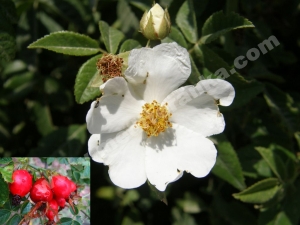
Evergreen rose (Rosa sempervirens) belongs to the family of rose (Rosaceae), a shrub up to 5 meters with climbing branches. Name comes from the Latin semper-virens, the literal translation is ever-green. Light brown to red-brown shiny crust is thin with sparse, curved thorns. The leaves are glossy on both sides, 2-4 cm long and crested peaks. Flowers to 5 cm in diameter, with 5 white petals oval shape with many yellow stamens. It blooms from May to July, to 7 flowers are collected in clusters, or panicles (appearance). The fruit is hanging hip, oval shaped, 2.5 cm long, red and full of seeds (nuts). The largest habitat is on the rocky and warm areas of the Mediterranean region, such as hedges, open oak forests, often close to the shore.
Hips of all kinds of roses contain a lot of vitamin C (one of the richest sources at all) so for a long time it has been used in medicine and cooking. From the hip you can cook tea that is outstanding in the prevention of colds and flu, then make jam, wine, liquor or sauce for grilled meat. Pomegranate (hip) extract is useful in the treatment of kidney stones. The petals contain relatively many essential oils, and are used in aromatherapy and cosmetics industry (rosewater) and candied used to decorate the cakes. The flowers have lots of nectar and pollen, as well as most of the genera and species of this family (cherry and other fruit trees, hawthorn), and it is frequently visited by many species of insects. Importance of Roses in horticulture is not necessary to tell, there are thousands of different varieties and hybrids, obtained from barely a hundred 'wild' types of roses.
Ragged lady
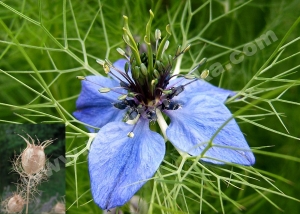
Nigella damascena (love-in-a-mist, ragged lady) is an annual garden flowering plant, belonging to the buttercup family Ranunculaceae. It is native to southern Europe (but adventive in more northern countries of Europe), north Africa and southwest Asia, where it is found on neglected, damp patches of land.
The specific epithet damascena relates to Damascus in Syria. The plant's common name comes from the flower being nestled in a ring of multifid, lacy bracts. It is also sometimes called devil-in-the-bush. It grows to 20–50 cm tall, with pinnately divided, thread-like, alternate leaves. The flowers, blooming in early summer, are blue, but can be white, pink, or pale purple. The fruit is a large and inflated capsule, growing from a compound ovary, and is composed of several united follicles, each containing numerous seeds. This is rather exceptional for a member of the buttercup family. The capsule becomes brown in late summer. The plant self-seeds, growing on the same spot year after year. It is now widely cultivated throughout the temperate world, and numerous cultivars have been developed for garden use.
Jerusalem cherry
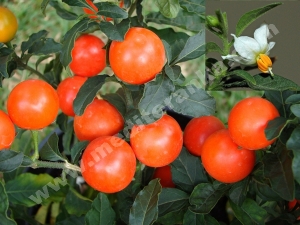
Solanum pseudocapsicum is a nightshade species with poisonous fruit. It is commonly known as the Jerusalem Cherry, Madeira Winter Cherry. These perennials can be grown decoratively as house plants. Native to Peru and Ecuador, they can survive frosts and cold weather. They generally live up to 10 years, producing fruit usually in their second or third year, and every year after that.
They are congeners of tomatoes and the fruit is extremely similar to cherry tomatoes in taste and texture, and are therefore easily confused with them. The Jerusalem Cherry's poison is primarily solanocapsine, which is similar to other alkaloids found in their genus, such as solanine and atropine. Although the toxin is poisonous, it is generally not life-threatening. It may cause gastric problems, including vomiting and gastroenteritis. Jerusalem cherries are also highly poisonous to dogs, cats, and some birds.
Supposedly, the plant described as Solanum capsicastrum and called False Jerusalem Cherry is closely related but distinct species, and the trade name "Winter Cherry" is also held to apply to this exclusively. It is said to be recognizable by more mediocre size, and/or a greyish hue to the foliage and/or stems, and/or fruit that have a pronounced yellow hue when unripe and whose pulp is not or less poisonous (though the seeds still are, making the whole fruit still inedible), and/or higher frost hardiness.
The Common Dogwood

The Common Dogwood (Cornus sanguinea), is a species of dogwood native to most of Europe and western Asia. It is widely grown as an ornamental plant. It is a medium to large deciduous shrub, growing 2–6 metres tall. The leaves are opposite, 4–8 centimetres long, with an ovate shape and an entire margin. The hermaphrodite flowers are small, 5–10 millimetres and insect pollinated. The fruit is a globose black berry 5–8 millimetres diameter, containing a single seed. The berries are sometimes called "dogberries".
It prefers moderate warmth in sunny places, though it can tolerate shade and in the more southern areas of its distribution area grows in the mountains. It requires light, often alkaline soils. The species spreads by seeds and stolons. It is especially abundant in riversides, especially in shady areas and ravines. It grows in the margins of forests or unforested areas as woods in regeneration, prickly woodland fringes, with other thorny shrub species like Clematis vitalba (see my offer). It reproduces by seed and root sprouts, which makes it effective at occupying areas of land and forming dense groves. The leaves provide food for some animals. Dogberries are eaten by some mammals and many birds. Many frugivorous passerines find them irresistible, and prefer them over fruits grown by humans. The plant is thus often grown in organic gardening and permaculture to prevent harm to orchard crops, while benefitting from the fact that even frugivorous birds will hunt pest insects during the breeding season, as their young require much protein to grow. The straight woody shoots produced by the plant can be used as prods, skewers or arrows.
Rosy periwinkle
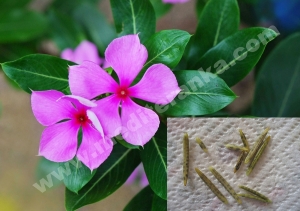
Catharanthus roseus, commonly known as the Madagascar periwinkle, is a species of Catharanthus native and endemic to Madagascar. Other English names occasionally used include Cape periwinkle, rose periwinkle, rosy periwinkle, and "old-maid". It is an evergreen subshrub or herbaceous plant growing to 1 m tall. The leaves are oval to oblong, 2.5–9 cm long, glossy green, hairless. The flowers are white to dark pink with a darker red centre, with five petal-like lobes. The fruit is a pair of follicles 2–4 cm long. In the wild, it is an endangered plant, the main cause of decline is habitat destruction by slash and burn agriculture. It is also however widely cultivated and is naturalised in subtropical and tropical areas of the world. The species has long been cultivated for herbal medicine and as an ornamental plant.
In Ayurveda (Indian traditional medicine) the extracts of its roots and shoots, though poisonous, is used against several diseases. In traditional Chinese medicine, extracts from it have been used against numerous diseases, including diabetes, malaria, and Hodgkin's lymphoma. The substances vinblastine and vincristine extracted from the plant are used in the treatment of leukemia. It can be dangerous if consumed orally. It can be extremely toxic. As an ornamental plant, it is appreciated for its hardiness in dry and nutritionally deficient conditions, popular in subtropical gardens where temperatures never fall below 5 °C to 7 °C, and as a warm-season bedding plant in temperate gardens. It is noted for its long flowering period, throughout the year in tropical conditions, and from spring to late autumn, in warm temperate climates. Full sun and well-drained soil are preferred.
Rose of Sharon

Hibiscus syriacus is a species of flowering plant in the family Malvaceae, native to much of Asia. Common names include Rose of Sharon (especially in North America), Rose mallow (United Kingdom) and St Joseph's rod (Italy).
H. syriacus is a hardy deciduous shrub. It is upright and vase-shaped, reaching 2–4 m height, bearing large trumpet-shaped dark pink flowers with prominent yellow-tipped white stamens. Individual flowers are short-lived, lasting only a day. However, numerous buds are produced on the shrub's new growth, which provides prolific flowering over a long summer blooming period. Shoots make interesting indoor vase cuttings, as they stay green for a long time. In the vase some new flowers may open from the more mature buds. The species has naturalized very well in many suburban areas, and might even be termed slightly invasive, so frequently does it seed around.
Hibiscus syriacus has been a garden shrub in Korea since time immemorial, its leaves were brewed for a tisane and its flowers are eaten. It was grown in Europe from the 16th century. Though it has no autumn color and can be stiff and ungainly if badly pruned, H. syriacus remains a popular ornamental shrub today, with many cultivars. Cultivars of H. syriacus are widely planted in areas with hot summers for their very attractive white, pink, red, lavender, or purple large and edible flowers.
Hibiscus syriacus is fairly easily propagated from either seeds, with variable results (color), or by layering or cuttings, cloning the original.
Hibiscus s. is the national flower of South Korea. The flower appears in national emblems, and Korea is compared poetically to the flower in the South Korean national anthem. The flower's symbolic significance stems from the Korean word mugung, which means "eternity".
Bolivian rainbow
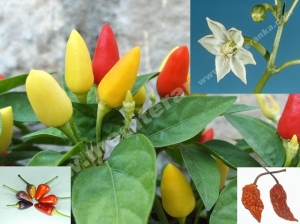
Bolivian rainbow - Capsicum annuum is a domesticated species of the plant genus Capsicum native to southern North America and northern South America. This species is the most common and extensively cultivated of the five domesticated capsicums. The species encompasses a wide variety of shapes and sizes of peppers, both mild and hot, ranging from bell peppers to chili peppers.
Although the species name annuum means “annual” (from the Latin annus = “year”), the plant is not an annual and in the absence of winter frosts can survive several seasons and grow into a large perennial shrub. The single flowers are an off-white (sometimes purplish) color while the stem is densely branched and up to 60 centimetres tall. The fruit is a berry and may be green, yellow or red when ripe. While the species can tolerate most climates, C. annuum is especially productive in warm and dry climates. The species is a source of popular sweet peppers and hot chilis with numerous varieties cultivated all around the world. Sweet peppers are very often used as a bulking agent in ready-made meals and take-away food, because they are cheap, have a strong flavour, and are colorful. The colorful aspect of peppers increases the visual appeal of the food, making it more appetizing. Foods containing peppers, especially chili peppers, often have a strong aftertaste due to the presence of capsinoids in peppers. Capsaicin, a chemical found in chili peppers, creates a burning sensation once ingested, which can last for several hours after ingestion. Hot peppers are used in medicine as well as food in Africa and other places around the world. Some cultivars grown specifically for their aesthetic value like Black Pearl and the Bolivian Rainbow. Ornamental varieties tend to have unusually coloured fruit and foliage with colors such as black and purple being notable. All are edible, and most (like Royal Black and Bolivian rainbow) are hot.
Offer:
20 seeds
Soldier thistle
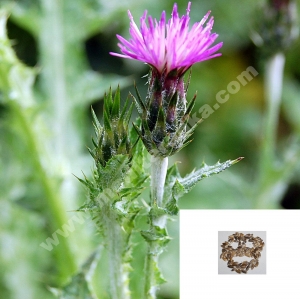
Soldier thistle (Picnomon acarna), from family Asteraceae, is an erect annual plant (not a grass) growing to 1 m high. Yellow-green in appearance due to numerous yellow spines on the leaves. Stems of soldier thistle are ranched with spiny wings and dense white hairs. They are woolly in appearance. Soldier thistle leaves are covered with fine white hairs and yellow spines, 1-1.5 cm long. White hairs on the leaves give them a woolly appearance. Rosette leaves grow to 30 cm long, S. thistle has pink or purple flower heads, growing 2-4 cm long and can be solitary or in groups at the end of branches. Flowers are formed in late spring from September to November with the plant flowering in early summer.
The seeds of Soldier thistle are smooth and shiny with a detachable parachute of bristles on one end about 4-6 mm long. Seed germinates mainly in autumn, but has been seen to germinate after sufficient summer rainfall in disturbed areas. Wind is the main method of dispersal for this weed. Seeds can disperse over short distances and whole plants can also be blown around after breaking off at the base. Seeds can also be carried on animals, vehicles, machinery and in water. P. acarna grows rapidly in spring, particularly on heavy red-brown soil and spreads fast in degraded areas with little competition. A small percentage of seeds can remain viable in the soil for several years. Plants may appear on recently cultivated areas where there has been no seeding for several years.
Saffron thistle
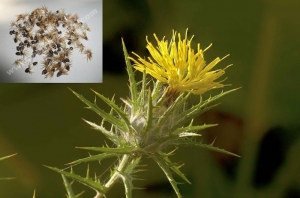
Carthamus lanatus is a species of thistle known as woolly distaff thistle or saffron thistle. It is closely related to safflower, which is in the same genus. This annual plant is a native of the Mediterranean Basin, but it is familiar in other places where it was introduced. This is a spiny, glandular, woolly plant, which often looks like it is covered in spiderweb due to its fine tangled fibers. It has a pale stem which may reach a meter in height, and rigid, pointed, very spiny leaves. The flower head has many long, sharp phyllaries that can be up to several centimeters long. The disc florets are bright yellow. The fruit is an achene about half a centimeter long with many rigid pappus scales.
Seed germination is stimulated by red light. This means that germination is most likely in areas with little vegetation or pasture cover. Seeds also require specific temperature cues and water, which means that most seeds germinate in Autumn. Many C. lanatus seeds are dormant (will not germinate, even in ideal conditions). In pastures, good pasture cover in Autumn will reduce germination, suggesting that pastures should be managed to reduce grazing pressure over summer increase the cover from summer-growing perennial grasses. Population models suggest that strategic grazing may be one of the most effective long-term control option for infested pastures.
Asphodeline lutea
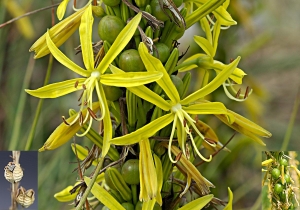
Asphodeline lutea is a perennial growing to 1 m by 1 m. It is in flower from Jun to July, and the seeds ripen from July to September. The flowers are sweetly scented. Plants seem to be immune to the predations of rabbits. The flowers are hermaphrodite (have both male and female organs) and are pollinated by insects. It can grow in semi-shade (light woodland) or no shade. The plant can tolerate maritime exposure.
Root - roasted - this food was highly valued by the ancient Greeks, who roasted the roots like potatoes and ate them with salt and oil or mashed them with figs. The roots are not very thick but are abundantly produced and have a nice nutty flavour. They can be harvested at any time of the year, but are best used when the plant is dormant in late summer and early autumn. They do not store well and should be used within a few weeks of harvest.
Young shoots – cooked, smell less than pleasant whilst cooking but have a fairly bland flavour. Some people find that they have a very pleasant flavour. The plant comes into growth in late summer and the autumn, the young shoots can be harvested in moderation all through the winter.
Flowers – raw have a delightful sweetness, they are a very decorative and tasty addition to the salad bowl but should be used as soon as possible after harvesting because they soon start to decompose. The flowers are very short-lived and are best picked in the late afternoon - thus you can enjoy them visually during the day and gastronomically in the evening.
A. lutea is very ornamental plant, though it looks very untidy in late summer when it dies down after flowering.
Seed - sow March/April in a greenhouse and only just cover the seed. Germination usually takes place in 1 - 3 months at 15°C. Once the seedlings are large enough to handle, prick them out into individual pots and grow them on in the greenhouse for their first winter. Plant them out into their permanent positions in late spring. Division in spring or autumn, with care since the roots are easily damaged. Ensure each division has at least one growing bud. Large divisions can be planted out straight into their permanent positions, smaller ones are best potted up until they are growing away strongly and can then be panted out.