


- You are here:
-
Home

- Krunoslav Tripalo
Products Categories
Your Cart
Currency
Taxi Booking


Krunoslav Tripalo
Strelitzia nicolai

Strelitzia nicolai, commonly known as the Giant White Bird of Paradise or Wild Banana are banana-like plants with erect woody stems reaching a height of 6 m and the clumps formed can spread as far as 3.5 m. The 1.8 m long leaves are grey-green and arranged like a fan at the top of the stems, similar to Ravenala madagascariensis. The inflorescence is composed of a dark blue bract, white sepals and a bluish-purple "tongue". The entire flower can be as much as 18 cm high by 45 cm long and is typically held just above the point where the leaf fan emerges from the stem. Flowers are followed by triangular seed capsules.
The plant prefers rich, moist soils with good drainage in full sun to part shade. The plant tolerates light frost.
Propagation is via division of clumps, offsets and from seed but note that plants require many years of growth before they begin blooming. In favourable conditions they self-seed freely, and their invasive root systems are best kept away from buildings.
Picture a crown of banana-like leaves atop a palm tree trunk, combine with huge, uniquely beautiful flowers, and then what you have is the exotically named bird of paradise tree. Related to the bird of paradise flower (Strelitzia reginae), this close cousin is a much larger plant forming huge clumps of stems to 30 feet in comparison to S. regina's 3 to 4 feet height.
All members of the family Strelitziaceae are native to sub-tropical South Africa. The bird of paradise tree is becoming very popular both as a subject for use in near frost-free landscapes and as a subject for interiorscapes. Plant in sheltered spot as high winds will shred leaves resulting in scruffy looking plants.
This is an easy to grow, very non-messy, low maintenance plant that is a good choice for use near pool and patio. Plants are inexpensive, available in a range of sizes, and grow rather quickly and so are a great choice for new home landscapes in warm areas. Bird of paradise tree is just the ticket when you want tough, durable beauty and unique form in a large plant.
Christmas holly

Christmas holly (Ilex aquifolium), other names are holly, common holly, English holly, European holly, or occasionally Christmas holly), is a species of holly native to western and southern Europe, northwest Africa, and southwest Asia. I. aquifolium is the species familiar in Christmas decoration, and is regarded as the type species of the genus Ilex, which by association is also called "holly". It has a great capacity to adapt to different conditions and is a pioneer species that repopulates the margins of forests or clearcuts.
It is slow growing and it does not usually fully mature due to grazing, cutting, or fire. It can live 500 years, but usually does not reach 100. Holly is an evergreen tree growing to 10–25 m tall with a woody stem as large as 40–80 cm, rarely 1 m or more, in diameter. The leaves are 5–12 cm long and 2–6 cm broad; they are evergreen, lasting about five years.
Holly is dioecious, meaning that there are male plants and female plants. The sex cannot be determined until the plants begin flowering, usually between 4 and 12 years of age. In male specimens, the flowers are yellowish and appear in axillary groups. In the female, flowers are isolated or in groups of three and are small and white or slightly pink. The flowers are attractive as nectar sources for insects such as bees, wasps, flies, and small butterflies.
The fruit is a red drupe, about 6–10 mm in diameter, a bright red or bright yellow, which matures around October or November; at this time they are very bitter due to the ilicin content and so are rarely eaten until late winter after frost has made them softer and more palatable. They are eaten by rodents, birds and larger herbivores.
During the Cenozoic Era, the Mediterranean region, Europe, and northwest Africa had a wetter climate and were largely covered by laurel forests. Holly was a typical representative species of this biome, where many current species of the genus Ilex were present. With the drying of the Mediterranean Basin during the Pliocene, the laurel forests gradually retreated, replaced by more drought-tolerant sclerophyll plant communities. The modern Ilex aquifolium resulted from this change. Most of the last remaining laurel forests around the Mediterranean are believed to have died out approximately 10,000 years ago at the end of the Pleistocene.
Colutea arborescens

Colutea arborescens is a genus of about 25 species of deciduous flowering shrubs in the legume family Fabaceae, growing from 2–5 m tall, native to southern Europe – Mediterannean area, north Africa and southwest Asia. The leaves are pinnate and light green to glaucous grey-green. The flowers are yellow to orange, pea-shaped and produced in racemes throughout the summer. These are followed by the attractive inflated seed pods which change from pale green to red or copper in colour, now is grown mostly for its attractive seed pods., used in dried arrangements.
Colutea arborescens will grow in poor sandy soils in preference to heavy or loamy soils. It is easy to propagate from seed. It is generally pest resistant, though garden snails will climb up the plant in wet weather to eat the leaves. Colutea species are used as food plants by the larvae of some Lepidoptera species including Coleophora colutella.
Colutea arborescens is a species of leguminous shrub known by the common name bladder senna. It is known on other continents where it is grown as an ornamental and used in landscaping for erosion control. It is also known in the wild as an occasionally weedy escapee from cultivation. The inflorescence is a raceme of generally pea-like yellow flowers about 3 centimeters long. The fruit is an inflated bladdery pod which dries to a papery texture. It is 2 to 3 centimeters long and contains many seeds.
Opuntia humifusa
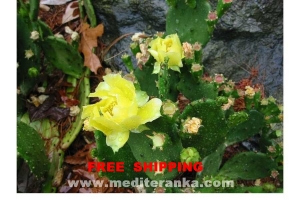
Opuntia humifusa, commonly known as the Eastern Prickly Pear or Indian Fig, is a native cactus found in most of eastern North America. It ranges from Montana eastward to southern Ontario and then on to Massachusetts, south to Florida and westward to New Mexico.
The flowers are yellow to gold in color and are found along the margins of mature segments. The flowers are waxy and sometimes have red centers. They measure 4-6 cm wide and bloom in the late spring. The juicy and edible red egg shaped fruits called tunas measure from 5.1-7.6 cm. Fruits of the prickly pear are very popular everywhere except the United States. In fact, annual worldwide commercial production of prickly pear tunas is more than twice that of strawberries, avocados, or apricots! The pads, called nopales, are a popular vegetable in Mexico and Central America. They are usually cooked but can be eaten raw.
As the fruit matures, it changes colour from green to red, it tastes a little like watermelon and green beans and often remains on the cactus until the following spring. There are 6 to 33 small, flat, light-colored seeds in each fruit.
This plant is very intolerant of shade. It thrives in full sun and well-drained soil.
Asparagus densiflorus - Sprengeri

Asparagus densiflorus is an extremely versatile perennial, evergreen plant that can be used as a groundcover or container plant in full sun or light shade. Asparagus densiflorus is a scrambling, slightly woody plant with upright or trailing branches up to 1 m long. The best known forms belong to the so-called emerald ferns of the Asparagus densiflorus 'Sprengeri' group. These plants form large cushions with long, arching stems more or less densely covered with dark green, needle-like leaves. The plants of this group can be used as groundcovers in shade as well as in full sun.
A. densiflorus flowers are small, most often white or pale pink and are very sweetly scented. The small flowers are followed by showy bright red berries, which each have one large black seed in them. The berries are attractive to birds and may be spread by them.
Asparagus densiflorus grows in the Mediterranean areas, from coastal dunes to open rocky places or woods. It is hardy to -7°C (20°F).
The genus name of Asparagus is thought to be derived from the Greek Asparagos for the cultivated asparagus and is possibly derived from 'a-'- intensive and sparassa - to tear, referring to the sharp spines of many species. The species name of densiflorus refers to the way the small flowers are densely packed along the stem of the plant. They are now grown all over the world and have proved hardy, drought tolerant and even fairly salt tolerant plants which can be used as garden plants or for cut foliage. There are about 69 species in southern Africa, possibly 30 to 40 in tropical Africa and also some in Asia. They are widespread and common but are not often collected because of the short flowering period and the presence of the spines.
The plants have extensive root systems with fairly large tubers, which are used in nature to provide food during long periods of drought in summer. They can be readily propagated by separating the tubers in fairly large clumps, or by sowing the seed in spring or early summer. The seed should be removed from the fleshy berries, placed in a suitable sowing medium in a warm spot or with bottom heating of about 25°C and kept moist.
Pistacia lentiscus
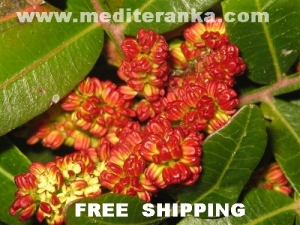
Pistacia lentiscus is a shrub or tree dioecious, with separate male and female plants, evergreen from 1 to 5 m high, with a strong smell of resin, which grows in the dry and rocky areas in Mediterranean Europe. from Morocco and Iberian peninsula in the west through southern France and Turkey to Iraq and Iran in the east. It is also native to the Canary Islands. The word mastic derives either from the Greek verb mastichein ("to gnash the teeth", origin of the English word masticate) or massein ("to chew").
It resists heavy frosts and grows on all types of soils and can grow well in limestone areas and even salty or saline, this makes it more abundant near the sea. It is also found in woodlands, dehesas (almost deforested pasture areas), kermes oak wood, oaks wood, garrigue, maquis, hills, gorges, canyons and rocky hillsides of the entire Mediterranean area. It is a very typical species that grows in Mediterranean mixed communities of myrtle, Kermes oak, Mediterranean dwarf Palm, buckthorn, sarsaparilla, etc. and serves as protection and food for birds and other fauna in this ecosystem. It is a very hardy pioneer species dispersed by birds and abundant in dry Mediterranean. In appropriate areas, when allowed to grow freely and age, it often becomes a tree of up to 7 m. However, logging, grazing and fires often prevent its development. It has been introduced as an ornamental shrub in Mexico, where it has naturalized and is often seen primarily in suburban and semi-arid areas where summer rainfall climate contrary to the Mediterranean, where the species originates, doesn't hurt it.
The resin is collected by bleeding the trees from small cuts made in the bark of the main branches, and allowing the sap to drip onto the specially prepared ground below. The harvesting is done during the summer months between June and September. Mastic resin is a relatively expensive kind of spice that has been used principally as a chewing gum for at least 2,400 years. The flavour can be described as a strong, slightly smoky, resiny aroma and can be an acquired taste.
Some scholars identify the bakha mentioned in the Bible - as in the Valley of Baca of Psalm 84 - with the mastic plant. The word bakha appears to be derived from the Hebrew word for crying or weeping, and is thought to refer to the "tears" of resin secreted by the mastic plant, along with a sad weeping noise which occurs when the plant is walked on and branches are broken.
Mastic is known to have been popular in Roman times when children chewed it, and in Medieval times it was highly prized for the Sultan's harem both as a breath freshener and for cosmetics. It was the Sultan's privilege to chew mastic, and it was considered to have healing properties. The spice's use was widened when Chios became part of the Ottoman Empire, and it remains popular in North Africa and the Near East.
As a spice, it continues to be used in Greece to flavour spirits and liquors (such as Chios's native drinks of Mastichato and mastica), chewing gum, and a number of cakes, pastries, spoon sweets, and desserts. Sometimes it is even used in making cheese. Mastic resin is a key ingredient in Dondurma (Turkish ice cream) and Turkish puddings, giving those confections their unusual texture and bright whiteness. In Lebanon and Egypt the spice is used to flavour many dishes, ranging from soups to meats to desserts, while in Morocco smoke from the resin is used to flavour water. In Turkey mastic is used as a flavor of Turkish delight. Recently, a mastic flavoured fizzy drink has also been launched, called "Mast".
Mastic resin is also chewed as a gum to soothe the stomach. People in the Mediterranean region have used mastic as a medicine for gastrointestinal ailments for several thousand years. The first century Greek physician and botanist, Dioscorides, wrote about the medicinal properties of mastic in his classic treatise De Materia Medica ("About Medical Substances"). Some centuries later Markellos Empeirikos and Pavlos Eginitis also noticed the effect of mastic on the digestive system.
Mimosa pudica (touch-me-not)

Mimosa pudica (from Latin: pudica "shy, bashful or shrinking", also called sensitive plant and the touch-me-not), is a creeping annual or perennial herb often grown for its curiosity value: the compound leaves fold inward and droop when touched or shaken, re-opening minutes later. The species is native to South America and Central America, but is now a pantropical weed.
The stem is erect in young plants, but becomes creeping or trailing with age. The stem is slender, branching, and sparsely to densely prickly, growing to a length of 1.5 m. The leaves of the mimosa pudica are compound leaves. The leaves are bipinnately compound, with one or two pinnae pairs, and 10-26 leaflets per pinna. Pink or purple flower heads arise from the leaf axils in mid summer with more and more flowers as the plant gets older. The globose to ovoid heads are 8–10 mm in diameter (excluding the stamens). The fruit consists of clusters of 2-8 pods from 1–2 cm long each, these prickly on the margins. The pods break into 2-5 segments and contain pale brown seeds some 2.5 mm long. The flowers are pollinated by the wind and insects. The seeds have hard seed coats which restrict germination.
Like a number of other plant species, it undergoes changes in leaf orientation termed "sleep" or nyctinastic movement. The foliage closes during darkness and reopens in light.
The leaves also close under various other stimuli, such as touching, warming, blowing, or shaking. These types of movements have been termed seismonastic movements. When the plant is disturbed, specific regions on the stems are stimulated to release chemicals including potassium ions which force water out of the cell vacuoles and the water diffuses out of the cells, producing a loss of cell pressure and cell collapse; this differential turgidity between different regions of cells results in the closing of the leaflets and the collapse of the leaf petiole. This characteristic is quite common within the Mimosoideae subfamily of the legume family, Fabaceae. The stimulus can also be transmitted to neighboring leaves. It is not known exactly why Mimosa pudica evolved this trait, but many scientists think that the plant uses its ability to shrink as a defense from predators. Animals may be afraid of a fast moving plant and would rather eat a less active one. Another possible explanation is that the sudden movement dislodges harmful insects.
Spanish gold

Sesbania punicea (Spanish gold, rattlebox) is an ornamental shrub that produces reddish orange flowers, has deciduous leaves and grows to 15 feet high. This plant has a high demand for water, and thrives in swamps or high-moisture areas. It also requires a mildly acidic soil.
This species is native to Brazil and a few other South American countries such as Argentina, Paraguay and Uruguay. It has spread to parts of Africa, other parts of South America, and many coastal southern United States. Due to its high demand for water this species is often found at marshy shorelines. It also forms dense thickets and thrives in disturbed areas.
The flowers begin to appear in the late spring and persist until the autumn. In the United States the blooming period for this species is between june and september, whereas in South Africa they are blooming between november and january.
When the pods/fruits dry out they are distributed close to the base of the parent plant when found inland. Commonly these plants are found near waterways due to the effective seed dispersal technique via moving water. The seeds of this plant have impermeable seed coats, which allows the survival of the seeds when dispersed via waterways. This impermeable quality of the seed coat has been formally studied by L. Bevilacqua who has found that callose is the compound causing this characteristic. These seeds require scarification before they are able to germinate. It is certain that seed dispersal is not performed via animals due to the plants toxic characteristics. This species is known to be shade tolerant, allowing seedling growth under shady conditions. Once seedlings have grown for three months, they can potentially produce flowers and seeds. Although, flowering most commonly occurs once the seedlings become 2 years of age. This plant is capable of surviving freezing conditions, but not for prolonged periods of time.
The flowers are shaped like pea flowers, between 2–3 cm long and are commonly a red-orange or red-purple color.
The fruits are large pea pods compartmentalized into four, and appear as if they have shrunk slightly due to drying. These fruits are dehiscent and dry out as they become mature. Each fruit can contain between 5-10 seeds, which are only dispersed when the pod dries out and opens up. The amount of pods found on a single plant depends on age and growing conditions of the plant. On average a single plant can produce between 100-300 pods. When the pods first emerge on the plants and are not yet fully mature they are a yellow or green color. As the season progresses these pods become a darker green color, eventually becoming a dismal brown . These seedpods often stay on the plant far into the winter, and the seeds inside create a distinct rattling sound when they are shaken by the wind, giving the plant its common name of “rattlebox”. These plants are seen to have an ornamental value due to the beautiful red flowers the plant produces. When purchasing this plant for ornamental purposes you can choose to buy either seeds or seedlings grown to varying heights.
Magnolia grandiflora
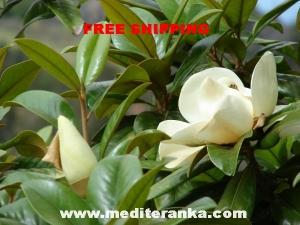
Magnolia grandiflora is a large evergreen tree which will grow 30 meters tall and 1.8 meters in trunk diameter. Alternate, simple leaves, each 10-20 cm long, oval-oblong tapering at both ends. Stiff, leathery, shiny-green above and rusty-tomentose beneath. Covered with rust colored hairs when young, but become smooth and stay rusty with age. Each 17.5 to 20 cm across with 6 to 12 petals which are creamy white. Each flower is on a stout hairy stalk. They are very fragrant and appear in late spring and early summer.
Fruit is cylindrical cone 7.5-10 cm long, purplish, turning rusty-brown with bright red, shiny seeds hanging from filamentous threads when mature in September and October. Gray to brown coloring, smooth when young but becomes lightly furrowed into close, flat plates or scales. Bark is fragrant and bitter.
The seeds of Magnolia grandiflora are consumed by many species of birds and small mammals. The leathery green leaves and beautiful flowers are used in decorating and floral arrangements. Although beautiful, the Magnolia grandiflora is a high maintenance tree because it drops foilage throughout the year. The wood is limited in its uses but may be made into furniture, paneling, veneer, creates, and cabinets.
The genus Magnolia was named by Linnaeus in honor of Pierre Magnol, who was the physician of King Louis XIV of France and was the director of a botanical garden at Montpellier. Magnolia grandiflora is relatively common and is native in North America. It occurs from North Carolina to Florida to Texas. Although its native range is along the Coastal Plain, it can be seen as an ornamental tree throughout much of the Southeast, inland as far as the foothills of the Appalachian mountains. Flowers bloom from april to june, but in general the trees do not begin blooming until their seventh year, once their growth rate has decreased. Fruits mature in october to november and produce scarlett seeds.
According to geologists, magnolia trees have been on earth for 80 to 100 million years. The ancestors of the magnolias were growing in the time of the dinosaurs. The magnolia is a very primitive type of flower because all the floral parts are spirally arranged. In the center of the magnolia blossom, numberous pistils spiral about a cone shaped receptacle, and below them a great many stamens are similarly arranged. The pistils mature into a tight cluster of fruits and each individual fruit splits along one side. This releases 1 to 2 fleshy, scarlett-coated seeds which dangle on slender threads. This morphology is what leads geologists and botanists to the conclusion that magnolias are an ancient tree.
Acacia dealbata - Mimosa
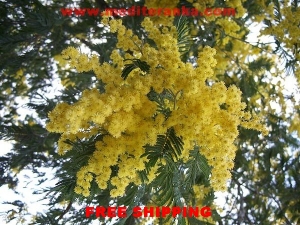
Acacia dealbata - mimosa is a fast growing evergreen tree or shrub growing up to 30 m tall, typically a pioneer species after fire. The leaves are bipinnate, glaucous blue-green to silvery grey, 1–12 cm (occasionally to 17 cm) long and 1–11 cm broad, with 6–30 pairs of pinnae, each pinna divided into 10–68 pairs of leaflets; the leaflets are 0.7–6 mm long and 0.4–1 mm broad. The flowers are produced in large racemose inflorescences made up of numerous smaller globose bright yellow flowerheads of 13–42 individual flowers. Trees generally do not live longer than 30 to 40 years, after which in the wild they are succeeded by other species where bushfires are excluded. In moist mountain areas, a white lichen can almost cover the bark, which may contribute to the descriptor "silver".
Acacia dealbata is widely cultivated as an ornamental plant in warm temperate regions of the world, and is naturalised in some areas, including southwestern Western Australia, southeastern South Australia, Norfolk Island, the Mediterranean region, California, south-western China and Chile It does not survive prolonged frost.
The timber is useful for furniture and indoor work, but has limited uses, mainly in craft furniture and turning. It has a honey colour, often with distinctive figures like birdseye and tiger stripes. It has a medium weight (540–720 kg/m3), and is similar to blackwood.
The flowers and tip shoots are harvested for use as cut flowers, when it is known by florist trade as "mimosa". In Italy, Albania, Russia and Georgia the flowers are also frequently given to women on International Women's Day. The essence of the flowers, called 'cassie' or 'opopanax', is used in perfumes. The leaves are sometimes used in Indian chutney.