


- You are here:
-
Home

- Krunoslav Tripalo
Products Categories
Your Cart
Currency
Taxi Booking


Krunoslav Tripalo
Rosa canina
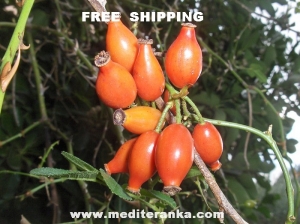
Rosa canina (commonly known as the dog rose) is a variable climbing wild rose species native to Europe, northwest Africa and western Asia. It is a deciduous shrub normally ranging in height from 1–5 m, though sometimes it can scramble higher into the crowns of taller trees. Its stems are covered with small, sharp, hooked prickles, which aid it in climbing. The leaves are pinnate, with 5-7 leaflets. The flowers are usually pale pink, but can vary between a deep pink and white. They are 4–6 cm diameter with five petals, and mature into an oval 1.5–2 cm red-orange fruit, or hip.
The plant is high in certain antioxidants. The fruit is noted for its high vitamin C level and is used to make syrup, tea and marmalade. It has been grown or encouraged in the wild for the production of vitamin C, from its fruit, especially during conditions of scarcity or during wartime. During World War II in the United States Rosa canina was planted in victory gardens, and can still be found growing throughout the United States, including roadsides, and in wet, sandy areas up and down coastlines. Forms of this plant are sometimes used as stocks for the grafting or budding of cultivated varieties. The wild plant is planted as a nurse or cover crop, or stabilising plant in land reclamation and specialised landscaping schemes. The hips are used as a flavouring in Cockta, a soft drink made in Slovenia. However it also known that it was used in the eighteenth and nineteenth centuries to treat the bite of rabid dogs, hence the name "dog rose" may result from this.
Pyracantha coccinea
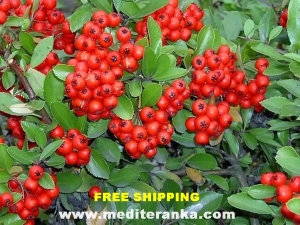
Pyracantha coccinea is medium-sized to large-sized ornamental shrub, species form matures at about 15' tall by 15' wide, but cultivars are usually smaller, and most shrubs are frequently pruned to smaller dimensions anyway. Upright oval growth habit in youth, becoming open, straggly, and spreading with age. Pyracantha prefers moist, well-drained soils in full sun, but is very urban tolerant and adaptable to poor soils, compacted soils, soils of various pH, heat, drought, and heavy pruning, propagated by seeds or rooted stem cuttings.
Best time to prune vigorously growing specimens or espaliers is either right after bloom (to set up flower buds and fruits for the following year) or in autumn or early spring - to gain firm control with heavy pruning, and fore go flowering and fruiting for an entire year.
Foliage is dark green, broadleaf evergreen to semi-evergreen, and becoming unattractively bronzed in Winter, sometimes "burning" in exposed areas and turning dead-brown.
Flowers are white, somewhat malodorous, in late May to early June, as flat-topped to slightly curving 2" to 3" diameter inflorescences, derived from floral buds on the previous year's spur shoots.
Fruits are orange, orange-red, or yellow, depending upon cultivar. In the raw state are not for human consumption but can be processed into jams, syrups, jelly and compote (as hawthornes). Heaviest ornamental fruiting occurs on unpruned shrubs of scab-resistant cultivars sited in full sun, and can be quite outstanding in early Autumn when contrasted against the dark green foliage. Maturing in September as pendulous clusters from the numerous spur shoots, and usually persistent only into late Autumn, before abscission or being eaten by wildlife.
Wisteria sinensis
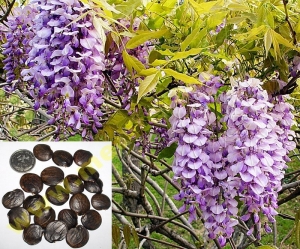
Wisteria, in Croatia known as blue rain is very hardy and fast-growing. It can grow in fairly poor-quality soils, but prefers fertile, moist, well-drained soil. They thrive in full sun. Wisteria can be propagated via hardwood cutting, softwood cuttings, or seed.
Wisteria can grow into a mound when unsupported, but is at its best when allowed to clamber up a tree, pergola, wall, or other supporting structure. Whatever the case, the support must be very sturdy, because mature Wisteria can become immensely strong with heavy wrist-thick trunks and stems. These will certainly rend latticework, crush thin wooden posts, and can even strangle large trees. Wisteria allowed to grow on houses can cause damage to gutters, downspouts, and similar structures. Its pendulous racemes are best viewed from below.
Wisteria flowers develop in buds near the base of the previous year's growth, so pruning back side shoots to the basal few buds in early spring can enhance the visibility of the flowers. If it is desired to control the size of the plant, the side shoots can be shortened to between 20 and 40 cm long in mid summer, and back to 10 to 20 cm in the fall. The flowers of some varieties are edible, and can even be used to make wine.
Sharp cedar
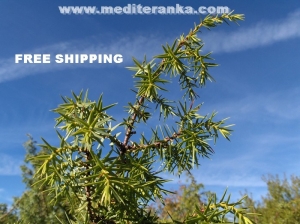
Sharp cedar (Juniperus oxycedrus) - Prickly Juniper, Prickly Cedar, Cade Juniper, is a species of juniper, native across the Mediterranean region growing on a variety of rocky sites from sea level up to 1600 m altitude. The specific epithet oxycedrus means "sharp cedar" and this species may have been the original cedar or cedrus of the ancient Greeks.
The Juniperus oxycedrus tree is very variable in shape, forming a spreading shrub 2–3 m tall to a small erect tree 10–15 m tall. It has needle-like leaves in whorls of three, the leaves are green, 5–20 mm long and 1–2 mm broad, with a double white stomatal band on the inner surface. It is usually dioecious, with separate male and female plants. The seed cones are berry-like, green ripening in 18 months to orange-red with a variable pink waxy coating, they are spherical, 7–12 mm diameter. The seeds are dispersed when birds eat the cones, digesting the fleshy scales and passing the hard seeds in their droppings.
The seed requires a period of cold stratification. The seed has a hard seedcoat and can be very slow to germinate, requiring a cold period followed by a warm period and then another cold spell, each of 2 - 3 months duration. Soaking the seed for 3 - 6 seconds in boiling water may speed up the germination process. The seedlings can be potted up into individual pots when they are large enough to handle. Grow on in pots until large enough, then plant out in early summer. When stored dry, the seed can remain viable for several years.
The people use Juniperus to treat many diseases, for internal use as a diuretic, colds, coughs, gonorrhea, asthma, the stomach, sweating, and for outdoor use in strong brandy for bandages and rubbing against hypothermia, rheumatism and similar diseases. Klekovača is a very well-known aromatic brandy. Is used as a home remedy and disinfectant. Bath salts enriched with essential oils of juniperus helps tension and stress, improves circulation, reduces pain in joints and muscles, wound healing, sweaty feet.
Samphire

Samphire or rock samphire, Crithmum maritimum, is the sole species of the genus Crithmum. It is an edible wild plant found on southern and western coasts of Britain and Ireland, on mediterranean area and western coasts of Europe including the Canary Islands, North Africa and the Black Sea. The term samphire is used for several unrelated species of coastal plant.
Crithmum maritimum is a perennial growing to 0.3 m by 0.3 m.
It is in flower from Jun to August, and the seeds ripen from Aug to October. The flowers are hermaphrodite (have both male and female organs) and are pollinated by insects.
Prefers a moist light sandy or gravelly soil, doing very well between stones or by a south-east facing wall. Requires a warm dry well-drained sunny position. Plants are best grown in moist salty soil. When grown away from the coast, this plant requires a warm sheltered position and some protection in cold winters.
Edible Uses:
The stems, leaves and seed pods may be pickled in hot, salted, spiced vinegar, or the leaves used fresh in salads.
Leaves - raw or cooked. Vaguely reminiscent of fennel, but the taste is more bitter and brackish. The leaves are used as a flavouring in salads. Gathered in spring, the young leaves when sprinkled with salt and boiled make a very good pickle. The leaves are rich in vitamin C. Seed pods are used to make a warm aromatic pickle.
Rock samphire is little used in herbal medicine, though it is a good diuretic and holds out potential as a treatment for obesity. It has a high vitamin C and mineral content and is thought to relieve flatulence and to act as a digestive remedy. The young growing tips are carminative, depurative, digestive and diuretic. The leaves have the reputation for helping people lose weight and so are used in treating cases of obesity as well kidney complaints. The essential oil is a digestive, a few drops being sprinkled on the food.
An essential oil from the plant is used in perfumery.
Prefers a moist light sandy or gravelly soil, doing very well between stones or by a south-east facing wall. Requires a warm dry well-drained sunny position. Plants are best grown in moist salty soil. When grown away from the coast, this plant requires a warm sheltered position and some protection in cold winters.
Offer:
50 seeds
Ribwort
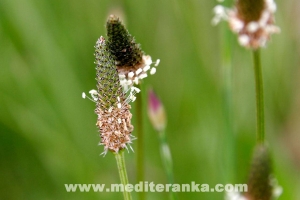
Ribwort (Plantago lanceolata) is a species of genus Plantago known by the common names ribwort plantain, English plantain, buckhorn plantain, narrowleaf plantain, ribleaf, blackjack, costa canina, snake plantain, soldier's herb and lamb's tongue. It is a common weed of cultivated land.
P. lanceolata is used frequently in tisanes and other herbal remedies. A tea from the leaves is used as a highly effective cough medicine.
Ribwort is used for:
coagulates blood , rids the blood of toxins, diuretic, diarrhea, gastritis, kidneys, asthma, bronchitis, coughs and disorders of the respiratory system.
Locust - acacia
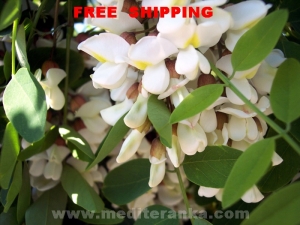
Locust (Robinia pseudoacacia L.) is a deciduous tree species belonging to the family of legumes. It originates from the southeastern part of the U.S., but it has spread to North America, Europe and Asia. In some areas it is considered an invasive species. In private forests of continental Croatia is one of the most widespread tree species. Likes sandy soil. Foresters use it in plantations for protection from erosion.
It grows to heights of 25 m, and thickness up to 90 cm. Older bark is longitudinally furrowed trunk. Bract scales are converted into strong spines, about 2 cm long, mostly flat and woody. List comprises 9-25 elliptical, less hairy leaves 3-5 cm long. The flowers are white and fragrant, in clusters 20 cm long. Blooms in May, after leafing. Pods up to 10 cm long and bare, has 4 to 10 seeds. Optimum maturity is achieved around 30 years of age. Wood is yellow-brown in color and hard, great for firewood, burning slowly, with barely visible smoke and achieves high temperature combustion. Wood is great for making different items. That was doing in his youth, and Abraham Lincoln. Because flavonoids, locust tree can survive 100 years underground.
Acacia honey is extremely bright yellow color, mild flavor and pleasant aroma, light and tasty, it is recommended for children and reconvalescents. Because of their properties is one of the most valued type of honey. Helps with insomnia, calms over stimulated nervous system and eliminates effects of accumulated stress. Months remains in a liquid state and crystallizes very slowly, in part because it contains more fructose than glucose. The bees overwinter well and successfully, if they are provided in winter acacia honey. Recommended to take tea with chamomile, because it enhances the activity of honey and tea. It is also advisable to take at night before bedtime. Strong and abundant acacia bash for bees found in almost all regions of mainland Croatian which was once planted or spread naturally as a very adaptable plant.
All parts of Locust are poisonous, except flowers. Bark is particularly toxic. It is especially toxic to horses. If the horse eats parts of trees, after an hour, he develops the symptoms of diarrhea, weakness, cardiac arrhythmias, of abdominal pain and depression. We urgently need to call the vet.
Blackberry

The blackberry is an edible fruit produced by Rubus fruticosus in the Rosaceae family. Blackberries are perennial plants which typically bear biennial stems ("canes") from the perennial root system. The flowers are produced in late spring and early summer on short racemes on the tips of the flowering laterals. Each flower is about 2–3 cm in diameter with five white or pale pink petals. The drupelets only develop around ovules that are fertilized by the male gamete from a pollen grain. The most likely cause of undeveloped ovules is inadequate pollinator visits. Even a small change in conditions, such as a rainy day or a day too hot for bees to work after early morning, can reduce the number of bee visits to the flower, thus reducing the quality of the fruit. Incomplete drupelet development can also be a symptom of exhausted reserves in the plant's roots, or infection with a virus such as Raspberry bushy dwarf virus. In botanical terminology, the fruit is not a berry, but an aggregate fruit of numerous drupelets.
Blackberry leaves are food for certain caterpillars: some grazing mammals, especially deer, are also very fond of the leaves. When mature, the berries are eaten and their seeds dispersed by several mammals, such as the red fox and the Eurasian badger, as well as by small birds.
As there is forensic evidence from the Iron Age Haraldskar Woman that she consumed blackberries some 2500 years ago, it is reasonable to conclude that blackberries have been eaten by humans over thousands of years. The soft fruit is popular for use in desserts, jams, seedless jelly and sometimes wine. It is often mixed with apples for pies and crumbles. Black berries are also used to produce candy.
Blackberries have a high abundance of healthy antioxidants and nutrients such as anthocyanins, salicylic acid, ellagic acid, and fiber. Anthocyanins are antioxidants found in blackberries that are responsible for giving blackberries their rich and dark color.
Blackberries contain a compound called salicylic acid. This compound found in blackberries has been used for centuries for its medicinal qualities. Salicylic acid has been proven to numb bodily pains and treat unusually high body temperature, or fevers. Salicylic acid may have similar properties to aspirin that aid in protecting the body against heart disease.
Arguably, the most beneficial property of the blackberry is its profusion of ellagic acid. Ellagic acid is a phytochemical, meaning it is only found in certain plants. In experimental studies, ellagic acid is used to treat tumors in mice; the result being ellagic acid is reliable for causing the death of particular cancer cells. Researchers believe that ellagic acid may also work to reduce the harmful effects of estrogen that create breast cancer cells.
Blackberries are notable for their high nutritional contents of dietary fiber, vitamin C, vitamin K, folic acid (a B vitamin), and the essential mineral manganese.
Blackberries contain numerous large seeds that are not always preferred by consumers. The seeds contain some oil which is rich in omega-3 (alpha-linolenic acid) and -6 fats (linoleic acid), as well as some protein, dietary fiber, carotenoids, ellagitannins and ellagic acid.
Blackberry production in Mexico has expanded enormously in the past decade. While once based on the cultivar 'Brazos', an old erect blackberry cultivar developed in Texas in 1959, the Mexican industry is now dominated by the Brazilian 'Tupi' released in the 1990s. 'Tupi' has the erect blackberry 'Comanche' and a "wild Uruguayan blackberry" as parents. Since there are no native blackberries in Uruguay, the suspicion is that the widely grown 'Boysenberry' is the male parent. In order to produce these blackberries in regions of Mexico where there is no winter chilling to stimulate flower bud development, chemical defoliation and application of growth regulators are used to bring the plants into bloom.
Judas tree

Cercis siliquastrum, commonly known as Judas Tree, is a small deciduous tree from Southern Europe and Western Asia which is noted for its prolific display of deep-pink flowers in spring. This species forms a small tree up to 12 metres in height and 10 metres in width.
The deep pink flowers are produced on year-old or older growth, including the trunk in late spring. The leaves appear shortly after the first flowers emerge. These are heart-shaped with a blunt apex, which occasionally has a shallow notch at the tip. The tree produces long flat pods that hang vertically. The flowers are edible and purportedly have a sweet-acid taste.
The species is native to Western Asia and Southern Europe - Mediterranean region.
The flowers are pollinated by bees, attracted by nectar. Pollen from the protuding stamens is deposited on the bee's body and carried to another flower's stigma. The species prefers deep, well-drained soils and a position in full sun or partial shade. Propagation is by seed or cuttings.
This tree produce hard wood with an attractive grain. It is used in veneers and polishes well.
There is a longstanding myth that Judas Iscariot hanged himself from a tree of this species. This belief is related to the common name "Judas Tree" which is possibly a corrupted derivation from the French common name, Arbre de Judée meaning tree of Judea, referring to a region where the tree occurs.
Virginia creeper (1000x)
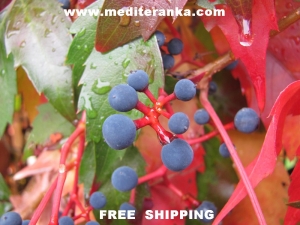
Virginia creeper, five-leaved ivy, or five-finger (Parthenocissus quinquefolia) is a woody vine native to Mediterranean area, eastern and central North America, in southeastern Canada, the eastern and central United States, eastern Mexico, and Guatemala, west as far as Manitoba, South Dakota, Utah and Texas. Parthenocissus quinquefolia is also known as woodbine although woodbine can refer to other plant species.
It is a prolific climber, reaching heights of 20 to 30 m in the wild. It climbs smooth surfaces using small forked tendrils tipped with small strongly adhesive pads 5 mm in size. The leaves are palmately compound, composed of five leaflets (rarely three leaflets, particularly on younger vines) joined from a central point on the leafstalk, and range from 3 to 20 cm (rarely 30 cm) across. The leaflets have a toothed margin. The species is often confused with Parthenocissus vitacea, which has the same leaves, but does not have the adhesive pads at the end of its tendrils.
The flowers are small and greenish, produced in clusters in late spring, and mature in late summer or early fall into small hard purplish-black berries 5 to 7 mm diameter. These berries contain oxalic acid, which is only moderately toxic to humans and other mammals. The berries provide an important winter food source for birds.
The leaf structure of Virginia creeper is superficially similar to that of Cannabis sativa, with the effect that persons familiar with only the plants leaf structures and not with their stem structures (which are markedly different) often mistake Virginia creeper for "ditch weed" (wild marijuana).
Virginia creeper is grown as an ornamental plant, because of its deep red to burgundy fall foliage. It is frequently seen covering telephone poles or trees. The creeper may kill vegetation if it covers by shading its support and thus limiting the supporting plants' ability to photosynthesize.
Virginia creeper can be used as a shading vine for buildings on masonry walls. Because the vine, like its relative Boston ivy, adheres to the surface by disks rather than penetrating roots, it will not harm the masonry but will keep a building cooler by shading the wall surface during the summer, saving money on air conditioning.
Native Americans used the plant as an herbal remedy for diarrhea, difficult urination, swelling, and lockjaw.
In Canada garden centres sell a small leaf variety called "Engelmann's Ivy" that is said to adhere to walls better.