


- You are here:
-
Home

- Krunoslav Tripalo
Products Categories
Your Cart
Currency
Taxi Booking


Krunoslav Tripalo
Tilia platyphyllos
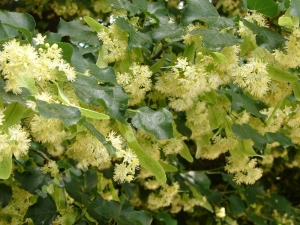
Tilia platyphyllos is a species of flowering plant in the family Malvaceae. It is a deciduous tree, native to much of Europe. The specific epithet platyphyllos means "with broad leaves".
T. platyphyllos is a narrowly domed tree with a moderate growth rate, and can eventually attain a height of 40 m. The reddish-brown young stems later develop dark grey bark with fine fissures and furrows. The branches spread upwards at wide angles. The twigs are reddish-green and slightly pubescent. The foliage consists of simple, alternately arranged leaves. The small, fragrant, yellowish-white flowers are arranged in drooping, cymose clusters in groups of 3 to 4. The geniculate peduncles are between 1.5–3 cm long. The flowers are hermaphroditid and pollinated by bees. The fruit is a small, round, tomentose, cream-colored nutlet with a diameter of 1 cm or less. T. platyphyllos is widely planted throughout the temperate world as an ornamental tree in parks and city streets.
T. platyphyllos is used medicinally and somewhat interchangeably. The dried flowers are mildly sweet and sticky, and the fruit is somewhat sweet and mucilaginous. Linden tea has a pleasing taste, due to the aromatic volatile oil found in the flowers. The flowers, leaves, wood, and charcoal (obtained from the wood) are used for medicinal purposes. Active ingredients in the linden flowers include flavonoids (which act as antioxidants), volatile oils, and mucilaginous constituents (which soothe and reduce inflammation). The plant also contains tannins that can act as an astringent. Linden flowers are used in colds, cough, fever, infections, inflammation, high blood pressure, headache (particularly migraine), as a diuretic (increases urine production), antispasmodic (reduces smooth muscle spasm along the digestive tract), and sedative. The flowers were added to baths to quell hysteria, and steeped as a tea to relieve anxiety-related indigestion, irregular heartbeat, and vomiting. The leaves are used to promote sweating to reduce fevers. The wood is used for liver and gallbladder disorders and cellulitis. That wood burned to charcoal is ingested to treat intestinal disorders and used topically to treat edema or infection, such as cellulitis or ulcers of the lower leg.
European elder

European elder, Sambucus nigra is a species complex of flowering plants in the family Adoxaceae, native to most of Europe. Common names include elder, elderberry, black elder, European elderberry and European black elderberry, it grows in a variety of conditions including both wet and dry fertile soils, primarily in sunny locations.
It is a deciduous shrub or small tree growing to 6 m tall and wide (rarely 10m tall). The bark, light grey when young, changes to a coarse grey outer bark with lengthwise furrowing. The leaves are arranged in opposite pairs, 10–30 cm long, pinnate with five to seven leaflets, the leaflets 5–12 cm long.
The hermaphrodite flowers are borne in large, flat corymbs 10–25 cm diameter in mid summer, the individual flowers ivory white, 5–6 mm diameter, they are pollinated by flies.
The fruit is a glossy dark purple to black berry 3–5 mm diameter, produced in drooping clusters in late autumn, they are an important food for many fruit-eating birds, notably blackcaps.
The dark blue/purple berries can be eaten when fully ripe but are mildly poisonous in their unripe state. All green parts of the plant are poisonous, containing cyanogenic glycosides. The berries are edible after cooking and can be used to make jam, jelly, chutney and Pontack sauce.
The flowerheads are commonly used in infusions, giving a very common refreshing drink in Northern Europe and Balkans. Commercially these are sold as elderflower cordial, etc. In Europe, the flowers are made into a syrup or cordial (in Romanian: Socată, in Swedish: fläder(blom)saft), which is diluted with water before drinking. The popularity of this traditional drink has recently encouraged some commercial soft drink producers to introduce elderflower-flavoured drinks (Fanta Shokata, Freaky Fläder). The flowers can also be dipped into a light batter and then fried to make elderflower fritters. In Scandinavia and Germany, soup made from the elder berry (the German Fliederbeersuppe) is a traditional meal.
Both flowers and berries can be made into elderberry wine, and in Hungary an elderberry brandy is made that requires 50 kg of fruit to produce 1 litre of brandy. In south-western Sweden, it is traditional to make a snaps liqueur flavoured with elderflower. Elderflowers are also used in liqueurs such as St. Germain and a mildly alcoholic sparkling elderflower 'champagne'.
This plant is traditionally used as a medicinal plant by many native peoples and herbalists alike. Stembark, leaves, flowers, fruits, and root extracts are used to treat bronchitis, cough, upper respiratory cold infections, fever. In a placebo-controlled, double-blind study, black elderberry (Sambucus nigra) was shown to be effective for treating Influenza B. People using the elderberry extract recovered much faster than those only on a placebo.
A small study published in 2004 showed that 93% of flu patients given extract were completely symptom-free within two days, those taking a placebo recovered in about six days. This current study shows that it works for type A flu. Elderberry flowers are sold in Ukrainian and Russian drugstores for relief of congestion, specifically as an expectorant to relieve dry cough and make it productive. The dried flowers are simmered for 15 minutes, the resulting flavorful and aromatic tea is poured through a coffee filter. The flowers can be used to make an herbal tea as a remedy for inflammation caused by colds and fever.
Trumpet vine
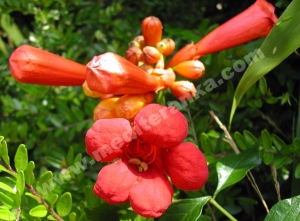
Campsis radicans (trumpet creeper, also known as cow itch vine or hummingbird vine), is a large and vigorous deciduous woody perennial vine of the family Bignoniaceae, alternate scientific names have included Tournefort's Bignonia radicans and Tecoma radicans.
It is notable for its showy trumpet-shaped flowers. It is native to woodlands and riverbanks of the southeastern United States, but is a popular garden subject especially in Mediterranean area. Some cultivars are hardy to as low as -34 °C. The leaves are opposite, ovate, pinnate, 3–10 cm long, and emerald green when new, maturing into a dark green. The flowers come in terminal cymes of 4–12, orange to red in color with a yellowish throat, and generally appear after several months of warm weather. It grows to 3–10 m. The flowers are very attractive to hummingbirds, and many types of birds like to nest in the dense foliage. The flowers are followed by large seed pods. As these mature, they dry and split. Hundreds of thin, brown, paper-like seeds are released. These are easily grown when stratified.
The vigor of the trumpet vine should not be underestimated. In warm weather, it puts out huge numbers of tendrils that grab onto every available surface, and eventually expand into heavy woody stems several centimeters in diameter. It grows well on arbors, fences, telephone poles, and trees, although it may dismember them in the process. Ruthless pruning is recommended. Outside of its native range this species has the potential to be highly invasive.
50 seeds
Rock rose

Cistus salviifolius, common name Sage-leaved Rock Rose or Salvia Cistus, is a perennial ligneous plant of Cistaceae family. The genus name Cistus derives from the Greek words (kisthos) meaning basket, while the species name salviifolius refers the wrinkled leaves similar to those of the sage.
Cistus salviifolius has spreading stems covered by clumpy hairs. This bushy shrub reaches on average 30–60 centimetres in height, with a maximum of 100 centimetres. The oval-shaped green leaves are 1 to 4 centimeters long.
This plant is pollinated by insects entomophily, especially bees. The flowering period extends from April through May. The fruit is a pentagonal capsule, 5–7 mm long and the seeds ripen in August.
Suitable for: light (sandy) and medium (loamy) soils, prefers well-drained soil and can grow in nutritionally poor soil. It cannot grow in the shade. The plant can tolerate maritime exposure.
The dried leaves are used as an adulterant for marjoram (Origanum majorana)
Requires a sunny position in a dry or moist well-drained light sandy soil. Plants are hardy to about -12°C. Dislikes pruning or root disturbance. Plants should be pot grown and then planted out in their final positions whilst still small.
Seed - gather when ripe and store dry. Surface sow in late winter in a greenhouse. The seed usually germinates in 1 - 4 weeks at 20°C. Prick out the seedlings as soon as they are large enough to handle into individual pots. Grow them on in the greenhouse for their first winter and plant them out the in the following spring or early summer, after the last expected frosts. The seed stores for at least 3 years. Cuttings of softish to half-ripe wood, 8cm long with a heel or at a node, June/August in a frame. Roots are formed within 3 weeks. Lift and pot up in the spring, plant out when a good root system has formed.
Coronilla emeroides
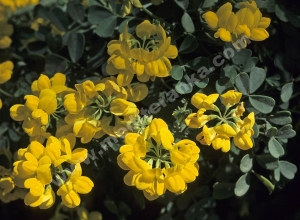
Coronilla emeroides is a bushy fully hardy perennial deciduous shrub with yellow flowers in late Spring, early Summer, late Winter and mid Summer. It grows well in direct sun, and prefers medium levels of water. The flowers are papilionaceous shaped. This shrub has all year round interest.
This is a rounded shrub has an ultimate height of 2 m and spread of 2 m, it can take 6-10 years to reach its ultimate height. The leaves are green in Spring and Summer and green in Autumn. The plant prefers a sheltered situation. Arbor or trellis, borders, coastal/seaside suitable, cottage informal garden, flowering shrub, gravel, rock garden and wall side.
This plant has a lignified stem with green branches bearing five to nine leaflets. The flowers are pale yellow, 14–20 millimetres long, arranged in groups of 1 to 5. Their legumes (seed pods) are oblong-cylindrical and 5–11 centimetres long, with three to twelve segments.
Seed - scarify and then pre-soak the seed for 1 - 2 hours in warm water. A period of cold stratification is also said to be helpful. Sow the seed in spring in a greenhouse. Germination usually takes place in 4 - 6 weeks at 15°c. Pot up the seedlings as soon as possible into individual pots and plant them out in the following spring.
Cuttings of nearly mature side shoots, firm at the base and 7 - 10 cm long with a heel, October/November in a frame. Plants are well rooted after 12 months. Good percentage.
Succeeds in a sunny position in most well-drained soils, preferring a moderately rich loamy soil.
An easily grown plant, it is hardy to about -20°C if it is sheltered from cold winds. Plants can be pruned almost back to the base if required, they usually resprout freely. The flowers are sweetly scented. This species has a symbiotic relationship with certain soil bacteria, these bacteria form nodules on the roots and fix atmospheric nitrogen. Some of this nitrogen is utilized by the growing plant but some can also be used by other plants growing nearby.
Honeylocust
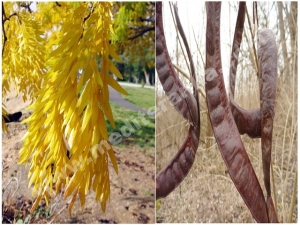
Gleditsia triacanthos inermis - 'Imperial' Thornless Honeylocust. The family is Leguminosae. This cultivar of Honeylocust is smaller than others, growing to 10 m with a flat-topped, vase-shaped canopy. The species has undesirable thorns on the trunk and main branches and large seed pods but this cultivar is thornless and usually fruitless. The tree is strong-wooded and casts light shade. Lawns grow fairly well beneath the tree and there is little to rake up in the fall since the tiny leaflets filter in between the blades of grass or are washed away in the rain. Honeylocust has a yellow or golden fall color in the northern part of its range. Trees often defoliate early in the south and are bare by October. Some of the cultivars may develop thorns and/or seed pods when they get older.
The tree has no particular soil preferences and is useful in dry or alkaline areas, it tolerates compacted, poorly aerated soil and flooding for a period of time and does well in confined soil spaces. Honeylocust adapts well as a city street tree and is tolerant to small planting pits in concrete. It is susceptible to breakage in ice storms.
Unfortunately, it has been overplanted in some areas and insect problems are beginning to catch up with Honeylocust, including the cultivars. Recommend planting only small numbers of this tree to avoid catastrophe if insects or diseases invade. It might be best to plant Pistacia, Zelkova, Taxodium, Quercus or some other proven urban tough tree in place of Honeylocust to avoid potential insect, disease and early defoliation problems.
Fenugreek - Trigonella
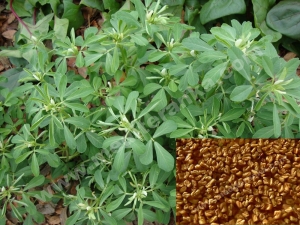
Fenugreek (Trigonella foenum-graecum) is an annual plant in the family Fabaceae. The plant has small round leaves, is cultivated worldwide as a semi-arid crop, and is a common ingredient in dishes from the Indian Subcontinent.
Major fenugreek-producing countries are India, Iran, Nepal, Bangladesh, Pakistan, Argentina, Egypt, France, Spain, Turkey, Morocco and China. The largest producer of fenugreek in the world is India. Fenugreek has three culinary uses: as a herb (dried or fresh leaves), as a spice (seeds), and as a vegetable (fresh leaves, sprouts, and microgreens). Sotolon is the chemical responsible for fenugreek's distinctive sweet smell.
The distinctive cuboid-shaped, yellow-to-amber colored fenugreek seeds are frequently encountered in the cuisines of the Indian subcontinent. The seeds are used in the preparation of pickles, vegetable dishes, and spice mixes, such as panch phoron and sambar powder. Fenugreek seeds are used both whole and in powdered form and are often roasted to reduce their bitterness and enhance their flavor. Fenugreek is also used as a vegetable. Fresh fenugreek leaves are an ingredient in some Indian curries. The sprouted seeds and microgreens are used in salads.
In Persian cuisine, fenugreek leaves are used and called shanbalile. It is the key ingredient and one of several greens incorporated into ghormeh sabzi and Eshkeneh, often said to be the Iranian national dishes. The seed is used in Ethiopia as a natural herbal medicine in the treatment of diabetes. Fenugreek seeds are thought to be a galactagogue that is often used to increase milk supply in lactating women.
Fenugreek seed is widely used as a galactagogue (milk producing agent) by nursing mothers to increase inadequate breast milk supply. Studies have shown that fenugreek is a potent stimulator of breast milk production and its use was associated with increases in milk production. It can be found in capsule form in many health food stores.
Several human intervention trials demonstrated that the antidiabetic effects of fenugreek seeds ameliorate most metabolic symptoms associated with type-1 and type-2 diabetes in both humans and relevant animal models by reducing serum glucose and improving glucose tolerance.
Crab's eye
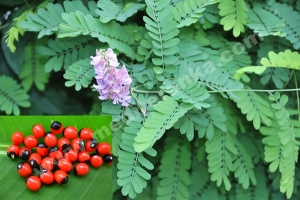
Abrus precatorius, known commonly as jequirity, Gunj, Crab's eye, rosary pea, John Crow Bead, precatory bean, Indian licorice, Akar Saga, is a slender, perennial climber that twines around trees, shrubs, and hedges. It is a legume with long, pinnate-leafleted leaves. The plant is best known for its seeds, which are used as beads and in percussion instruments, and which are toxic due to the presence of abrin.
The plant is native to Indonesia and grows in tropical and subtropical areas of the world where it has been introduced. The toxin abrin is a dimer consisting of two protein subunits, termed A and B. The B chain facilitates abrin's entry into a cell by bonding to certain transport proteins on cell membranes, which then transport the toxin into the cell. Symptoms are identical to those of ricin, except abrin is more toxic by almost two orders of magnitude, the fatal dose of abrin is approximately 75 times smaller than the fatal dose of ricin. Abrin can kill with a circulating amount of less than 3 micrograms.
Abrus precatorius, called kudri mani in Tamil and guru ginja in Telugu, has been used in Siddha medicine for centuries. The Tamil Siddhars knew about the toxic effects in plants and suggested various methods which is called "suththi seythal" or purification. This is done by boiling the seeds in milk and then drying them. The protein is denatured when subjected to high temperatures which removes its toxicity. In Siddha medicine, the white variety is used to prepare oil that is claimed to be an aphrodisiac. A tea is made from the leaves and used to treat fevers, coughs and colds. Seeds are poisonous and therefore are used after mitigation. The plant is also used in Ayurveda.
The seeds of Abrus precatorius are much valued in native jewelry for their bright coloration. Most beans are black and red, suggesting a ladybug, though other colors are available. Jewelry-making with jequirity seeds is dangerous, and there have been cases of death by a finger-prick while boring the seeds for beadwork.
St Lucie cherry

Prunus mahaleb, mahaleb cherry, St Lucie cherry, is a species of cherry tree. The tree is cultivated for a spice obtained from the seeds inside the cherry stones. The seeds have a fragrant smell and have a taste comparable to bitter almonds with cherry notes.
The tree is native in the Mediterranean region, Iran and parts of central Asia. It is adjudged to be native in northwestern Europe or at least it is naturalized there. It is a deciduous tree or large shrub, growing to 2–10 m (rarely up to 12 m) tall with a trunk up to 40 cm diameter.
The leaves are 1.5-5 cm long, 1-4 cm. Wide. The flowers are fragrant, pure white, small, 8-20 mm diameter, they are arranged 3-10 together. The flower pollination is mainly by bees. The fruit is a small thin-fleshed cherry-like drupe 8–10 mm in diameter, green at first, turning red then dark purple to black when mature, with a very bitter flavour; flowering is in mid spring with the fruit ripening in mid to late summer.
The plant is cultivated for a spice obtained from the seeds inside the cherry stones. It is fragrant and has the taste of bitter almonds. It is used in small quantities to sharpen sweet foods, such as the Turkish sweet-bread çörek (chorak), the Greek sweet-bread tsoureki or the Armenian sweet-bread chorak. The wood is hard, and is used in cabinet-making and for pipes.
The bark, wood, and seeds contain coumarin. They have anti-inflammatory, sedative and vasodilation effects.
Today its cultivation and use is largely restricted to the region that in the 19th and earlier centuries formed the Ottoman Empire. Syria is the main exporting country.
Golden chain
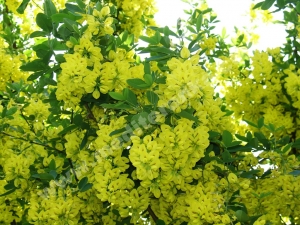
Golden chain, Golden rain or Common laburnum (Laburnum anagyroides) is an upright, sparsely branched deciduous tree. It grows 4–9 m tall and 3–4 m wide at the crown. Leaves are trifoliate, 3–7 cm long, comprised of alternate leaflets, each 3–8 cm long and 2.5 cm wide. The plant blooms in late spring (in may), flowers are golden yellow, sweet scented, densely packed and arranged in pendulous racemes 10–20 cm long.
Laburnum anagyroides is popular garden ornamental native to the mountains of central Europe. Reproduction is from seeds. L. anagyroides is best suited to cooler, upland areas. The Fabaceae is a large and economically important family of flowering plants found throughout the world, with 730 genera and over 19,400 species.
The seeds are legumes with large numbers of black seeds that contain cytisine, an alkaloid extremely poisonous to humans but also goats and horses, especially when not ripe. However, some wild animals such as hares and deer can feed on them without any problems, and because of this the plant is believed to have magic properties in some regions. All parts of the plant contain cytisine and are poisonous if consumed.
The wood is hard and heavy, of a yellow/brown colour, ideal for making posts, for woodturning and as fuel. In the past (and today on historic re-enactments) it was used for making bows. The tree is also known as false ebony since the wood from very old specimens could be used in place of ebony. Laburnum anagyroides is cultivated as an ornamental tree.