


- You are here:
-
Home

- Krunoslav Tripalo
Products Categories
Your Cart
Currency
Taxi Booking


Krunoslav Tripalo
The loquat
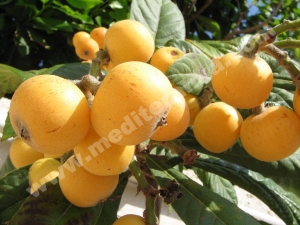
The loquat (Eriobotrya japonica) is a species of flowering plant in the family Rosaceae, native to central China. It is a large evergreen shrub or small tree, grown commercially for its yellow fruit, and also cultivated as an ornamental plant. The tree can grow to 5–10 metres tall, but is often smaller, about 3–4 metres. The leaves are alternate, simple, 10–25 cm long, dark green.
Loquats are unusual among fruit trees in that the flowers appear in the autumn or early winter, and the fruits are ripe in late winter or early spring. The flowers are 2 cm in diameter, white, with five petals and have a sweet, heady aroma that can be smelled from a distance.
Loquat fruits, growing in clusters, are oval, rounded or pear-shaped, 3–5 cm long, with a smooth or downy, yellow or orange, sometimes red-blushed skin. The fruits are the sweetest when soft and orange. The flavor is a mix of peach, citrus and mild mango.
The loquat is originally from southeastern China. It was introduced into Japan and became naturalised there in very early times, and has been cultivated there for over 1,000 years. It has also become naturalised in Afghanistan, Kenya, India, Iraq, the whole Mediterranean Basin, Pakistan and many other areas. Chinese immigrants are presumed to have carried the loquat to Hawaii.
The loquat is easy to grow in subtropical to mild temperate climates where it is often primarily grown as an ornamental plant, and secondarily for its delicious fruit. The boldly textured foliage adds a tropical look to gardens, contrasting well with many other plants.
Japan is the leading producer of loquats followed by Israel and then Brazil.
In the highland parts of Central America, the loquat has become naturalized, and is often found growing wild in areas that have been disturbed but abandoned, its seeds having been dispersed by birds. Below 1000 meters, the fruit remains inedible for its high acidity, but above it, the wild fruit is appreciated and much harvested for its sweet, fruity flavor. It is occasionally planted for living fenceposts, as the tree is long-lived, not much subject to disease, and the wood is hard and durable. Good quality logs are much sought-after by furniture makers in Central America, who prize its hardness and durability.
The loquat has a high sugar, acid, and pectin content. It is eaten as a fresh fruit and mixes well with other fruits in fresh fruit salads or fruit cups. The fruits are also commonly used to make jam, jelly, and chutney, and are often served poached in light syrup.
Loquats can also be used to make light wine. It is fermented into a fruit wine, sometimes using just the crystal sugar and white liquor. Lemon or lemon zest is often paired with the wine because the fruit has very low acidity.
In Italy the nespolino liquer is made from the seeds, reminiscent of nocino and amaretto, both prepared from nuts and apricot kernels. Both the loquat seeds and the apricot kernels contain cyanogenic glycosides, but the drinks are prepared from varieties that contain only small quantities, so there is no risk of cyanide poisonings. The loquat is low in saturated fat and sodium, and is high in vitamin A, dietary fiber, potassium, and manganese.
Like most related plants, the seeds (pips) and young leaves of the plant are slightly poisonous, containing small amounts of cyanogenic glycosides (including amygdalin) which release cyanide when digested, though the low concentration and bitter flavour normally prevents enough being eaten to cause harm.
Loquat syrup is used in Chinese medicine for soothing the throat and is a popular ingredient for cough drops. The leaves, combined with other ingredients and known as pipa gao (literally loquat paste), it acts as a demulcent and an expectorant, as well as to soothe the digestive and respiratory systems.
In Japan, Loquat leaves are dried to make a mild beverage known as Biwa Cha by brewing them using the traditional Japanese "Senjiru" method, believed to beautify skin and heal inflammatory skin conditions such as psoriasis and eczema and for healing chronic respiratory conditions such as in bronchitis.
Siberian pine
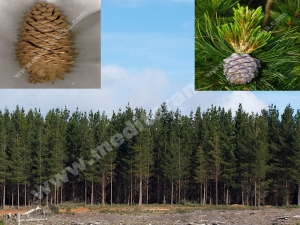
The Siberian Pine, Pinus sibirica, in the family Pinaceae is a species of pine tree that occurs in Siberia from the Ural Mountains to central Mongolia. In the north of its range, it grows at low altitudes, typically 100–200 m, whereas further south, it is a mountain tree, growing at 1,000-2,400 m altitude. It often reaches the alpine tree line in this area. The mature size is up to 30–40 m height, and 1.5 m trunk diameter. Its maximum lifetime is 800–850 years. Pinus sibirica is a member of the white pine group, Pinus subgenus Strobus, and like all members of that group, the leaves ('needles') are in fascicles (bundles) of five, with a deciduous sheath. They are 5–10 cm long. Siberian Pine cones are 5–9 cm long. Siberian Pine is a popular ornamental tree in parks and large gardens where the climate is cold, such as central Canada, giving steady though not fast growth on a wide range of sites. It is very tolerant of severe winter cold, hardy down to at least –60 °C, and also of wind exposure. The seeds are also harvested and sold as pine nuts. The Russian name (tr. Sibirsky Kedr) is often miss-translated in English as "Siberian Cedar"; references to "cedar" in texts translated from Russian usually refer to this tree or related pines, not to cedars.
Salvia officinalis

Salvia officinalis (sage, also called garden sage, or common sage) is a perennial, evergreen subshrub, with woody stems, grayish leaves, and blue to purplish flowers. It is a member of the family Lamiaceae and is native to the Mediterranean region, though it has naturalized in many places throughout the world. It has a long history of medicinal and culinary use, and in modern times as an ornamental garden plant.
The plant flowers in late spring or summer. The leaves are oblong, ranging in size up to 6 cm long by 2.5 cm wide. Leaves are grey-green, rugose on the upper side, and nearly white underneath due to the many short soft hairs.
Salvia officinalis has been used since ancient times for warding off evil, snakebites, increasing women's fertility, and more. Pliny the Elder said the latter plant was called salvia by the Romans, and used as a diuretic, a local anesthetic for the skin, a styptic, and for other uses. The plant had a high reputation throughout the Middle Ages, with many sayings referring to its healing properties and value.
Salvia and "sage" are derived from the Latin salvere (to save), referring to the healing properties long attributed to the various Salvia species. It has been recommended at one time or another for virtually every ailment by various herbals. Modern evidence shows possible uses as an antisweating agent, antibiotic, antifungal, astringent, antispasmodic, estrogenic, hypoglycemic, and tonic. In a double blind, randomized and placebo-controlled trial, sage was found to be effective in the management of mild to moderate Alzheimer's disease.
The strongest active constituents of sage are within its essential oil, which contains cineole, borneol, and thujone. Sage leaf contains tannic acid, oleic acid, ursonic acid, ursolic acid, cornsole, cornsolic acid, fumaric acid, chlorogenic acid, caffeic acid, niacin, nicotinamide, flavones, flavonoid glycosides, and estrogenic substances.
Investigations have taken place into using sage as a treatment for Alzheimer's disease patients. Sage leaf extract may be effective and safe in the treatment of hyperlipidemia.
European privet
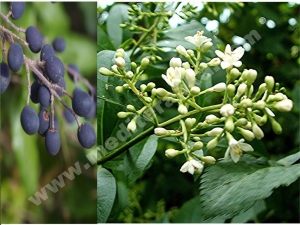
Ligustrum vulgare (Wild privet, also sometimes known as Common privet or European privet), is a species of Ligustrum native to central and southern Europe, north Africa and southwestern Asia, from southern England and southwestern Sweden south to Morocco, and east to Poland and northwestern Iran.
It is a semi-evergreen or deciduous shrub, growing to 3-5m tall. The leaves are borne in decussate opposite pairs, sub-shiny green, narrow oval to lanceolate, 2–6 cm long and 0.5–1.5 cm broad. The flowers are produced in mid summer in panicles 3–6 cm long, each flower creamy-white. The flowers produce a strong, pungent fragrance that many people find unpleasant. The fruit is a small glossy black berry 6–8 mm diameter, containing one to four seeds. The berries are poisonous to humans but readily eaten by thrushes, which disperse the seeds in their droppings. The plant can tolerate maritime exposure.
A very tolerant and easily grown plant, it succeeds in any soil that is not very impoverished. Grows well in heavy clay soils. Prefers a calcareous soil and succeeds in thin dry soils. Grows well in light woodland or the full shade of a wall but flowers and fruits best in a sunny position. A suckering shrub, forming dense thickets and making good bird cover. An important food plant for many caterpillars, including the larvae of the privet hawk moth. This species is notably susceptible to honey fungus. Sow the seed in spring in a cold frame. Stored seed germinates better if it is stratified, remove any fruit flesh from around the seed before it is sown since this can inhibit germination. When they are large enough to handle, prick the seedlings out into individual pots and grow them on in the cold frame for their first winter. Plant them out into their permanent positions in late spring or early summer, after the last expected frosts. The seed can also be sown in outdoor seed beds in the autumn. You can leave the plants to grow on in the seedbed for up to 4 years before planting them out into their permanent positions in the winter.
Paliurus spina
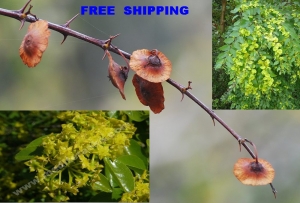
Paliurus spina-christi, commonly known as Jerusalem Thorn, Garland Thorn, Christ's Thorn, or Crown of Thorns, is a species of Paliurus native to the Mediterranean region and southwest and central Asia, from Morocco and Spain east to Iran and Tajikistan. It is a deciduous shrub or small tree growing to 3–5 m tall. The shoots are zig-zagged, with a leaf and two stipular spines (one straight, one curved) on the outside of each kink. The leaves are oval, 2–5 cm long and 1–4 cm broad, glossy green, with an entire margin. The fruit is a dry woody nutlet centred in a circular wing 2–3.5 cm diameter. The name reflects an old legend that the spiny branches were used to make the crown of thorns placed on Christ's head before his crucifixion. It is viewed as an ornamental curiosity and is cultivated in some areas spreading its range, including Fiji.
Ephedra fragilis
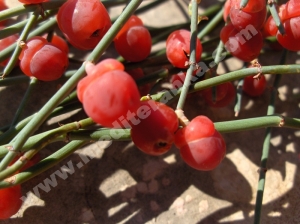
Ephedra fragilis is a genus of gymnosperm shrubs, the only genus in its family, Ephedraceae, and order, Ephedrales. 50 species of Ephedra grow in dry climates over wide areas of the northern hemisphere, including southwestern North America, Europe, north Africa, and southwest and central Asia, and, in the southern hemisphere, in South America south to Patagonia. In temperate climates, most Ephedra species grow on shores or in sandy soils with direct sun exposure. Common names in English include Joint-pine, Jointfir, Mormon-tea or Brigham Tea. The Chinese name for the Ephedra species is mahuang. Ephedras is also sometimes called sea grape (from the French - raisin de mer), a common name for the flowering plant Coccoloba uvifera.
Plants of the Ephedra genus, including E. sinica and others, have traditionally been used by indigenous people for a variety of medicinal purposes, including treatment of asthma, high fever, and the common cold. The alkaloids ephedrine and pseudoephedrine are active constituents of E. sinica and other members of the genus. These compounds are sympathomimetics with stimulant and decongestant qualities and are related chemically to the amphetamines.
Pollen of Ephedra spp. was found in the Shanidar IV burial site in Iraq, suggesting its use as a medicinal plant dates to over 60,000 years ago. It has been suggested that Ephedra may be the Soma plant of Indo-Iranian religion. This is reflected in its Sanskrit name "somalata"
Melia azedarach
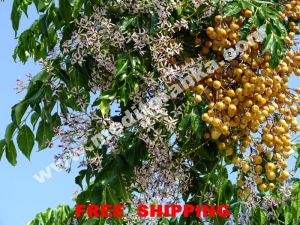
Melia azedarach, commonly known as Chinaberrry tree, Persian lilac, white cedar, Texas umbrella, bead-tree, Cape lilac, Ceylon cedar, Pride of India, malai vembu, bakain, zanzalakht and dharek or dhraik. Cape lilac, is a species of deciduous tree in the mahogany family, Meliaceae, that is native to Pakistan, India, Indochina, Southeast Asia and Australia.
The adult tree has a rounded crown, and commonly measures attains a height of 7-12 metres, however in exceptional circumstances M. azedarach can attain a height of 45 metres. The flowers are small and fragrant, with purple or lilac petals. The fruit is a drupe, marble-sized, light yellow at maturity, hanging on the tree all winter, and gradually becoming wrinkled and almost white. The leaves are up to 50 cm long, the leaflets are dark green above and lighter green below.
The main utility of chinaberry is its timber. This is of medium density, and ranges in colour from light brown to dark red. Melia azedarach in keeping with other members of the family Meliaceae has a timber of high quality, but as opposed to many almost-extinct species of mahogany it is under-utilised. Seasoning is relatively simple in that planks dry without cracking or warping and are resistant to fungal infection.
The hard, 5-grooved seeds were widely used for making rosaries and other products requiring beads, before their replacement by modern plastics.
Some hummingbirds like Sapphire-spangled Emerald, Glittering-bellied Emerald and Planalto Hermit have been recorded to feed on and pollinate the flowers, these only take it opportunistically.
Fruits are poisonous to humans if eaten in quantity. However, like those of the Yew tree, these toxins are not harmful to birds, who gorge themselves on the fruit, eventually reaching a "drunken" state. Leaves have been used as a natural insecticide to keep with stored food, but must not be eaten as they are highly poisonous. A diluted infusion of leaves and trees has been used in the past to induce uterus relaxation.
Trichocereus peruvianus
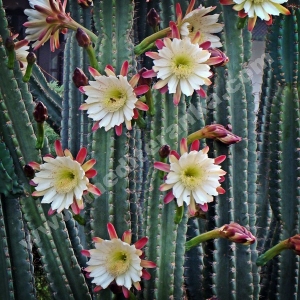
Trichocereus peruvianus (syn. Echinopsis peruviana), Peruvian Torch cactus, is a fast-growing columnar cactus native to the western slope of the Andes in Peru, between about 2,000–3,000 m above sea level. The Peruvian Torch grows high in the Andean mountain deserts of Peru and Ecuador and is similar to the San Pedro cactus (Echinopsis pachanoi) which is found in the same region.
The human use of the cactus dates back thousands of years to the northern coast of Peru and the monks of a pre-Inca culture known as Chavín (900 BC to 200 BC). They prepared a brew called "achuma", "huachuma" or "cimora" which was used during ritualistic ceremonies to diagnose the spiritual links to a patient's illness.
The plant is bluish-green in colour, with frosted stems, it has large, white flowers. It can grow up to 3–6 meters tall, with stems up to 8–18 cm in diameter; it is fully erect to begin with, but later possibly arching over, or even becoming prostrate. Groups of 6-8 honey-coloured to brown rigid spines, up to 4 cm in length, with most about 1 cm, are located at the nodes, which are evenly spaced along the ribs. A short-spined variant which is nearly identical in appearance to its relative, Echinopsis pachanoi (San Pedro cactus), is known.
Propagation from cuttings - depending upon the local environmental conditions soil should well draining and able to hold enough moisture for a week or more without drying out. Any soil used should never be "rich" in nitrogen. These are easily identified as being dark in color and / or high in manure content. A good basic soil mixture will consist of a basic "cactus soil mix" supplemented with 25% washed sand and 35% perlite. Pots must be well draining and do not need to be large in order to support an extensive root network.
Once established these plants will be able to handle large amounts of watering compared to other cacti genera. Like other plants warm temperature and sunlight will result in rapid growth. Watering should take on a cycle between watering and keeping the soil moist (but not damp) with a short "drying out" period to keep soil microflora in check once every 10–14 days. Watering should be stopped or severely limited in the winter months when plants go dormant.
Echinopsis peruviana can be propagated from either seeds or cuttings.
Wild asparagus (20x)
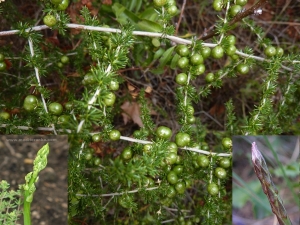
Wild asparagus (Asparagus acutifolius) is an evergreen perennial plant belonging to the genus Asparagus. The Latin name acutifolius of this species, meaning "thorny leaves", derives from the characteristics shape of the leaves, a quite common feature in the typical plants of the Mediterranean. Asparagus acutifolius reaches on average 30–70 centimetres of height. The stems have much-branched feathery foliage. The "leaves" are in fact needle-like modified stems. The flowers are bell-shaped and in small clusters, greenish-white to yellowish, 4–5 millimetres long. The flowers are dioecious (on each plant they are only male or female).
In some Mediterranean regions flowering occurs in late Summer from August through September, often after heavy storms. In this case the small green (black) berries with 1-2 seeds, 5-6 millimetres of diameter, are fully ripe in Winter.
Sea buckthorn

Hippophae rhamnoides, common sea-buckthorn, is a species of flowering plant in the family Elaeagnaceae and can grow 2–4 m high. The leaves are alternate, with silvery-green upper faces. It is dioecious, which means that the male and female flowers grow on different shrubs. Male plants need to be planted near the female plants to allow fertilisation and fruit production. The oval or lightly roundish fruits grow in compact grapes varying from pale yellow to dark orange and weighing from 0.2 g to 1 g. The plant has a very developed root system that can maintain the soil on high slopes, is resistant to wind and frost, tolerates salty soils.
The Latin rhamnoides means "resembling buckthorn". As the buckthorns are in a different family, and the common name sea buckthorn can refer to more than one species, it is preferable to refer to this plant by its unique Latin name.
Hippophae rhamnoides is a native plant throughout Europe, including Britain, from Norway south and east to Spain and Asia to Japan and the Himalayas. It is grown as an agricultural plant in Germany, France, Finland, India and China. China is the largest agricultural producer. The origin of the plant is Nepal and it migrated to other parts of Eurasia after the last Ice Age. The fruits of sea buckthorn are used in a wide variety of products. Due to difficult harvest conditions and long ramp-up time of 6 to 8 years buckthorn is a relatively expensive raw material. Especially in France (southern Alps) sea buckthorn is commonly sold as fruit juice or as an ingredient in non-alcoholic and alcoholic mixed beverages. Other uses include the berries to be processed as fruit wine or into liquor as well as jam. The fruits have a very high vitamin C content, on average exceeding that of lemons and oranges.
Various pharmacological activities such as cytoprotective, anti-stress, immunomodulatory, hepatoprotective, radioprotective, anti-atherogenic, anti-tumor, anti-microbial and tissue regeneration have been reported.