Mediteranka

Your Cart

No items in cart

Currency

Taxi Booking

taxibooking

Krunoslav Tripalo

Krunoslav Tripalo

Monday, 30 June 2014 10:20

Wild cherry

7
Quantity:
 
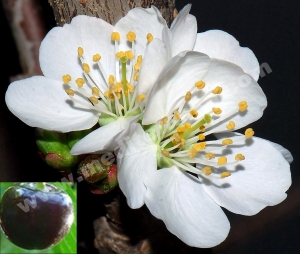
Wild cherry (Prunus avium), commonly called sweet cherry, bird cherry, orgean, is a species of cherry native to Europe, and western Asia. This species are in the rose family (Rosaceae), and all parts of the plant except for the ripe fruit are slightly toxic, containing cyanogenic glycosides. Prunus avium is a deciduous tree growing to 15–32 m tall, with a trunk up to 1.5 m in diameter. Young trees show strong apical dominance with a straight trunk and symmetrical conical crown, becoming rounded to irregular on old trees. The bark is smooth purplish-brown. The leaves are alternate, 7–14 cm long and 4–7 cm broad. In autumn, the leaves turn orange, pink or red before falling. The flowers are produced in early spring at the same time as the new leaves. The fruit is a drupe 1–2 cm in diameter, bright red to dark purple when mature in midsummer, edible, variably sweet to somewhat astringent and bitter to eat fresh. Each fruit contains a single hard-shelled stone 8–12 mm long, 7–10 mm wide. The fruit are readily eaten by numerous kinds of birds and mammals, which digest the fruit flesh and disperse the seeds in their droppings. The sweet cherry is one of the two cherry species which supply most of the world's commercial cultivars of edible cherry.
 
It is often cultivated as a flowering tree. Because of the size of the tree, it is often used in parkland, and less often as a street or garden tree.
The hard, reddish-brown wood (cherry wood) is valued as a hardwood for woodturning, and making cabinets and musical instruments. The gum from bark wounds is aromatic and can be chewed as a substitute for chewing gum. Medicine can be prepared from the stalks of the drupes that is astringent, antitussive, and diuretic.
 
Offer:
 
100 seeds
7
Quantity:
Sunday, 29 June 2014 08:44

Alcea rosea

7
Quantity:
 
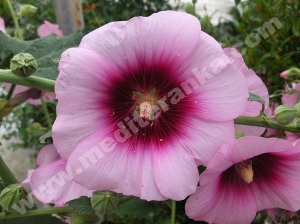
Alcea rosea (Common hollyhock) is an ornamental plant in the Malvaceae family. It was imported into Europe from southwestern China during, or possibly before the 15th century. Alcea rosea is variously described as a biennial (having a two-year life cycle), as anannual, or as a short-lived perennial. It frequently self-sows, which may create a perception that the plants are perennial. The plant may flower during its first year when sown early. It will grow in a wide range of soils, and can easily reach a height of about 2.4 m. The flowers are a range of colours from white to dark red, including pink, yellow and orange. Different colours prefer different soils. The darker red variety seems to favour sandy soils, while the lighter colour seems to favour clay soils.
 
The plants are easily grown from seed, and readily self-seed. However, tender plants, whether young from seed or from old stock, may be wiped out by slugs and snails. The foliage is subject to attack from rust (Puccinia malvacearum), which may be treated with fungicides. In herbal medicine, Hollyhock is believed to be an emollient and laxative. It is used to control inflammation, to stop bedwettingand as a mouthwash in cases of bleeding gums.
 
Offer:
 
100 seeds
7
Quantity:
Sunday, 29 June 2014 05:22

Pink rock rose

7
Quantity:
 
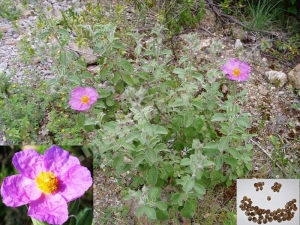
Cistus incanus, or pink rock rose, is a low-growing flowering shrub with pink flowers that belongs to the family Cistaceae. Pink rock rose has other names in various regions of the world, including rock rose, hairy rock rose, and soft-hairy rock rose. It is native to southern Europe and the area around the eastern Mediterranean. This plant and at least one other closely related species have been prized since ancient times as the source of the substance labdanum, also known as ladanum. This sticky resin, derived from the sap of Cistus incanus has been used for centuries as an ingredient in perfumes and incense. Today, it is still a popular and important component of many perfumes, scented soaps and bath products, and flavorings for candies and other foods.
 
Gardeners and landscapers favor the pink rock rose for its beauty and toughness. Cistus incanus is known for its ability to thrive in poor soils and in dry conditions. Its roots are known for being very resistant to fire, and it is often one of the first plants to sprout a new after fire destroys the vegetation in an area where it grows. It prefers uncultivated soils and does not require much water.
 
Pink rock rose flowers have five petals surrounding a center of bright yellow. Its foliage, traditionally used to make tea in some regions of Greece, is often described as hairy or fuzzy and is covered with fine, soft hairs. Cistus incanus makes a good ground cover, as it will gradually form a thick, lush layer that bears pink flowers in great numbers in the spring. As an evergreen, its attractive foliage can be enjoyed year-round.
 
Offer:
 
50 seeds
7
Quantity:
Sunday, 29 June 2014 03:41

Buckthorn

19
Quantity:
 
Buckthorn (Frangula rupestris) belongs to family Rhamnaceae. It is a low deciduous shrub up to 150 cm in height, thin light crust. The branches are hairy when young, then naked. Buds are bare, flowers are inconspicuous, tiny with 5 greenish petals, hermaphroditic. It blooms from May to July, after fertilizing flowers, fruits appears that ripen in September. The fruit is round, fleshy berry, pea-sized, first green, then red and black after maturation. Every berry contains 2-3 shiny, yellowish seeds with a long and narrow furrow, the fruits are not edible.
It is widespread in the Mediterranean region, Balkan Peninsula and the Transylvanian Alps. It grows in rocky places and crevices in areas with warm climates, benefiting from the limestone and plenty of sun and heat.
 
Buckthorn is one of the oldest species in Mediterranean region known in the preparation laxative resources that enhance digestion and stimulate bowels. All parts of buckthorn are rich and anthraquinone derivatives and are recommended for constipation , anal fissures and hemorrhoids. Buckthorn family belongs jujube (Ziziphus jujuba), South Asian species of edible fruits (see offer) which is recommended as an excellent natural ''stress remover''.  Zizifin, substance found in the leaves of jujube, prevents the sensation of sweetness taste in humans in a way that has not yet been sufficiently explored.
 
Offer:
 
1000 seeds
19
Quantity:
Friday, 27 June 2014 19:04

Italian thistle

7
Quantity:
 
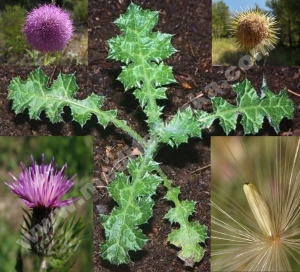
Carduus pycnocephalus, with common names including Italian thistle, Italian plumeless thistle, and Plymouth thistle, is a species of thistle. It is native to the Mediterranean region in southern Europe. The plant has become an introduced species in other regions, and on other continents, often becoming a noxious weed or invasive species.
 
A winter annual, Carduus pycnocephalus stems range from 20 cm to 2 m, and are glabrous to slightly wooly. The multiple stems are winged with spines. The plant grows in a rosettesof 25–36 cm in diameter, with four to ten lobed basal leaves that are 10–15 cm long. Cauline leaves aretomentose on the underside and contain spines on the lobe tips. Flower heads are pink to purple, approx. 1-1.4 cm long, and the fruits are brown to gold, with a bristly, minutely barbed pappus.
 
Offer:
 
100 seeds
7
Quantity:
Tuesday, 24 June 2014 08:09

Alyssum

14
Quantity:
 
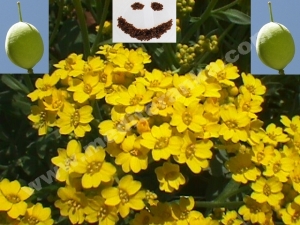
Alyssum (Aurinia sinuata) belongs to the Brassicaceae family. It is gray, poorly branched perennial with a height of 15-50 cm, just numb at the base. The leaves are oblong, lower deeply etched with wavy edges. It blooms from March to June, the flowers are up to 1 cm in diameter, bright yellow petals. Seminal quiver is naked and very bloated, round or slightly elliptical in shape, 6-12 mm long with up to eight seeds in each chamber.
 
Alyssum is subendemic species of the western part of the Balkan Peninsula, growing in the Adriatic coastal area with mountains, rocks, cliffs, stone walls, embankments along the road. This is a beautiful plant, popular and common in horticulture worldwide. Family Aurinia could be well recognized by some characteristic chemical compounds and the whole group is considered potentially curative and applicable in dermatology because some of its members are deposited nickel and its salts, and is known to have beneficial effects against some skin diseases.
 
Offer:
 
500 seeds 
14
Quantity:
Tuesday, 03 June 2014 04:32

Mallow tree

7
Quantity:
 
Mallow tree (Lavatera arborea), sometimes known as Malva arborea, is a species of mallow native to the coasts of western Europe and the Mediterranean region. It is a shrubby annual, or perennial plant growing to 1–2 m (rarely 3 m) tall. The leaves are orbicular, 8–18 cm diameter. The flowers are 3–4 cm diameter, dark pink to purple and grow in clusters of two to seven.
It grows mainly on exposed coastal locations, often on small islands, only rarely any distance inland. Lavatera arborea tolerates sea water to varying degrees, at up to 100% sea water in its natural habitat, excreting salt through glands on its leaves. This salt tolerance can be a competitive advantage over inland plant species in coastal areas.
The leaves of the species are used in herbal medicine to treat sprains, by steeping them in hot water and applying the poultice to the affected area. It is theorised that lighthouse keepers may have spread the plant to some British islands for use as a poultice and to treat burns, an occupational hazard. Tree Mallow seeds may be transported between separated coastal areas by the floating fruit, and seabirds are considered a likely means of spread. The seeds are encased in an impermeable outer case, and can remain viable for years, even after extended immersion in saltwater. 
 
Offer:
 
100 seeds
7
Quantity:
Sunday, 16 March 2014 05:19

Papaya

7
Quantity:

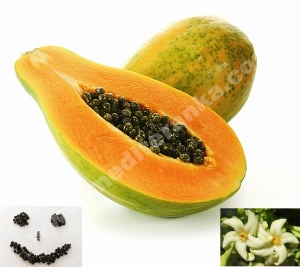
The papaya, papaw, or pawpaw is the fruit of the plant Carica papaya, the sole species in the genus Carica of the plant family Caricaceae. It is native to southern Mexico. The papaya is a large, tree-like plant, with a single stem growing from 5 to 10 m tall, with spirally arranged leaves confined to the top of the trunk. The leaves are large, 50–70 cm in diameter, deeply palmately lobed, with seven lobes. The flowers appear on the axils of the leaves, maturing into large fruit, 15–45 cm long and 10–30 cm in diameter. The fruit is ripe when it feels soft and its skin has attained an amber to orange hue. In some parts of the world, papaya leaves are made into tea as a treatment for malaria.

Offer:
 
5 seeds
7
Quantity:
Saturday, 15 March 2014 12:37

Black pine

7
Quantity:
 
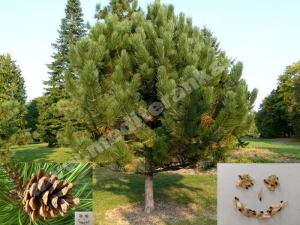
Black pine (Pinus nigra) is a moderately variable species of pine, occurring across southern Mediterranean Europe. Pinus nigra is a tree of the Mediterranean forests, woodlands, and scrub biome. There are remnant populations in the Mediterranean conifer and mixed forests ecoregion. It is found at elevations ranging from sea level to 2,000 metres, most commonly from 250–1,600 metres. Pinus nigra is a large coniferous evergreen tree, growing to 20–55 metres tall at maturity. The bark is grey to yellow-brown, and is widely split by flaking fissures into scaly plates, becoming increasingly fissured with age.
The leaves (needles) are thinner and more flexible in western populations. The ovulate and pollen cones appear from May to June. The mature seed cones are 5–10 cm long, with rounded scales, they ripen from green to pale grey or yellow in September to November, about 18 months after pollination. The seeds are dark grey, 6–8 mm long and they are wind-dispersed when the cones open from December to April. Sexual maturity is reached at 15–40 years, large seed crops are produced at 2–5 year intervals. P. nigra is moderately fast growing, at about 30–70 cm per year. It usually has a rounded conic form, that becomes irregular with age. The tree can be long lived, with some trees over 500 years old. It needs full sun to grow well, is intolerant of shade, and is resistant to snow and ice damage.
 
Offer:
 
40 seeds
7
Quantity:
Saturday, 15 March 2014 07:12

Fennel

7
Quantity:

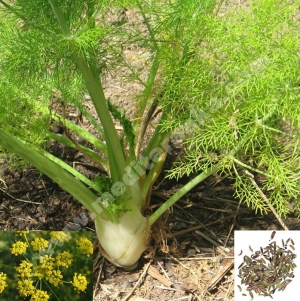
Fennel (Foeniculum vulgare) is a plant species in the genus Foeniculum. It is a hardy, perennial herb, with yellow flowers and feathery leaves. It is indigenous to the shores of the Mediterranean but has become widely naturalized in many parts of the world, especially on dry soils near the sea-coast and on riverbanks. It is a highly aromatic and flavorful herb with culinary and medicinal uses and, one of the primary ingredients of absinthe. Fennel is erect, glaucous green, and grows to heights of up to 2.5 m, with hollow stems. The leaves grow up to 40 cm long, the flowers are yellow, produced in terminal compound umbels 5–15 cm wide, the fruit is a dry seed from 4–10 mm long.

Fennel is widely cultivated, both in its native range and elsewhere, for its edible, strongly flavoured leaves and fruits. Its aniseed flavour comes from anethole, an aromatic compound also found in anise and star anise, and its taste and aroma are similar to theirs, though usually not as strong. The bulb, foliage, and seeds of the fennel plant are widely used in many of the culinary traditions of the world. Dried fennel seed is an aromatic, anise-flavoured spice, brown or green in colour when fresh, slowly turning a dull grey as the seed ages. For cooking, green seeds are optimal. The leaves are delicately flavoured and similar in shape to those of dill. The bulb is a crisp vegetable that can be saulted, stewed, braised, grilled, or eaten raw. They are used for garnishes and to add flavor to salads. They are also added to sauces and served with pudding. The leaves used in soups and fish sauce and sometimes eaten raw as salad. Fennel seeds are sometimes confused with those of anise, which are similar in taste and appearance, though smaller. Fennel is also used as a flavouring in some natural toothpastes. The seeds are used in cookery and sweet desserts.

Offer:
 
100 seeds
7
Quantity:
Page 11 of 24
FaLang translation system by Faboba