


- You are here:
-
Home

- Krunoslav Tripalo
Products Categories
Your Cart
Currency
Taxi Booking


Krunoslav Tripalo
Oleander
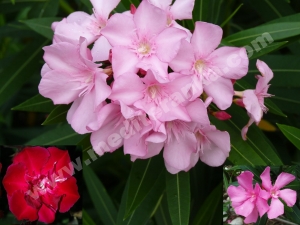
Nerium oleander is an evergreen shrub or small tree in the family Apocynaceae, toxic in all its parts. It is the only species currently classified in the genus Nerium. It is most commonly known as oleander, from its superficial resemblance to the unrelated olive Olea. Oleander is one of the most poisonous of commonly grown garden plants. Oleander grows to 2–6 m tall, the leaves are dark-green, narrow lanceolate, 5–21 cm long. The flowers grow in clusters at the end of each branch, they are white, pink to red, 2.5–5 cm diameter. The fruit is a long narrow capsule 5–23 cm long, which splits open at maturity to release numerous downy seeds. Oleander grows well in warm subtropical regions, where it is extensively used as an ornamental plant in landscapes, in parks, and along roadsides. It is drought-tolerant and will tolerate occasional light frost down to -10 °C. Oleander can also be grown in cooler climates in greenhouses and conservatories, or as indoor plants that can be kept outside in the summer.
Grisu Ibrido F1
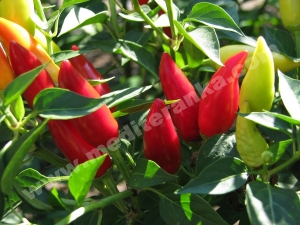
Grisu Ibrido F1 (Capsicum frutescens) is a chili pepper variety in the Capsicum genus. Grisu Ibrido F1 is generally thought of as a hybrid variety. The Grisu Ibrido is originally from the island of Sardegna in Italy where people like their food full of earthy flavours and hot like the sunshine which blesses the land. This Hybrid chilli is fast-growing, highly productive and can be grown anywhere from a sunny windowsill to outside in a garden pot. The chillies are abundant on the plant and are often consumed at all stages from green to deep red. As the Grisu ripens to red, it’ll develop a little extra sweetness which, with the no-nonsense heat, will invigorate any dish you choose to add it to. This chilli mainly grows as an annual/perennial plant - which means it typically can have a varying lifetime - from 1 year to several.
Grisu Ibrido F1 normally grows to a max height of 45 cm, it is normally fairly low maintenance and is normally quite easy to grow, as long as a level of basic care is provided throughout the year. Being aware of the basic soil, sun and water preferences will result in a happier and healthier plant. Grisu Ibrido F1 likes a position of full sun and remember to water moderately and remember to protect this plant from frosts and low temperatures. This chilis are hot, rated 16000 on the Scoville scale.
Habanero red
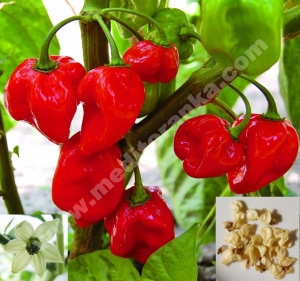
The habanero (Capsicum chinense) is a variety of chili pepper. Unripe habaneros are green, and they color as they mature. Common colors are orange and red, but white, brown, and pink are also seen. Typically a ripe habanero chili is 2–6 centimetres long. Habanero chilis are very hot, rated 100,000–350,000 on the Scoville scale. The habanero's heat, its fruity, citrus-like flavor, and its floral aroma have made it a popular ingredient in hot sauces and spicy foods. In 2000, the habanero was listed in the Guinness Book of World Records as the world's hottest chili, but it has since been displaced by a number of other peppers, the record tending to change hands every few years.
Habaneros thrive in hot weather. As with all peppers, the habanero does well in an area with good morning sun. The habanero should be watered only when dry. The habanero is a perennial flowering plant, meaning that with proper care and growing conditions, it can produce flowers and fruits for many years. Habanero bushes are good candidates for a container garden. In temperate climates, though, it is treated as an annual, dying each winter and being replaced the next spring. In tropical and subtropical regions, the habanero, like other chiles, will produce year round. As long as conditions are favorable, the plant will set fruit continuously.
Japanese aralia

Japanese aralia (Fatsia japonica) is a species of flowering plant in the family Araliaceae, native to southern Japan and South Korea. It is an evergreen shrub growing to 3–6 m tall, with stout, sparsely branched stems. The leaves are large, 20–50 cm in width and on a petiole up to 50 cm long, with 7–9 broad lobes. The flowers are small, white, in late autumn or early winter, followed by small black fruit. The name "fatsi" is old Japanese word for 'eight', referring to the eight lobes. It is commonly grown as an ornamental plant in warm temperate regions where winters do not fall below about -15°C.
Japanese privet

Ligustrum ovalifolium, also known as oval-leaved privet, is a semi-evergreen shrub in the privet genus Ligustrum. The species is native to Japan. It is sometimes known as Japanese privet. The plant flowers in midsummer, the abundant white blooms producing a unique pungent fragrance, unpleasant to some. Flowering starts after 330 growing degree days. The fruits, borne in clusters, are small purple to black drupes, poisonous for humans but readily eaten by many birds. In favorable growing conditions, individual shrubs may produce thousands of fruits. Privet hedges need to be trimmed several times during a growing season, in order to maintain their shape. Regularly trimmed plants do not produce flowers or fruit. Privet is used as a food plant by the larvae.
Castor oil plant
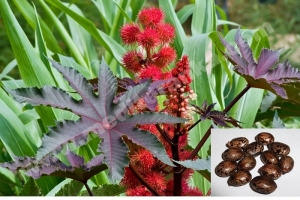
The castor oil plant (Ricinus communis) can vary greatly in its growth habit and appearance. The variability has been increased by breeders who have selected a range of cultivars for leaf and flower colours, and for oil production. It is a fast-growing, suckering perennial shrub that can reach the size of a small tree (around 12 metres). The glossy leaves are 15–45 centimetres long. In some varieties they start off dark reddish purple or bronze when young, gradually changing to a dark green. The fruit is a spiny, greenish (to reddish-purple) capsule containing large, shiny, bean-like, highly poisonous seeds. Castor seeds have a warty appendage called the caruncle, which is a type of elaiosome. The caruncle promotes the dispersal of the seed by ants.
Although castor is indigenous to the southeastern Mediterranean Basin, Eastern Africa, today it is widespread throughout tropical regions. In areas with a suitable climate, castor establishes itself easily where it can become an invasive plant and can often be found on wasteland. It is also used extensively as a decorative plant in parks and other public areas, particularly as a "dot plant" in traditional bedding schemes.
The toxicity of raw castor beans is due to the presence of ricin. Although the lethal dose in adults is considered to be four to eight seeds, reports of actual poisoning are relatively rare. However, the poison can be extracted from castor by concentrating it with a fairly complicated process similar to that used for extracting cyanide from almonds. If ricin is ingested, symptoms may be delayed by up to 36 hours but commonly begin within 2–4 hours. These include a burning sensation in mouth and throat, abdominal pain, purging and bloody diarrhea. Unless treated, death can be expected to occur within 3–5 days, however in most cases a full recovery can be made. Poisoning occurs when animals, including humans, ingest broken seeds or break the seed by chewing, intact seeds may pass through the digestive tract without releasing the toxin. The toxin provides the castor oil plant with some degree of natural protection from insect pests such as aphids. Commercially available cold-pressed castor oil is not toxic to humans in normal doses, either internal or externally.
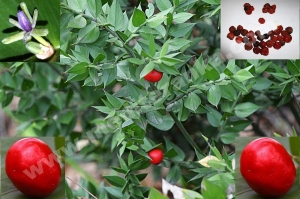
Butcher's broom
Nandina
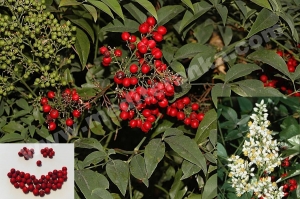
Nandina domestica, commonly known as nandina, heavenly bamboo or sacred bamboo, is a species of flowering plant in the family Berberidaceae, native to eastern Asia. Despite the common name, it is not a bamboo but an erect evergreen shrub up to 2 m tall by 1.5 m wide, with numerous, usually unbranched stems growing from ground level. The glossy leaves are sometimes deciduous in colder areas, 50–100 cm long. The young leaves in spring are brightly coloured pink to red before turning green, old leaves turn red or purple again before falling. The flowers are white, borne in early summer. The fruit is a bright red berry 5–10 mm diameter, ripening in late autumn and often persisting through the winter.
All parts of the plant are poisonous, containing hydrocyanic acid, and could potentially be fatal if ingested. Birds are generally not affected by these toxins and will disperse the seeds through their droppings. Nandina is widely grown in gardens as an ornamental plant and can take heat and cold, from (-23 - 43 °C). A true low-care plant, it needs no pruning, unless it is to harvest some leaves for use in a flower arrangement or berries for a holiday centerpiece, or occasionally to remove an old cane. The berries can also be left on the plants for birds to harvest in late winter. Spent berry stalks can easily be snapped off by hand in spring.
Kiwano
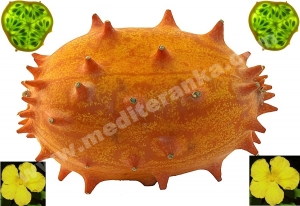
Kiwano (Cucumis metuliferus), horned melon, also called African horned cucumber or melon, jelly melon, hedged gourd, or melano, is an annual vine in the cucumber and melon family. The fruit of this plant is edible, but it is used as often for decoration as for food. When ripe, it has a yellow-orange skin and a lime green, jelly-like flesh with a tart taste, and texture similar to a cucumber. It is eaten young, mature green, or when ripe, bright yellow. It grows naturally in the fields and also in the bush. Some eat the peel, as well. The fibrous structure and protein composition of the peel provides for a taste and texture similar to the plantain family. One variety does not have horns, but looks and tastes similar. The seeds are covered in a gel-like substance. The skin is very rich in vitamin C and fiber. A small amount of salt or sugar can increase the flavor. The fruit can be used in cooking, but when eaten raw, most suck out the pulp and spit out the seeds.
Catalpa

Catalpas (Catalpa bignonioides) are mostly deciduous trees, they typically grow to 12–18 metres tall and 6–12 metres wide. They can be recognized by their large, heart-shaped leaves, showy white or yellow flowers and during the autumn by their 20–50 centimetres long fruits, which resemble a slender bean pod, containing numerous small flat seeds. Due to their large leaf size, catalpas provide very dark shade and are a popular habitat for many birds, providing them good shelter from rain and wind.
These trees have very little limb droppage, but drop large, dark brown bean pods during late summer. The wood of catalpas is quite soft. The tree is the sole source of food for the catalpa sphinx moth, the leaves being eaten by the caterpillars. When caterpillars are numerous, infested trees may be completely defoliated. Defoliated catalpas produce new leaves readily, but with multiple generations occurring, new foliage may be consumed by subsequent broods. Severe defoliation over several consecutive years can cause death of trees. Because the caterpillars are an excellent live bait for fishing, some dedicated anglers plant catalpa mini-orchards for their own private source of "catalpa-worms".