


- You are here:
-
Home

- Krunoslav Tripalo
Products Categories
Your Cart
Currency
Taxi Booking


Krunoslav Tripalo
Cycas revoluta

Cycas revoluta (king sago, sago cycad, Japanese sago palm), is a species of gymnosperm in the family Cycadaceae, native to southern Japan. It is one of several species used for the production of sago, as well as an ornamental plant. Cycads are not closely related to the true palms (Arecaceae). The Latin specific epithet revoluta means "curled back", in reference to the leaves. This very symmetrical plant supports a crown of shiny, dark green leaves on a thick shaggy trunk that is typically about 20 cm in diameter, sometimes wider. The trunk is very low to subterranean in young plants, but lengthens above ground with age. It can grow into very old specimens with 6–7 m of trunk, however, the plant is very slow-growing and requires about 50–100 years to achieve this height.
Propagation of Cycas revoluta is either by seed or by removal of basal offsets. It is one of the most widely cultivated cycads, grown outdoors in warm temperate and subtropical regions, or under glass in colder areas. It grows best in sandy, well-drained soil, preferably with some organic matter. It is fairly drought-tolerant and grows well in full sun or outdoor shade, but needs bright light when grown indoors. Of all the cycads, C. revoluta is the most popular in cultivation. It is seen in almost all botanical gardens, in both temperate and tropical locations. In many areas of the world, it is heavily promoted commercially as a landscape plant. It is also quite popular as a bonsai plant. It is tolerant of mild to somewhat cold temperatures, provided the ground is dry. Frost damage can occur at temperatures below -10°C, but require hot summers with mean temperatures of 30 to 35°C for successful growth, making outdoor cultivation impossible in colder temperate regions.
The pith contains edible starch, and is used for making sago. Before use, the starch must be carefully washed to leach out toxins contained in the pith. Cycad sago is extremely poisonous to animals (including humans) if ingested. Pets are at particular risk, since they seem to find the plant very palatable. Clinical symptoms of ingestion will develop within 12 hours, and may include vomiting, diarrhea, weakness, seizures, and liver failure or hepatotoxicity characterized by icterus, cirrhosis, and ascites.
All parts of the plant are toxic, however, the seeds contain the highest level of the toxin cycasin. Cycasin causes gastrointestinal irritation, and in high enough doses, leads to liver failure.
Yellow Toadflax
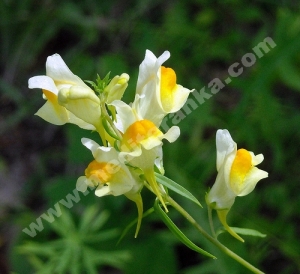
Yellow Toadflax (Linaria vulgaris), Common Toadflax or Butter-and-eggs is a species of toadflax (Linaria), native to most of Europe and northern Asia. It is a perennial plant with short spreading roots, erect to decumbent stems 15–90 cm high, with fine, threadlike, blue-green leaves 2–6 cm long. The flowers are 25–33 mm long, pale yellow except for the lower tip which is orange. The fruit is a globose capsule 5–11 mm long and 5–7 mm broad, containing numerous small seeds. The plant is widespread on ruderal spots, along roads, in dunes, and on disturbed and cultivated land. While most commonly found as a weed, toadflax is sometimes cultivated for cut flowers, which are long-lasting in the vase. The plant requires ample drainage, but is otherwise adaptable to a variety of conditions.
Despite its reputation as a weed, like the dandelion, this plant has also been used in folk medicine for a variety of ailments. A tea made from the leaves was taken as a laxative and strong diuretic as well as for jaundice, dropsy, and enteritis with drowsiness. For skin diseases and piles, either a leaf tea or an ointment made from the flowers was used. In addition, a tea made in milk instead of water has been used as an insecticide. It is confirmed to have diuretic and fever-reducing properties.
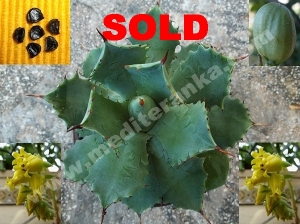
Dwarf butterfly agave
Thuja occidentalis
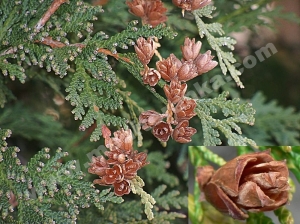
Thuja occidentalis is an evergreen coniferous tree, in the cypress family Cupressaceae, which is native to the northeast of the United States and the southeast of Canada, but widely cultivated as an ornamental plant. T. occidentalis has fan-like branches and scaly leaves. Thuja occidentalis grows naturally in wet forests, being particularly abundant in coniferous swamps where other larger and faster-growing trees cannot compete successfully. It also occurs on other sites with reduced tree competition, such as cliffs. Although not currently listed as endangered, wild Thuja occidentalis populations are threatened in many areas by high deer numbers, deer find the soft evergreen foliage a very attractive winter food, and strip it rapidly.
The foliage of Thuja occidentalis is rich in Vitamin C but due to the presence of the neurotoxic compound thujone, internal use can be harmful if used for prolonged periods or while pregnant.
The essential oil within the plant has been used for cleansers, disinfectants, hair preparations, insecticides, liniment, room sprays, and soft soaps. In the 19th century, Thuja was in common use as an externally applied tincture or ointment for the treatment of warts, ringworm and thrush. An injection of the tincture into venereal warts is said to cause them to disappear. T. occidentalis is widely used as an ornamental tree, particularly for screens and hedges, in gardens, parks and cemeteries. Over 300 cultivars exist, showing great variation in colour, shape and size.
Honesty (100x)
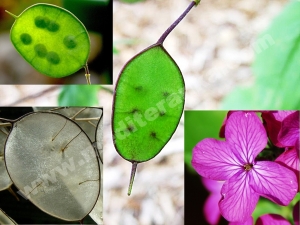
Lunaria annua, called honesty or annual honesty in English, is a species of flowering plant native to the Balkans and south west Asia, and naturalized throughout the temperate world. It is an annual or biennial growing to 90 cm tall by 30 cm broad, with large, coarse, pointed oval leaves with marked serrations. In spring and summer it bears terminal racemes of violet (rarely white) flowers, followed by showy, light brown, disc-shaped seedpods the skin of which falls off to release the seeds, revealing a central membrane which is white with a silvery sheen, 3–8 cm in diameter, they persist on the plant through winter. The Latin name lunaria means "moon-shaped" and refers to the shape and appearance of the seedpods. In South East Asia, it is called the "money plant".
This plant is easy to grow from seed. It is usually grown as a biennial, being sown one year to flower the next. It is suitable for cultivation in a shady or dappled area, or in a wildflower garden, and the flowers and dried seedpods are often seen in flower arrangements.
Butcher's broom

Butcher's broom (Ruscus aculeatus) is a low evergreen Eurasian shrub, with flat shoots known as cladodes that give the appearance of stiff, spine-tipped leaves. Small greenish flowers appear in spring, and are borne singly in the centre of the cladodes. The female flowers are followed by a red berry, and the seeds are bird-distributed, but the plant also spreads vegetatively by means of rhizomes. Ruscus aculeatus occurs in woodlands and hedgerows, where it is tolerant of deep shade, and also on coastal cliffs. It is also widely planted in gardens, and has spread as a garden escape in many areas outside its native range.
Butcher's broom has been known to enhance blood flow to the brain, legs, and hands. It has been used to relieve constipation and water retention and improve circulation. Since Butcher's broom tightens blood vessels and capillaries, it is used to treat varicose veins.
Morning glory

Morning glory is the common name for over 1,000 species of flowering plants in the family Convolvulaceae. Most morning glory flowers unravel into full bloom in the early morning. The flowers usually start to fade a few hours before the "petals" start showing visible curling. They prefer full solar exposure throughout the day. In some places, morning glory has turned into a serious invasive weed problem.
In cultivation, most are treated as perennial plants in frost-free areas and as annual plants in colder climates, but some species tolerate winter cold. Because of their fast growth, twining habit, attractive flowers, and tolerance for poor, dry soils, some morning glories are excellent vines for creating summer shade on building walls when trellised, thus keeping the building cooler and reducing heating and cooling costs. Many morning glories will self-seed in the garden. They have a hard seed coat which delays germination until late spring, at which time they will grow and flower rapidly. To improve the germination of purchased seeds, soak them in a dish of warm water overnight before planting.
Morning glory was first known in China for its medicinal uses, due to the laxative properties of its seeds. The seeds of many species of morning glory contain ergoline alkaloids such as the psychedelic ergonovine and ergine (LSA). The seeds of morning glory can produce a similar effect to LSD when taken in large doses, often numbering into the hundreds. Though the chemical LSA is not legal in some countries, the seeds are found in many gardening stores. however, the seeds from commercial sources are often coated in some form of pesticide or methylmercury. These coatings are especially dangerous if one has a history of liver disorders and may also cause neural damage.
Pagoda tree
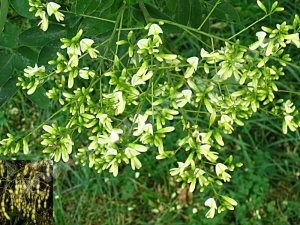
Styphnolobium japonicum, the Pagoda Tree (Chinese Scholar, Japanese pagodatree, syn. Sophora japonica) is a species of small tree or shrub in the subfamily Faboideae of the pea family Fabaceae. It was formerly included within a broader interpretation of the genus Sophora. The leaves are pinnate, with 9-21 leaflets, and the flowers in pendulous racemes similar to those of the Black locust.
Styphnolobium japonicum is native to eastern Asia (mainly China, despite the name), is a popular ornamental tree in Europe, North America and South Africa, grown for its white flowers, borne in late summer after most other flowering trees have long finished flowering. It grows into a lofty tree 10–20 m tall with an equal spread, and produces a fine, dark brown timber. S. japonicum is one of the 50 fundamental herbs used in traditional Chinese medicine. It has abortifacient, antibacterial, anticholesterolemic, antiinflammatory, antispasmodic, diuretic, emetic, emollient, febrifuge, hypotensive, purgative, styptic, and tonic properties.
Cruel vine
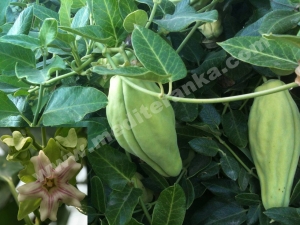
Araujia sericifera is a perennial ornamental plant in the genus Araujia belonging to Apocynaceae family. These plants grow in wastelands with trees and hedges, in forests and in rocky places or cliffs. They prefer sunny or partially shady places, at an altitude of 0–1,800 metres above sea level. Its common names include Moth Plant, White Bladderflower, Common Moth Vine and Cruel Vine. The Latin name sericifera of the species, meaning silk-bearing, refers to the silky hairs surrounding the seeds inside the fruits.
Araujia sericifera is a creeping vine that can climb up to 5–7 metres of height. If broken this plant releases a milky smelly exudate. Leaves are opposite, dark green, glossy and quite fleshy, almost triangular, with entire margins, about 10–12 millimetres long. Bisexual flowers are fragrant, about 2 centimetres of diameter, with five white, creamish, violet or pale pink petals. The flowers are usually pollinated by moths (the common name – Moth plant), butterflies and bees, but they are capable of automatic self-pollination. The flowering period extends from July through September. The pear-shaped fruits are large pods of about 8–10 centimetres of length. They contain numerous black seeds surrounded by silky hairs which enable them to be dispersed by the wind. The fast-growing vines can cover a tree canopy in two or three years, competing with the tree for light, water, and nutrients. They damage trees by this competition and by twining so tightly around their branches that it girdles them.
Rubia peregrina

Rubia peregrina, the common wild madder, is a herbaceous perennial plant species in the genus Rubia belonging to the Rubiaceae family. The genus name Rubia derives from the Latin ruber meaning "red", as the roots of some species (mainly Rubia tinctorum) have been used since ancient times as a vegetable red dye. The specific epithet possibly comes from the Latin peragrare meaning "to move or travel" or "to proceed" and refers to the ability of this plant to easily expand itself in its habitat.
The stem is woody, hairless, square and climbing and reaches on average 50–250 centimetres long. The evergreen leaves are sessile, glossy, leathery, oval-lanceolate and toothed on the margins. They are arranged in whorls, usually with five or more leaves radiating from a single node. The small flowers have five petals and are pale green-yellowish, about 5–7 mm in diameter, arranged at the top of long stalks. The flowering period extends from April through June. The hermaphroditic flowers are pollinated by insects. The fruits are fleshy green berries, black when ripe, about 5 mm in diameter.
It is mainly present in the Mediterranean Europe (Spain, Portugal, France, Italy, Greece and former Yugoslavia). This stress resistant weed is typical of Mediterranean scrub. It grows in thickets, bushes, hedges, stony grounds and along the roads and paths. It prefers dry soils, at an altitude of 0–1,000 metres above sea level.