


- You are here:
-
Home

- Krunoslav Tripalo
Products Categories
Your Cart
Currency
Taxi Booking


Krunoslav Tripalo
Bhot jolokia
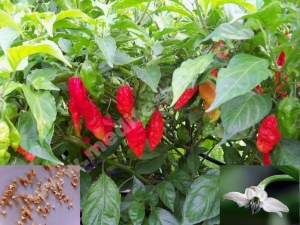
The Ghost Pepper (Bhot Jolokia) also known as Bih Jolokia, ghost pepper, ghost chili pepper, red naga chilli, and ghost chilli is an interspecific hybrid cultivated in the Indian states of Assam and Nagaland. In 2007, Guinness World Records certified that the Ghost Pepper (Bhot Jolokia) was the world's hottest chili pepper, 400 times hotter than Tabasco sauce. However, as of 2012 it was superseded by the Trinidad Moruga Scorpion. In 2000, India's Defence Research Laboratory reported a rating of 855,000 heat units (SHU) on the Scoville scale, and in 2004 a rating of 1,041,427 units was made using HPLC analysis. For comparison, Tabasco red pepper sauce rates at 2,500–5,000, and pure capsaicin (the chemical responsible for the pungency of pepper plants) rates at 16,000,000 SHU.
Ripe peppers measure 60 to 85 mm long and 25 to 30 mm wide with a red, yellow, orange or chocolate color. The unselected strain of Bhot Jolokia from India is an extremely variable plant, with a wide range in fruit sizes and amount of fruit production per plant, and offers a huge potential for developing much better strains through selection in the future. Bhot Jolokia pods are unique among peppers, with their characteristic shape, and very thin skin.
Bhot Jolokia is used as a food and a spice as well as an unexpected remedy to summer heat. It is used in both fresh and dried forms, to not only "heat up" curries, pickles and chutneys, but also to impart two distinct flavours to them. It is popularly used in combination with pork or dried fish or fermented fish. In northeastern India, the peppers are smeared on fences or incorporated in smoke bombs as a safety precaution to keep wild elephants at a distance.
Boxberry
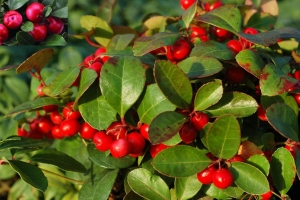
Gaultheria procumbens (eastern teaberry, checkerberry, boxberry, or American wintergreen) is a species of Gaultheria native to northeastern North America. It is a member of the Ericaceae (heath family). It is a small low-growing shrub, typically reaching 10–15 centimeters tall. The leaves are evergreen, elliptic to ovate, 2–5 cm long and 1–2 cm broad, with a distinct oil of wintergreen scent. The flowers are bell-shaped, 5 mm long, white, borne solitary or in short racemes. The berry-like fruit is actually a dry capsule 6–9 mm diameter. It is a calcifuge, favoring acidic soil, in pine or hardwood forests, although it generally produces fruit only in sunnier areas.
It often grows as part of the heath complex in an oak-heath forest. G. procumbens spreads by means of long rhizomes, which are within the top 20–30 mm of soil. Because of the shallow nature of the rhizomes, it does not survive most forest fires, but a brief or mild fire may leave rhizomes intact, from which the plant can regrow even if the above-ground shrub was consumed.
The fruits are edible, with a minty flavor, and the leaves and branches make a fine tisane, through normal drying and infusion process. For the leaves to yield significant amounts of their essential oil, they need to be fermented for at least 3 days. Teaberry is also an ice cream flavor in regions where the plant grows. Wintergreen is not taken in large quantities by any species of wildlife, but the regularity of its use enhances its importance. Its fruit persist through the winter and it is one of the few sources of green leaves in winter. White-tailed deer browse wintergreen throughout its range, and in some localities it is an important winter food.
Datura (inoxia)
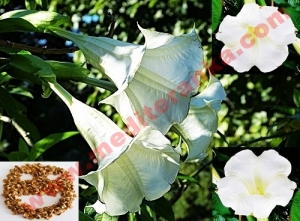
Datura inoxia (thorn-apple, downy thorn-apple, Indian-apple, lovache,moonflower, sacred datura, nacazcul, toloatzin, tolguache or toloache) is a species in the family Solanaceae. Datura inoxia is an annual shrubby plant that typically reaches a height of 0.6 to 1.5 metres. Its stems and leaves are covered with short and soft grayish hairs, giving the whole plant a grayish appearance. All parts of the plant emit a foul odor similar to rancid peanut butter when crushed or bruised, although most people find the fragrance of the flowers to be quite pleasant when they bloom at night. The flowers are white, trumpet-shaped, 12–19 cm long. They first grow upright, and later incline downward. It flowers from early summer until late fall. The fruit is an egg-shaped spiny capsule, about 5 cm in diameter. It splits open when ripe, dispersing the seeds.
All parts of Datura plants contain dangerous levels of poison and may be fatal if ingested by humans and other animals, including livestock and pets. When cultivated, the plant is usually grown from seed, but its perennial rhizomes can be kept from freezing and planted in the spring of the following year. Datura inoxia, like other Datura species, contains the highly toxic alkaloids atropine, hyoscine, andhyoscyamine. Datura intoxication typically produces a complete inability to differentiate reality from fantasy, hyperthermia, tachycardia, bizarre, and possibly violent behavior that can last several days. Pronounced amnesia is another commonly reported effect. It has also been planted throughout the world as an ornamental plant for its attractive large leaves, large white flowers, and distinctive thorny fruit. Datura inoxia is closely related to Datura stramonium (see offer) differs in having smaller flowers and tooth-edged leaves.
Mediterranean Cypress
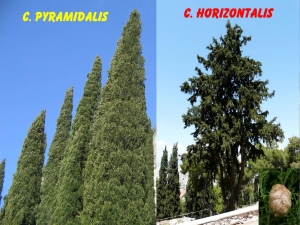
Mediterranean Cypress (Cupressus sempervirens), also known as Italian, Tuscan, or Graveyard Cypress, or Pencil Pine is a species of cypress native to the eastern Mediterranean region. It is a medium-sized coniferous evergreen tree to 35 m tall, with a conic crown with level branches and variably loosely hanging branchlets. It is very long-lived, with some trees reported to be over 1,000 years old. The foliage grows in dense sprays, dark green in colour. The leaves are scale-like, 2–5 mm long, and produced on rounded (not flattened) shoots. The seed cones are ovoid or oblong, 25–40 mm long, green at first, maturing brown about 20–24 months after pollination. The male cones are 3–5 mm long, and release pollen in late winter.
The species name sempervirens comes from the Latin for 'evergreen'. Mediterranean Cypress has been widely cultivated as an ornamental tree for millennia away from its native range, mainly throughout the central and western Mediterranean region, and in other areas with similar hot, dry summers and mild, rainy winters. It can also be grown successfully in areas with cooler, moister summers. The dark green 'exclamation mark' shape of these trees is a highly characteristic signature of Mediterranean town and village landscapes. Formerly, the species was sometimes separated into two varieties, the wild C. sempervirens var. sempervirens (syn. var. Horizontalis), and the fastigiate C. s. var. Pyramidalis.
It is also known for its very durable, scented wood, used most famously for the doors of St. Peter's Basilica in the Vatican City, Rome. Cypress used to be used in distilleries as staves to hold mash ferments to make alcohol before the invention of stainless steel. Commonly seen throughout New Mexico, the Mediterranean Cypress is also known as the "drama tree" because of its tendency to bend with even the slightest of breezes. In cosmetics it is used as astringent, firming, antiseborrheic, antidandruff, antiaging and as fragance. In classical antiquity, the cypress was a symbol of mourning and in the modern era it remains the principal cemetery tree in both the Muslim world and Europe.
In the classical tradition, the cypress was associated with death and the underworld because it failed to regenerate when cut back too severely. Cypress was used to fumigate the air during cremations. It was among the plants that were suitable for making wreaths to adorn statues of Pluto, the classical ruler of the underworld.
The poet Ovid, who wrote during the reign of Augustus, records the best-known myth that explains the association of the cypress with grief. The handsome boy Cyparissus, a favorite of Apollo, accidentally killed a beloved tame stag. His grief and remorse were so inconsolable that he asked to weep forever. He was transformed into cupressus sempervirens, with the tree's sap as his tears. In another version of the story, it was the woodland god Silvanus who was the divine companion of Cyparissus and who accidentally killed the stag. When the boy was consumed by grief, Silvanus turned him into a tree, and thereafter carried a branch of cypress as a symbol of mourning. In Greek mythology, the cypress is associated with both Artemis and Cyparissus, a boy beloved by Apollo. Ancient Roman funerary rites used it extensively. Cupressus sempervirens is the principal cemetery tree both in the Western and Muslim worlds. In Modern times cypress is associated with Hecate a Greek chthonic goddess of the magic, cross roads, underworld.
Offer:
50 seeds (horizontalis or pyramidalis)
Caper bush
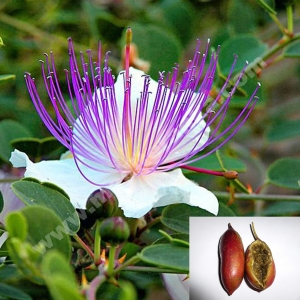
The Caper bush (Capparis spinosa), also called Flinders rose, is a perennial winter-deciduous plant that bears rounded, fleshy leaves and large white to pinkish-white flowers. The plant is best known for the edible flower buds (capers), often used as a seasoning, and the fruit (caper berry), both of which are usually consumed pickled. Other parts of Capparis plants are used in the manufacture of medicines and cosmetics.
Capparis spinosa is native to the Mediterranean region, East Africa, south-western and Central Asia and Australia. It is present in almost all the circum-Mediterranean countries. This species has developed special mechanisms to survive in the Mediterranean conditions, and introduction in semiarid lands may help to prevent the disruption of the equilibrium of those fragile ecosystems.
The shrubby plant is many-branched, with alternate leaves, thick and shiny, round to ovate in shape. The flowers are complete, sweetly fragrant, showy, with four sepals, and four white to pinkish-white petals, many long violet-colored stamens, and a single stigma usually rising well above the stamens. The caper bush requires a semiarid or arid climate. Mean annual temperatures in areas under cultivation are over 14°C and rainfall varies from 200 mm. A harvest duration of at least three months is necessary for profitability. Intense daylight and a long growing period are necessary to secure high yields. The caper bush can withstand temperatures over 40°C in summer, but it is sensitive to frost during its vegetative period. The caper bush has developed a series of mechanisms that reduce the impact of high radiation levels, high daily temperature and insufficient soil water during its growing period. Capers can be grown easily from fresh seeds gathered from ripe fruit and planted into well-drained seed-raising mix. Seedlings will appear in two to four weeks. Old, stored seeds enter a state of dormancy and require cold stratification to germinate.
The salted and pickled caper bud (often called simply capers) is often used as a seasoning or garnish. Capers are a common ingredient in Mediterranean cuisine, especially Cypriot, Italian and Maltese. The mature fruit of the caper shrub are prepared similarly and marketed as caper berries. The buds, when ready to pick, are a dark olive green and about the size of a fresh kernel of corn. They are picked, then pickled in salt, or a salt and vinegar solution, and drained. Intense flavor is developed as mustard oil (glucocapparin) is released from each caper bud. Capers are a distinctive ingredient in Italian cuisine, especially in Sicilian and southern Italian cooking. They are commonly used in salads, pasta salads, meat dishes and pasta sauces. Capers are known for being one of the ingredients of tartar sauce. They are often served with cold smoked salmon or cured salmon dishes (especially lox and cream cheese). Capers and caper berries are sometimes substituted for olives to garnish a martini. Dried caper leaves are also used as a substitute for rennet in the manufacturing of high-quality cheese.
Squirting cucumber
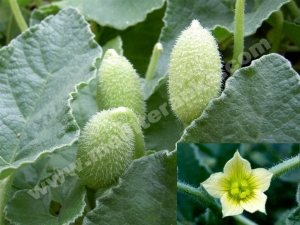
Squirting cucumber (Ecballium elaterium), also called the exploding cucumber, is a frost tender plant in the cucumber family growing to 0.3 by 1 m. It gets its unusual name from the fact that, when ripe, it squirts a stream of mucilaginous liquid containing its seeds, which can be seen with the naked eye. It is thus considered to have rapid plant movement. It is native to Mediterranean region, northern Africa, and temperate areas of Asia. It is grown as an ornamental plant elsewhere, and in some places it has naturalized. It is in flower from Jun to August, and the seeds ripen from Aug to September. The flowers are monoecious (individual flowers are either male or female, but both sexes can be found on the same plant) and are pollinated by Insects. The plant is self-fertile.
The squirting cucumber has been used as a medicinal plant for over 2,000 years, though it has a very violent effect upon the body and has little use in modern herbalism. The juice of the fruit is antirheumatic, cardiac and purgative. The plant is a very powerful purgative that causes evacuation of water from the bowels. It is used internally in the treatment of oedema associated with kidney complaints, heart problems, rheumatism, paralysis and shingles. Externally, it has been used to treat sinusitis and painful joints. It should be used with great caution and only under the supervision of a qualified practitioner. Excessive doses have caused gastro-enteritis and even death. It should not be used by pregnant women since it can cause an abortion. The fully grown but unripe fruits are harvested during the summer, they are left in containers until the contents are expelled and the juice is then dried for later use. This plant, and especially its fruit, is poisonous, containing cucurbitacins. In the ancient world it was considered to be an abortifacient. In Turkey, the fresh fruit juice of this plant is directly applied into the nostrils for the treatment of sinusitis as an herbal medicine.
Offer:
20 seeds
Washingtonia filifera
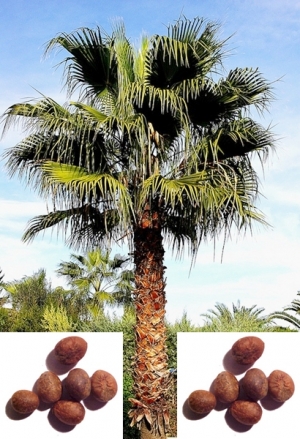
Washingtonia filifera is a species of flowering plant in the palm family Arecaceae, native to southwestern North America. Growing to 15–20 m tall by 3–6 m broad, it is technically an evergreen monocot (not actually a tree). Other common names include desert fan palm, California palm, fanpalm, petticoat palm, cotton palm, Arizona fan palm. The specific epithet filifera means "thread-bearing". As an ornamental tree it is cultivated in suitable temperate climates worldwide. Washingtonia filifera grows to 18 metres in height (occasionally to 25 metres) in ideal conditions. The fronds are up to 3.5–4 metres long, made up of a petiole up to 2 metres long, bearing a fan of leaflets 1.5–2 metres long. They have long thread-like white fibers and the petiole are pure green with yellow edges and filifera-filaments, between the segments. The trunk is gray and tan and the leaves are gray green. The shelter that the skirt creates provides a microhabitat for many small birds and invertebrates. Washingtonia filifera can live from 80 to 250 years or more.
The fruit of the fan palm was eaten raw, cooked, or ground into flour for cakes. The Cahuilla and related tribes used the leaves to make sandals, thatch roofs, and baskets. The stems were used to make cooking utensils. Washingtonia filifera is widely cultivated as an ornamental tree. It will survive temperatures of -10 °C with minor damage, and established plants have survived, with severe leaf damage, brief periods as low as -12 °C. The plants grow best in warm temperate climates with dry summers and wetter winters. Specimens outside of Mediterranean climates rarely exceed 15 metres.
Service tree
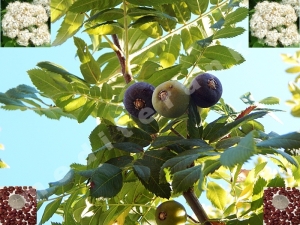
Service tree (Sorbus domestica) is a species of Sorbus native to western, central and southern Europe (Mediterranean region), northwest Africa, and southwest Asia. It is a deciduous tree growing to 15–20 m tall with a trunk up to 1 m diameter. The bark is brown, smooth on young trees, becoming fissured and flaky on old trees. The winter buds are green, with a sticky resinous coating. The leaves are 15–25 cm long, the flowers are 13–18 mm diameter, with five white petals and 20 creamy-white stamens. The fruit is a pome 2–3 cm long, greenish-brown, often tinged red on the side exposed to sunlight, apple-shaped.
It is a long-lived tree, with ages of 300–400 years. The largest and perhaps oldest known specimen in Europe is near the town of Strážnice in the province of Moravia, Czech Republic. Its trunk measures 458 centimetres in circumference, with a crown 11 metres high and 18 metres across. It is estimated to be around 400 years old. The fruit is a component of a cider-like drink which is still made in parts of Europe. Picked straight off the tree, it is highly astringent and gritty, however, when left to blet (over-ripen) it sweetens and becomes pleasant to eat.
Soursop - Annona muricata
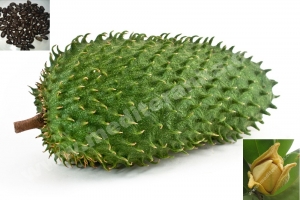
Annona muricata, prickly custard apple, soursop. Soursop trees are bushy and low, only about 7 - 9 m tall. Young branchlets are rusty-hairy. The underside of the leaves is somewhat lighter than the top. Solitary flowers emerge anywhere on the trunk, branches or twigs. The fruit is oval or heart-shaped and fairly variable in size, ranging from 10-30 cm long and up to 15 cm in width. They can weigh as much as 6.8 kg. The skin is dark-green in the immature fruit, becoming slightly yellowish-green before the mature fruit is soft to the touch. The white flesh, which is the edible part of the flesh is fibrous and juicy, and separates easily from the rind. The pulp smells a little like a pineapple, but the sweet, acrid flavor is unique. The fruit is segmented, with some segments containing a single oval, black seed, 1.25-2 cm long.
The soursop is one of the most abundant fruits in the Dominican Republic. Soursops are eaten straight from the tree, can be juiced, are popular as flavorings in ices and popsicles, and are occasionally made into a custard with sugar and milk. The juice from the seeds are poisonous and irritating and should be avoided. The juice of the ripe fruit is said to be diuretic.
Taken when fasting, it is believed to relieve liver ailments and leprosy. Pulverized immature fruits, which are very astringent, are decocted as a dysentery remedy. To draw out chiggers and speed healing, the flesh of an acid soursop is applied as a poultice unchanged for 3 days.
In parts of Carribean the leave are believed to have a relaxing, even sobering effect. In Africa, it is given to children with fever and they are also bathed lightly with it. A decoction of the young shoots or leaves is regarded in the West Indies as a remedy for gall bladder trouble, as well as coughs, catarrh, diarrhea, dysentery and indigestion. Mashed leaves are used as a poultice to alleviate eczema and other skin afflictions and rheumatism, and the sap of young leaves is put on skin eruptions. The roots of the tree are employed as a vermifuge and the root bark as an antidote for poisoning. A tincture of the powdered seeds and bay rum is a strong emetic.
Ruta graveolens
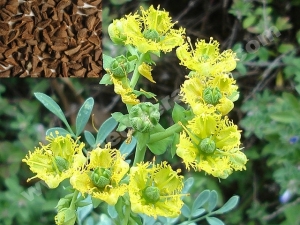
Ruta graveolens, commonly known as rue, common rue or herb-of-grace, is a species of Ruta grown as a herb. It is native to the Balkan Peninsula, southeastern Europe. It is now grown throughout the world as an ornamental plant in gardens, especially because of its bluish leaves, and also sometimes for its tolerance of hot and dry soil conditions. It also is cultivated as a medicinal herb, as a condiment, and to a lesser extent as an insect repellent.
Common rue is said to promote the onset of menstruation and of uterine contractions, for this reason the refined oil of rue was cited by the Roman historian Pliny the Elder and the gynecologist Soranus as a potent abortifacient (inducing abortion). Rue contains pilocarpine which is used in horses to induce abortion. It is also used in Brazil as the key ingredient in homemade herbal cough syrup, when mashed with caramelized sugar and honey.
Exposure to common rue, or herbal preparations derived from it, can cause severe phytophotodermatitis which results in burn-like blisters on the skin. Rue does have a culinary use if used sparingly, but it is extremely bitter and severe gastric discomfort may be experienced by some individuals. Although used more extensively in former times, it is not a herb that typically suits modern tastes, and thus its use declined considerably over the course of the 20th century to the extent that it is today largely unknown to the general public and most chefs, and unavailable in grocery stores.
It was used extensively in ancient Middle Eastern and Roman cuisine. Rue leaves and berries are an important part of the cuisine of Ethiopia. Rue is used as a traditional flavouring in Greece and other Mediterranean countries. In Istria (a region in Croatia), and in Northern Italy, it is used to give a special flavour to grappa/raki and most of the time a little branch of the plant can be found in the bottle. This is called grappa alla ruta. The bitter leaf can be added to eggs, cheese, fish, or mixed with damson plums and wine to produce a meat sauce. Rue is also grown as an ornamental plant, both as a low hedge and so the leaves can be used in nosegays. Most cats dislike the smell of it, and it can therefore be used as a deterrent to them.
Rue is considered a national herb of Lithuania and it is the most frequently referred herb in Lithuanian folk songs, as an attribute of young girls, associated with virginity and maidenhood. It was common in traditional Lithuanian weddings for only virgins to wear a rue (ruta) at their wedding, a symbol to show their purity.
In mythology, the basilisk, whose breath could cause plants to wilt and stones to crack, had no effect on rue. Weasels who were bitten by the basilisk would retreat and eat rue in order to recover and return to fight.